

Why understanding BI matters now: the intersection of AI and data
In today’s fast-moving business world of 2026, many company leaders and their teams are working hard to make good choices.

But sometimes, it’s hard to know what information really matters. You might wonder, what is business intelligence anyway, and how has the rise of smart AI tools changed everything we thought we knew? It’s a fair question, as the world of data moves faster than ever before.
Business intelligence, often called BI, is about taking raw, messy data and turning it into clear, useful insights that help you make better decisions. Think of it as a special system that collects, stores, and looks at data to give you knowledge. This helps businesses make choices for the big picture, daily tasks, and everything in between 1, 2. Traditionally, BI uses tools and steps to change this data into reports and dashboards that guide decisions 3.
But here’s the thing: AI has truly changed the game. Now, BI isn’t just about looking at what happened in the past. With new ai tools for data analysis, we can do much more. AI helps build better data pipeline systems, making it easier to gather information. It can even help with data scraping to pull in useful details from many places. Because of AI, businesses can now understand things faster and predict what might happen next 4. This means you can spot new chances, fix problems before they get big, and keep your business ahead of the curve. If you want to dive deeper into how technology drives smart decisions, you might be interested in exploring AI-driven business intelligence software unlocks smarter decisions.
This article is here to help you get a clear picture. We will explain exactly what is business intelligence in 2026 and show you how AI fits into it. We’ll break down the important building blocks of data and AI that make modern BI work. Plus, we’ll give you practical advice on how to put these ideas into action for your own team. Understanding this mix of AI and data is not just a fancy idea; it’s a must-have for anyone who wants to make smart, informed choices today.
Staying on top of these rapid changes in AI and technology can be tough. For quick, daily updates and in-depth insights, you should consider getting The AI Newsletter Worth Reading.
1. Business intelligence: core concepts and how it differs from analytics and data science
To really make those smart, informed choices, it helps to understand the main ideas behind business intelligence. At its heart, BI is about turning everyday business data into useful facts and clear pictures. It helps you see "what happened" in your business and "what is happening" right now [^Narrative Review].
What BI is all about
Think of BI as a way to keep a finger on your business’s pulse. It covers a few key areas:
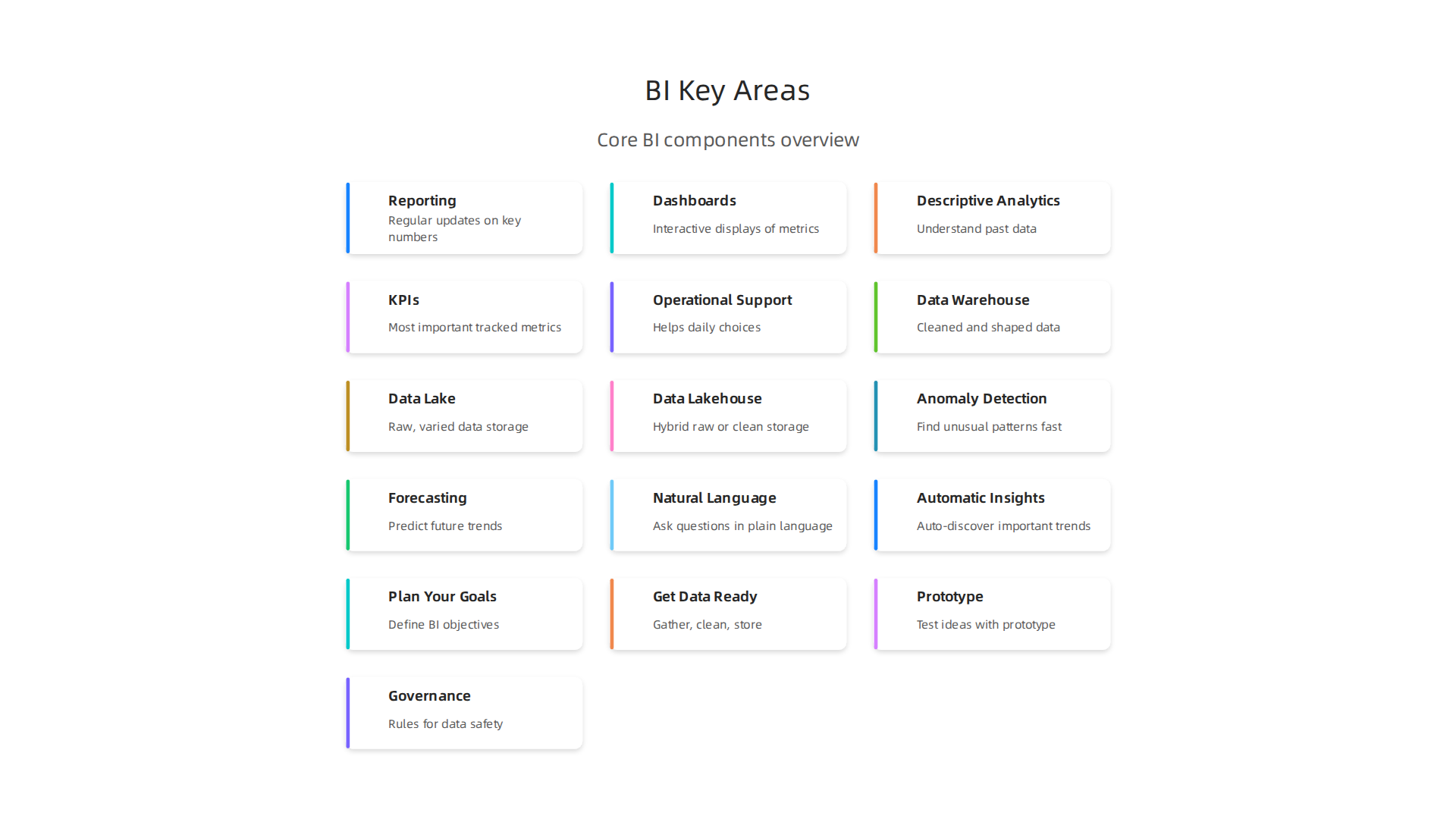
- Reporting: This means getting regular updates on important numbers. These reports show you things like how many products you sold last month or how many customers you gained.
- Dashboards: These are like interactive display screens. They show all your important numbers and graphs in one easy-to-see place. Imagine a car’s dashboard, but for your business. These visuals make it simple to track how things are going, helping you make quicker, smarter choices [^AI-ENHANCED BUSINESS INTELLIGENCE …]. You can even learn how to design a high impact Google Analytics dashboard for smarter decisions to improve your reporting.
- Descriptive Analytics: This is a fancy way of saying "looking at past data to understand the present." BI mostly does this kind of analysis. It answers questions like "How many sales did we make last quarter?" or "What were our most popular products?" It doesn’t tell you why these things happened, just that they did.
- Key Performance Indicators (KPIs): These are the most important numbers your business tracks. For example, a KPI might be "monthly sales growth" or "customer satisfaction score." BI systems help you watch these KPIs closely to see if you’re meeting your goals.
- Operational Decision Support: This means BI helps with the daily choices needed to run your business smoothly. For instance, deciding which products to stock more of based on recent sales trends.
These parts of BI work together to give you a clear, easy-to-understand view of your business’s health and performance.
How BI is different from analytics and data science
Sometimes, people get business intelligence mixed up with data analytics or data science. While they all work with data, they do different jobs.

- Business Intelligence (BI): As we talked about, BI mainly looks at the past and present. It answers: "What happened?" and "What is happening?" It uses reports and dashboards to give clear, factual summaries. The main goal is to help business leaders and managers with everyday decisions.
- Data Analytics: This goes a step further than BI. Data analysts don’t just show you what happened; they try to figure out why it happened. They might look for patterns in the data to explain a trend. For example, if sales went down, a data analyst might find that a marketing campaign ended around the same time. If you are interested in this role, you can find a what is a data analyst guide.
- Data Science: This is the deepest level of data work. Data scientists use complex math and
ai tools for data analysisto predict what will happen in the future or even suggest how to make something happen. They build smart models that can find hidden links in huge amounts of data. This might involve using advanced techniques for things likedata pipelinebuilding ordata scrapingto get all the right information. They often predict future trends or create new solutions using advanced algorithms. For those keen to explore this field, understanding data scientist skills 2026 is key.
In short, BI is about showing you the facts. Data analytics is about explaining those facts. And data science is about predicting outcomes and building new ways to solve problems using those facts and more advanced tools.
For business intelligence to truly shine and help you make smart choices, it needs a strong foundation: good data infrastructure. Think of it like building a house; you need solid ground and good pipes to make everything work right. This foundation includes special places to store data and smart ways to move and clean it.
Where Data Lives: Warehouses, Lakes, and Lakehouses
Businesses collect a lot of data, and where they keep it depends on what they want to do with it.
-
Data Warehouse: Imagine a very organized library. A data warehouse holds data that has already been cleaned, shaped, and made ready for use. It’s perfect for answering clear, common questions about "what happened" in your business, which is exactly what business intelligence aims to do. BI tools often connect directly to these warehouses for fast, accurate reports. For best practices in setting up this kind of system, learning about Data Warehousing & BI Best Practices can be helpful.
-
Data Lake: Now, imagine a huge, open field where you can dump all sorts of stuff: raw notes, recordings, pictures, and any other information, messy or neat. A data lake stores all kinds of raw data, in its original form. This is great for data scientists who need all the details, even the unorganized ones, for deep dives or using advanced
ai tools for data analysis. -
Data Lakehouse: This is a newer idea that tries to get the best of both worlds. A data lakehouse keeps all your data, raw or clean, in one big storage area, like a data lake. But it also adds smart tools that let you treat some of that data like it’s in a neat data warehouse. This means you can run powerful business intelligence reports directly on a wide range of data, while still having the raw data ready for more complex
ai tools for data analysisor machine learning projects [^final-the-data-teams-guide-to-the-db-lakehouse-platform-rd-6-14-22.pdf]. It’s a single place that serves both daily BI needs and future-looking data science work. Many experts see the data lakehouse as a key part of modern business intelligence [^Data Lakehouse-Enabled Enterprise Business Intelligence …].
The Journey of Data: Data Pipelines
For any of these storage places to work, data needs to travel and get ready. This journey is called a data pipeline. It’s a series of steps that bring data in, clean it, and make it useful.
- Ingestion: This is the first step, simply collecting data from all its different sources and bringing it into your system. Think of it like pouring water into a funneltop.
- ETL/ELT: These stand for Extract, Transform, Load or Extract, Load, Transform. It’s the process of getting data ready.
- Extract: Pulling the data from its original spot.
- Transform: Cleaning and changing the data so it’s in a useful format. This might mean fixing errors, changing dates, or combining information. Data often goes through stages, like "bronze" (raw), "silver" (cleaned), and "gold" (ready for use) [^Data lakehouse implementation: A journey from traditional data …].
- Load: Putting the prepared data into its final home, like a data warehouse or a serving layer of a lakehouse where BI tools can easily find it.
- Transformation: This step, often part of ETL/ELT, makes sure the data is accurate and fits your needs. It’s where raw data turns into structured information that answers questions about
what is business intelligencefor your company. - Cataloging: As data comes in and gets prepared, you need a way to keep track of it all. A data catalog is like an index for your data. It helps you know what data you have, where it is, and what it means [^4. Data Catalogs – Practical Lakehouse Architecture [Book]]. This is important so people can find the right data to use.
- Governance: This is all about the rules for data. It makes sure data is safe, of good quality, and used properly. It answers questions like "who can see this data?" and "is this data correct?"
All these parts work together to make sure that when you ask your business intelligence system a question, you get a quick, reliable answer. Understanding these processes can even help you advance in data-focused careers, by understanding how to master data careers.
After all the data is collected, cleaned, and organized, the real magic happens when artificial intelligence (AI) steps in to make business intelligence even more powerful. In 2026, AI is not just a fancy add-on; it’s a core part of how businesses get smarter answers from their data. AI helps business intelligence move beyond just knowing "what happened" to understanding "why it happened" and even "what will happen next."
AI Makes BI Smarter
AI-powered features, often called "augmented analytics," make it easier for everyone to get deep insights from data, not just data scientists. These ai tools for data analysis can spot things humans might miss, and they help you make quicker, better decisions. Think of it as having a super-smart assistant for your business data. This blend of AI and BI is transforming how decisions are made across industries A META-ANALYSIS OF AI-DRIVEN BUSINESS ANALYTICS.
Here are some ways AI helps:
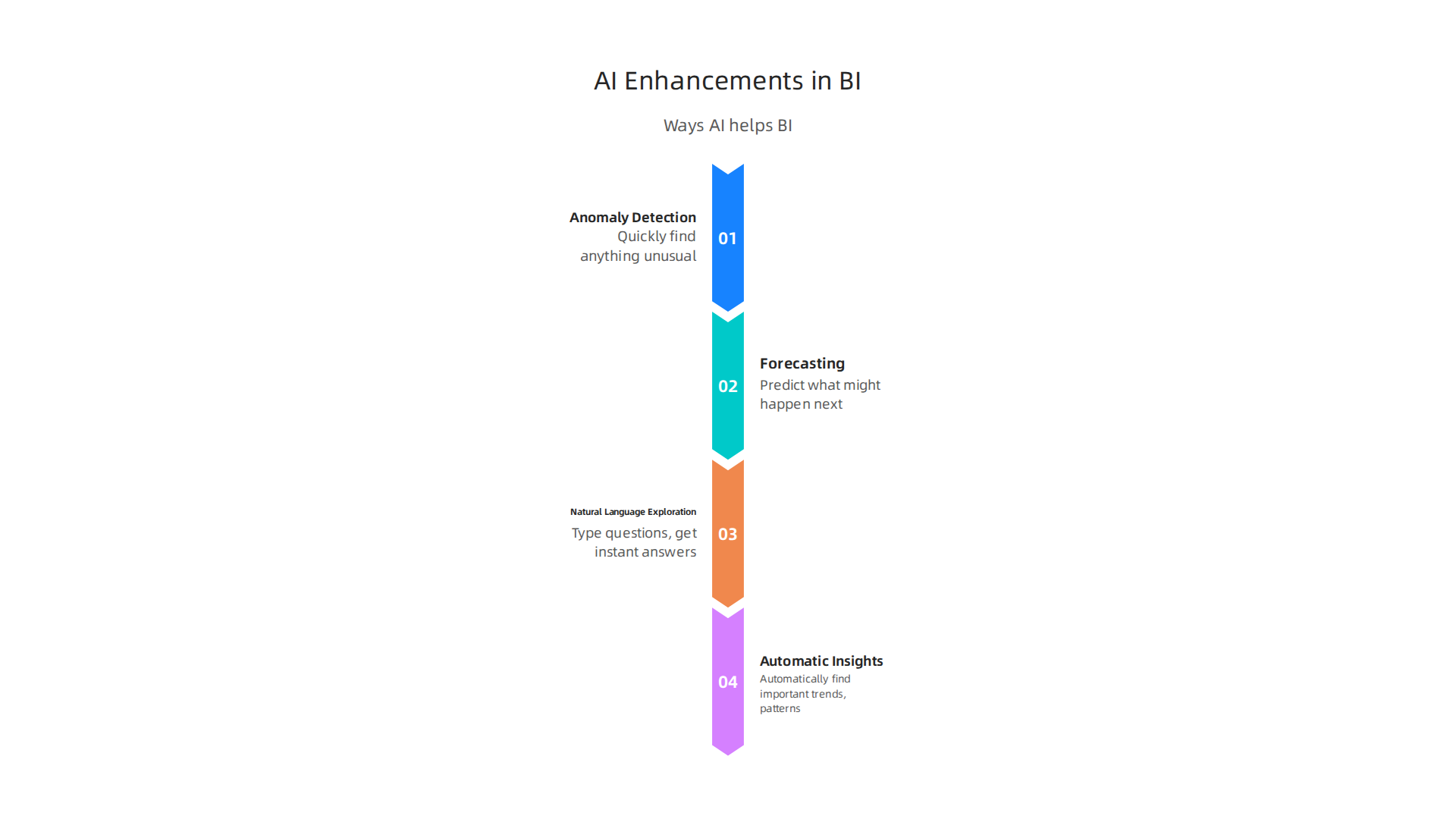
- Spotting Strange Things (Anomaly Detection): AI can look at huge amounts of data and quickly find anything unusual. For example, if sales suddenly drop much more than expected, AI can flag it right away. Or if a machine in a factory starts acting weird, AI can alert you before it breaks down. This helps prevent big problems and react faster.
- Looking into the Future (Forecasting): AI can learn from past data to predict what might happen next. This means you can get much better estimates for sales, customer demand, or even how much inventory you’ll need. These predictions are key for planning ahead Forecasting & Anomaly Detection Reports.
- Talking to Your Data (Natural Language Exploration): Imagine just typing a question like "What were our top 5 products last month?" and getting an answer instantly, with charts and graphs. AI, especially with natural language understanding, makes this possible. You don’t need to be a tech expert to ask complex questions about
what is business intelligencefor your company. - Getting Automatic Insights: Instead of sifting through reports, AI can automatically find important trends, patterns, and explanations in your data and present them to you. It’s like having the system tell you, "Here are the three most important things you need to know about your business today."
How AI Works in Your Business
For these smart AI features to work well, they need to be part of your everyday business flow.
- AI Inside Your Dashboards: Many modern business intelligence tools let you put AI predictions right into your dashboards. So, when you look at your sales numbers, you might also see AI’s prediction for next month’s sales right there. This makes it easy for everyone to use AI insights without extra steps. You can explore how AI-driven business intelligence software unlocks smarter decisions to see these features in action.
- Watching the AI (Model Monitoring): Just like you monitor your business data, you also need to watch your AI models. Are they still giving good predictions? Are they still accurate? Model monitoring makes sure the AI tools for data analysis are performing correctly over time.
- Always Learning (Continuous Retraining): The world changes, and so does your business data. AI models need to learn from new information to stay sharp. This means they are regularly updated, or "retrained," with the latest
data pipelineinformation. This keeps them accurate and relevant, ensuring that your business intelligence remains cutting-edge. Using machine learning in BI can greatly improve decision-making Machine Learning for Business Intelligence.
These AI advancements are making business intelligence more accessible and more predictive, helping companies not just see the past but also shape the future.
Staying on top of these fast-moving AI changes is crucial for any professional.
Get clear daily AI updates from The AI Newsletter Worth Reading.
Staying on top of these fast-moving AI changes is crucial for any professional. This is especially true when you see how business intelligence (BI) helps different parts of a company every day. From figuring out what customers want to making sure factories run smoothly, BI gives each team the information they need to do their best. When you add AI to the mix, these uses become even more powerful, changing how work gets done across the board.
4. Practical BI applications across functions: marketing, sales, finance, operations and product
Business intelligence isn’t just one big tool; it’s many smart tools that help different teams answer their specific questions.

Let’s look at how BI, especially with AI, is used in different parts of a business in 2026. This shows you exactly what is business intelligence in action.
Marketing
For marketing teams, BI helps understand customers and make campaigns better.
- What BI does: Marketers use BI to see things like customer age groups, where they live, and how they reacted to past ads. They track how well different marketing campaigns are doing, looking at things like website visits or how many people click on an email.
- AI makes it smarter: AI takes this further by predicting what customers are likely to buy. This is called "customer propensity scoring." AI can also help create ads that are just right for each person. This means less wasted effort and more sales. Key measures include how many people become customers (conversion rates) and how much money a customer brings in over time (customer lifetime value). Data comes from customer relationship management (CRM) systems, website tools, and social media. Using AI can greatly improve marketing success drive marketing success with AI powered online market research tools in 2026.
Sales
Sales teams use BI to hit their targets and find new chances to sell.
- What BI does: Sales professionals check their sales numbers, see how much product they’ve sold, and track how close they are to closing deals. This helps them understand what’s working and what’s not.
- AI makes it smarter: With AI, sales teams can get very good predictions for future sales. AI can also point out which customers are most likely to buy soon, helping sales staff focus their energy. This improves how accurate sales guesses are and how often deals are won. Many AI models are used for customer analytics and personalizing recommendations, which directly helps sales efforts AN REPORT FROM – Resources. Data usually comes from CRM and enterprise resource planning (ERP) systems.
Finance
In finance, BI helps keep track of money, spot problems, and plan for the future.
- What BI does: Finance teams use BI to watch budgets, create financial reports, and check how money is flowing in and out of the company.
- AI makes it smarter: AI
ai tools for data analysiscan automatically find strange things in financial data, like unexpected expenses or possible fraud. These "anomaly alerts" can warn finance teams right away if something looks wrong. AI also helps with spotting risks more quickly. This means better control over money and fewer surprises. Data comes from accounting software and records of all money transactions. Machine learning models, which are a part of AI, are commonly applied in areas like fraud detection Machine Learning Use Cases: Practical Industry Applications.
Operations
For operations, BI is all about making things run smoothly and efficiently.
- What BI does: Operations teams track how well machines are working, how much product is being made, and how quickly items are delivered.
- AI makes it smarter: AI helps predict when a machine might break down, so maintenance can happen before problems start. This is called "predictive maintenance." AI also helps figure out the best amount of products to keep in storage and the quickest ways to deliver them. These
ai tools for data analysislead to less downtime and happier customers. Data often comes from sensors on machines and logistics systems that manage deliveries.
Product
Product teams use BI to build better products that customers will love.
- What BI does: Product managers look at how people use their products, which features are popular, and if users stop using the product (churn).
- AI makes it smarter: AI can predict which new product features customers will like most, based on past behaviors and trends. It also helps understand how users interact with a product in very detailed ways, leading to better designs and updates. AI in BI provides advanced analytics that help anticipate changes in revenue, inventory needs, and market chances AI-Powered Business Intelligence. This means products are more likely to succeed. Data comes from app usage logs and feedback from users.
Across all these areas, the mix of business intelligence and AI means companies can not only see what’s happening now but also get a clearer picture of what will happen next. This helps them make smarter choices every day.
Now that we’ve seen how business intelligence and AI help different parts of a company, you might be asking: how do we actually set this up? Building a strong BI system, especially one that uses AI, needs a clear plan. It’s not just about buying tools; it’s about getting your data, people, processes, and rules all working together.
5. Implementation roadmap: data, people, process, tools and governance
Putting a BI system into place is like building a house. You need a good plan, the right materials, and everyone has to know their job. Here’s a simple roadmap to help you bring BI, and powerful ai tools for data analysis, to your business in 2026.
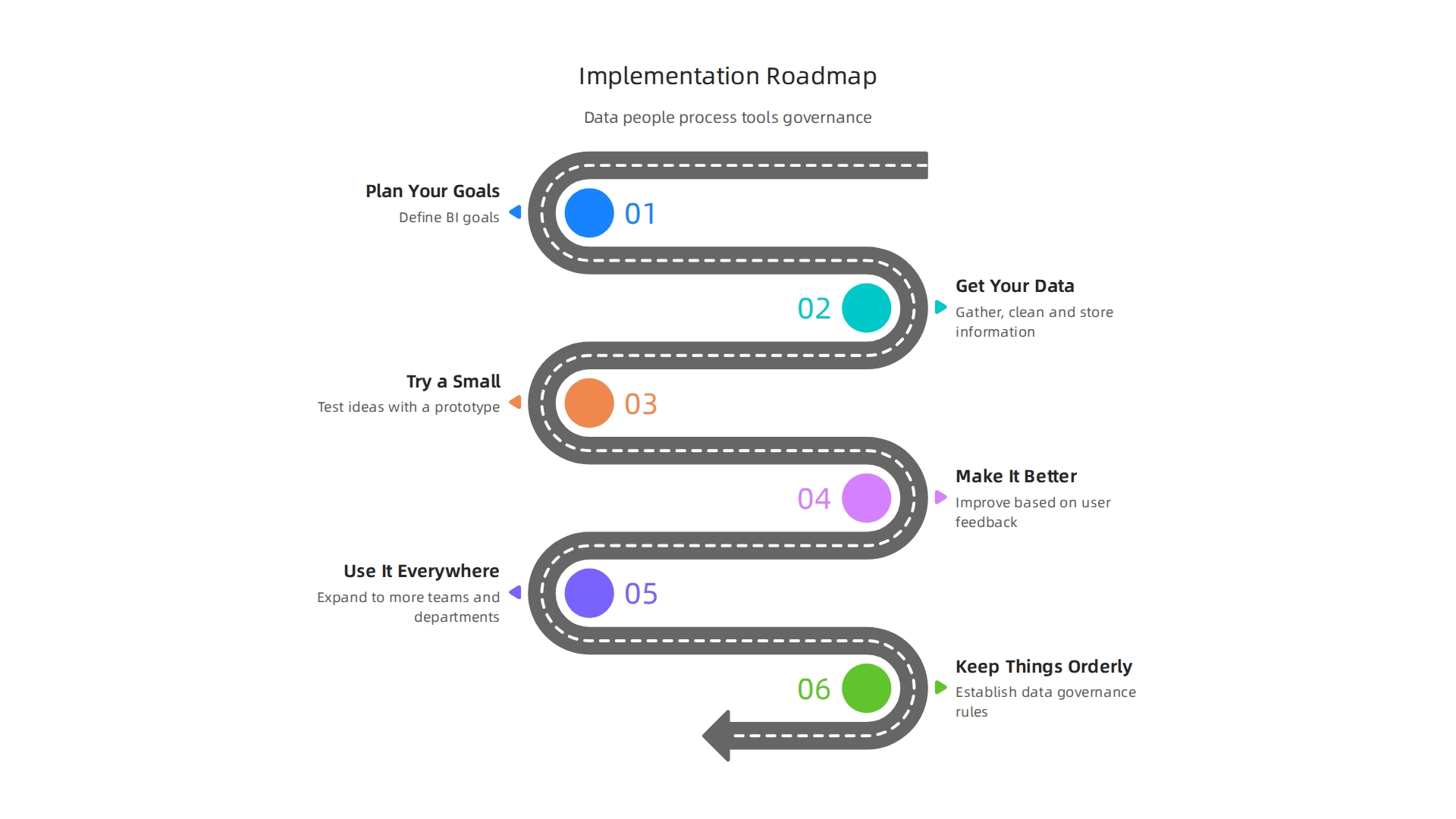
Step-by-step roadmap for BI
-
Plan Your Goals (Scoping): First, figure out exactly
what is business intelligencewill do for your company. What problems do you want to solve? What questions do you want to answer? For example, do you want to understand why customers leave, or find ways to save money? Knowing your goals helps you pick the right tools and focus your efforts AI Implementation Case Interview Guide (2026). -
Get Your Data Ready (Data Readiness): This is a very important step. BI needs good, clean data to work well. You need to gather data from all your different systems, like sales, marketing, and finance. This often involves building a
data pipelineto collect, clean, and store the information. Many companies use a modern setup called a "data lakehouse" which combines the best parts of different data storage systems for easier use Data Lakehouse-Enabled Enterprise Business Intelligence …. This helps make sure your data is ready for BI and AI. Data often moves through layers, from raw to validated, then refined for analysis Data lakehouse implementation: A journey from traditional data …. -
Try a Small Piece (Prototype): Don’t try to build everything at once. Pick a small project, like making a BI dashboard for one team, to test your ideas. This lets you learn what works and what doesn’t without spending too much time or money. It’s a good way to see how AI-driven business intelligence software unlocks smarter decisions.
-
Make It Better (Iterate): After your first small project, get feedback from the people who used it. What did they like? What could be better? Use their ideas to improve your BI system. This is an ongoing process of tweaking and upgrading.
-
Use It Everywhere (Scale): Once your BI system is working well for a small group, you can expand it to more teams and departments. This means getting more data, adding more reports, and connecting more
ai tools for data analysis. -
Keep Things Orderly (Governance): As your BI system grows, you need clear rules for who can see what data, how data is kept safe, and who is in charge of it. This is called governance, and it makes sure your data is always reliable and secure. It involves managing everything from storage to how queries are run Building an analytics lakehouse on Google Cloud.
Change management and value realization
Even the best BI system won’t help if people don’t use it. That’s why managing change is so important.
- Aligning People (Stakeholders): You need to get everyone on board, from top leaders to daily users. Explain why the new BI system is important and how it will make their jobs easier. Get people involved early so they feel a part of the change Building a Strong Case for Change Management in BI …. Leaders should show they support the new system.
- Training: People need to know how to use the new tools. Offer training in different ways, like workshops, videos, or quick guides Power BI Adoption & Change Management Guide. This helps everyone feel confident and ready to use BI.
- Measuring Success: After all this work, you need to check if the BI system is actually helping your business. Look at your original goals from step one. Are you solving the problems you set out to solve? Are you making smarter choices? This shows the value of your BI investment. Remember, implementing BI is a mix of technology, change management, and strategy Business Intelligence Solutions: Strategy & Tools 2026 – App Maisters.
Staying informed about new AI models, tools, and best practices can help you make the most of your BI implementation.
Do you want to stay updated on the latest AI trends and how they impact business intelligence? Get clear daily AI updates from The AI Newsletter Worth Reading.
Once you’ve put your BI system in place and people are using it, the next big question is: is it actually helping your business? This is where measuring its return on investment (ROI) comes in. It also means making sure your AI tools are used fairly and safely.
6. Measuring ROI, ethics and governance for BI and AI-enabled analytics
To see if your BI and AI tools are worth the effort, you need to track important numbers, called Key Performance Indicators (KPIs). These are like scorecards for your business goals.
- Usage: How many people are actually using your BI dashboards and AI insights? More users can mean more value for what is business intelligence.
- Faster Decisions: Are decisions being made quicker because of the insights from your data?
- Cost Savings: Is the business saving money in areas like operations, marketing, or inventory because of smarter choices?
- More Revenue: Is the company making more sales or finding new ways to earn money?
- Better Customer Experience: Are customers happier thanks to what you learned from your data?
It can be tricky to say for sure that a BI system or specific AI tools for data analysis directly caused all good changes. But by looking at your KPIs before and after, you can get a good idea of the value. Companies need to define their business objectives clearly before bringing in AI to measure success properly, according to the Inside AI Governance White Paper 2026. An executive playbook can even help show the financial value of AI governance, as detailed in The ROI of AI Governance: A 2026 Executive Playbook.
Ethics and governance for BI and AI
Beyond just measuring money, it’s really important to use AI and your business intelligence data in a good and fair way.

This means having strong rules, also known as governance. In 2026, AI governance is a big topic.
- Privacy: Keep customer and business data safe. Make sure you follow all privacy laws and rules.
- Fairness: AI systems learn from data. If the data is biased, the AI can make unfair decisions. For example, if you use data scraping from only one group of people, your AI might not work well for others. We must work to prevent unfairness and discrimination in all AI outputs, as discussed in Smart AI Governance in 2026.
- Transparency: People should understand how an AI came to its conclusions, especially for important decisions.
- Human Oversight: Even with smart AI, humans should still be in charge of making final big decisions.
- Following Laws: Governments around the world are creating new rules for AI. For instance, the EU AI Act is important for companies operating in Europe, with the AI Office and member states responsible for its enforcement from August 2, 2026, according to AI Act | Shaping Europe’s digital future. Many countries are publishing guides and reports on AI Regulations Around the World: A 2026 Guide and the State of AI Governance 2026.
Setting up a good AI governance framework means having a clear plan for direction, control, and keeping watch over your AI systems throughout their lives. This ensures they meet company goals and follow legal rules, as highlighted in the AI Governance Report 2026. It’s crucial for managing the real dangers of AI in 2026.
Summary
This article explains why business intelligence (BI) matters in 2026 and how AI is reshaping it from past-focused reporting into predictive, action-oriented decision support. It defines core BI components—reports, dashboards, KPIs—and distinguishes BI from analytics and data science, showing when to use each. The piece describes modern data foundations (warehouses, lakes, lakehouses), the role of data pipelines and catalogs, and why data readiness and governance matter. It then details how AI augments BI with anomaly detection, forecasting, natural language queries, and automated insights. Practical examples show BI applications across marketing, sales, finance, operations, and product teams. Finally, the article gives a step-by-step implementation roadmap, guidance on change management and training, and advice on measuring ROI and enforcing ethical AI governance so you can deploy BI responsibly and scale it effectively.