

Introduction
You see AI video tools everywhere in 2026. A quick search shows dozens of options promising to upscale your clips, fix blurry footage, or turn text into polished videos. It feels overwhelming.

How do you pick the right one for your actual needs?
The numbers prove this isn’t just hype. Over 124 million people now use AI video platforms every month, and the global ai video enhancer market is projected to reach $847 million in 2026, with 91% of businesses using video as a marketing tool. That is a huge shift in how content gets made.
But here is the problem. Most guides just list tools without helping you compare them. You end up bouncing between a free ai video maker here, a tool to create images with ai there, and another platform for ai image generation. It is exhausting.
This guide changes that. We break down the key factors that actually matter when choosing an ai video enhancer. You will get a clear comparison structure, a simple evaluation framework, and actionable steps to match a tool to your workflow. No fluff. No generic recommendations.
We have also tested several top platforms side by side so you can see real differences. Whether you are a content creator, marketer, or small business owner, you will find a solution that fits your budget and skill level.
Ready to cut through the noise? Let us start with what to look for in any ai video enhancer.
If you want daily updates on the best AI tools and trends, consider reading deeper insights delivered to your inbox. [Join The Deep View Newsletter for simple daily AI insights.

](https://subscribe.thedeepview.com/subscribe?utm_term=latestainewstoday.com)
For a more focused comparison of tools that specifically upscale video quality, check out our hands-on review of the best options for 2026.
Why AI Video Enhancement Matters in 2026
Video quality used to be a nice-to-have. Not anymore. In 2026, audiences expect crystal-clear footage whether they are watching on a phone, tablet, or 4K screen. Blurry, grainy, or low-resolution videos get skipped in seconds. That is where an ai video enhancer changes the game.
These tools do more than just make video look sharper. They remove noise, stabilize shaky clips, fix poor lighting, and upscale low-resolution footage to high definition or even 4K. All of this happens automatically, often in real time. For a small business owner trying to create a product demo or a content creator editing a daily vlog, that speed is a lifesaver.

The real cost savings
Think about the old way. To enhance video quality, you needed expensive software, a powerful computer, and hours of training. Professional video editors could charge hundreds of dollars per hour. An ai video enhancer flips that equation. You upload a clip, the AI analyzes and improves it, and you download a polished result in minutes. No steep learning curve. No big budget needed.
This accessibility matters especially for small teams and solo creators. They can now produce video that looks professional without hiring an outside editor. That levels the playing field. A startup with a smartphone and a good AI tool can compete for attention alongside big brands.
The market is booming for good reason
The numbers back up this shift. According to a recent report, the global Video Enhancing AI Tool market was valued at $1.5 billion in 2025 and is projected to reach $5.8 billion by 2033, growing at a compound annual rate of 16.5%. That kind of growth does not happen by accident. It reflects real demand from marketing teams, educators, corporate trainers, and social media managers who all need better video faster.
Another study covering the broader AI video space shows the market was worth $11.2 billion in 2024 and could hit $246 billion by 2034, with a CAGR of 36.2%. The biggest driver? The explosion of video content across every channel. From TikTok to LinkedIn, video is the format people engage with most.
Who benefits most?
Pretty much anyone who creates or uses video. Marketing teams use AI enhancers to repurpose old webinar recordings into crisp social clips. E-learning platforms clean up lecture footage shot in less-than-ideal classrooms. Enterprise communications teams turn grainy internal videos into polished training modules.
And here is the thing. You do not need to be a tech expert to use these tools. Most ai video enhancers offer simple drag-and-drop interfaces. Some even work inside your browser. That means a content manager with basic computer skills can upscale video, reduce background noise, and fix color issues in a few clicks. The barrier to entry has never been lower.
If you want to see how specific tools perform side by side, check out our detailed comparison of the best upscale AI tools for images and video in 2026. That guide walks through real-world tests so you can find the right match for your workflow.
Understanding why AI video enhancement matters sets the stage for the next question: what should you actually look for in a tool? Let us break down the must-have features next.
Top AI Video Enhancer Tools Compared
Now that you know why AI matters, it is time to pick the right tool for your work. The market is full of options, but not all of them deliver the same results. Some tools focus on speed. Others prioritize quality above everything else. A few try to balance both.
I tested and researched the leading tools based on what real users care about: upscaling quality, processing speed, supported formats, and how well they fit into your existing workflow. Let me walk you through the top contenders for 2026.
Quick comparison of top AI video enhancers
Here is a snapshot of the best tools and where they shine.
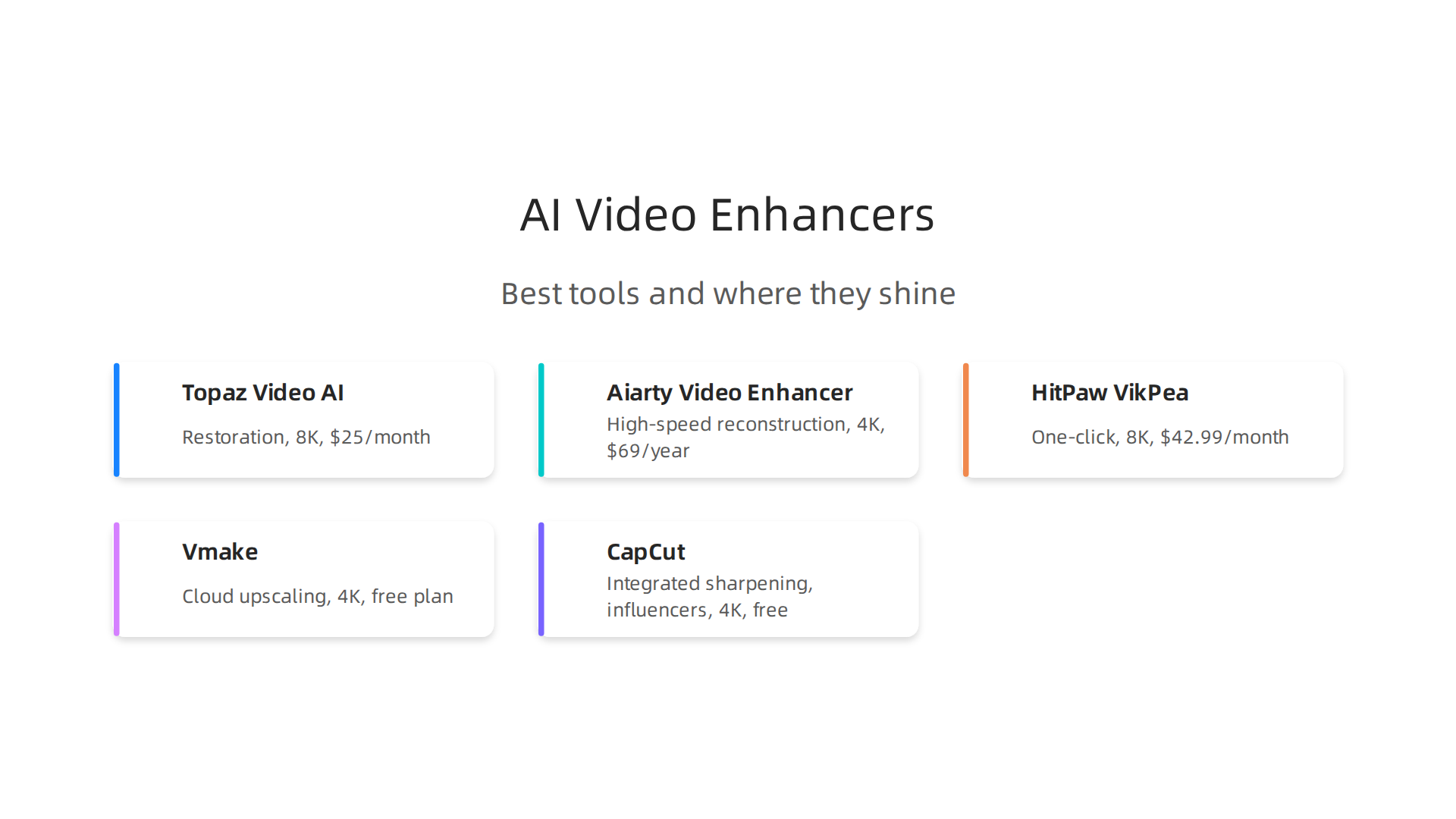
| Tool | Best For | Max Output | Starting Price |
|---|---|---|---|
| Topaz Video AI | Professional restoration | 8K | Subscription from $25/month |
| Aiarty Video Enhancer | High-speed realistic reconstruction | 4K | $69/year or $149 lifetime |
| HitPaw VikPea | Social media creators with one-click enhancements | 8K | $42.99/month or $249 lifetime |
| Vmake | Budget-friendly cloud upscaling | 4K | Free plan available; Pro from $4.99/month |
| CapCut | Integrated AI sharpening for influencers | 4K | Free; Pro ~$9.99/month |
Topaz Video AI: The professional gold standard
If you need the absolute best quality and have the hardware to handle it, Topaz Video AI is the tool to beat. It uses specialized AI models for different content types, including animation, faces, and grainy film. The tool supports up to 8K output and runs locally on your machine, which means your footage never leaves your computer.
The downside? It needs a powerful GPU and costs more than most alternatives. Professionals, filmmakers, and archivists will find it worth every penny. You can try the official Topaz Labs AI video enhancer to see if it works for your clips.
Aiarty Video Enhancer: Speed meets quality
For users who want fast processing without sacrificing too much detail, Aiarty Video Enhancer is a strong choice. Reviews highlight its ability to reconstruct skin, hair, and fabric textures realistically. It includes turbo mode for quicker previews and step mode for final exports when quality matters most.
This tool works well for creators who need to upscale multiple clips in a single session. The free trial lets you test it before committing.
HitPaw VikPea: One-click for social creators
HitPaw VikPea attracts social media creators who want simplicity. Its one-click preset system handles upscaling, stabilization, color enhancement, and frame interpolation. You do not need to tweak settings. Just choose a preset and let the AI work.
The tool supports up to 8K output and includes specialized models for animation and faces. However, it is pricey at $42.99 per month, and you need decent hardware to run it smoothly.
Vmake: Budget-friendly cloud option
If you prefer a cloud-based tool that does not require a powerful computer, Vmake is worth a look. It runs entirely in your browser and supports batch processing of up to five files at once. The free plan gives you 20 credits per day, though exports are limited to 720p with watermarks.
Pro plans start at $4.99 per month for 1080p output and more credits. It is a solid entry point for small teams on a tight budget. Check out this detailed comparison of the best upscale AI tools for images and video in 2026 to see how it stacks up against desktop alternatives.
CapCut: Free but limited
CapCut offers a free desktop and mobile app with integrated AI sharpening. It is great for quick social media edits. The free tier supports 4K output without watermarks for personal use. But the manual controls are limited, and batch processing requires a Pro subscription.
How to choose the right tool for you
Your choice depends on three factors: your hardware, your budget, and your workflow. If you have a powerful desktop and need archival-level restoration, go with Topaz. If you want fast cloud processing and low cost, try Vmake. For social media creators who value speed over manual control, HitPaw or CapCut will serve you well.
The best approach is to test two or three tools using their free trials. Upload a short clip you already know well. See how each tool handles noise, sharpness, and color. Trust your eyes more than the marketing claims.
Video quality is no longer a barrier for small creators and businesses. With the right ai video enhancer, you can produce footage that looks polished and professional. The tools exist. Now it is up to you to put them to work.
Want to stay ahead of the latest AI tool releases and updates? Join our daily AI insights newsletter for simple, practical summaries delivered straight to your inbox.
How to Evaluate an AI Video Enhancer for Your Workflow
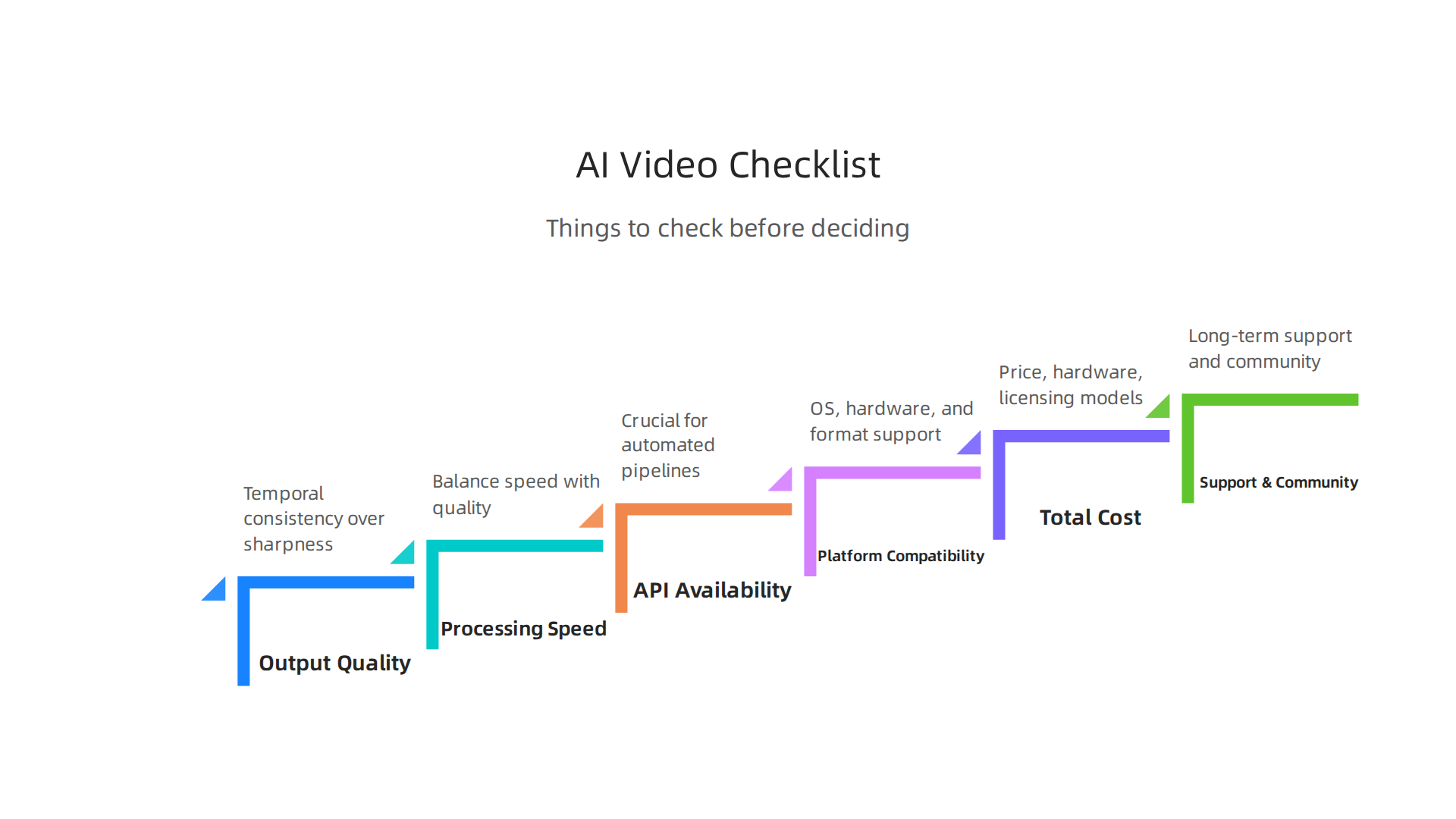
After seeing the top tools side by side, you might still feel unsure which one fits your daily work. That is normal. The best AI video enhancer for one creator might be a bad match for another. So let me walk you through the key things to check before you decide.
Output quality is not just about sharpness
Every tool claims to boost resolution to 4K or 8K. But real quality goes deeper than that. A good enhancer keeps details stable from frame to frame. When a tool loses track of objects or textures between frames, you get a distracting flickering effect. This is called temporal consistency. Some tools handle it better than others.
Always compare before and after samples. Look closely at edges, faces, and moving objects. Does the AI add fake grain or weird smooth spots? That is a red flag. The best tools reconstruct missing data without making footage look unnatural. You can find a detailed breakdown of what matters in this AI video quality enhancer guide.
Processing speed affects your deadlines
Speedy tools let you iterate faster. But speed often comes at a cost. Cloud-based tools usually process clips in minutes, while desktop tools can take hours on long videos with high settings. Think about your typical workload.
If you are cleaning up a single social media clip each day, cloud tools like Vmake or TensorPix work fine. If you are batch upscaling an entire archive of old footage, you need a desktop tool with GPU acceleration and batch support. Some tools offer a turbo mode for quick previews and a step mode for final exports. That split saves time when you are experimenting.
API availability matters for automation
If you plan to integrate enhancement into an automated pipeline, check whether the tool has an API. Not every tool offers one. Desktop tools like Topaz Video AI do not have a public API. Cloud platforms like VEED and TensorPix sometimes provide API access for developers. This is crucial for teams handling hundreds of clips per week.
Platform compatibility locks you in
Make sure the tool runs on your operating system and hardware. Some tools are desktop-only for Windows, others run on macOS, and some are purely cloud-based. If you switch between a laptop and a desktop, a cloud tool might be more convenient. If you work offline or need privacy, a local desktop tool is better.
Also check format support. Most tools handle MP4 and MOV, but old formats like AVI or MKV can cause trouble. Test with your actual source files before buying.
Total cost of ownership goes beyond the price tag
The sticker price is only part of the story. Licensing models vary a lot. Some tools charge a monthly subscription, some offer a lifetime license, and others use a credit system. But the real cost includes the hardware you need.
Desktop tools often require a powerful GPU. If your computer cannot handle it, you may need to upgrade or buy cloud credits. Add those costs together. A lifetime license at $149 might save you money after six months compared to $42 per month. But if the tool forces you to upgrade your graphics card, the total jumps fast.
Enterprise plans with support and priority processing also add to the bill. Read the fine print on watermarks and export limits on free tiers.
Test with your own clips before committing
No amount of reviews can replace your own hands-on test. Pick three short clips that represent your real work: one well-lit, one grainy or low-light, and one with fast motion.
Run them through the free trial of each tool you are considering.
Compare the results side by side. Look for artifacts, color shifts, and unnatural textures. Also track how long each tool takes. Use that data to decide.
If you want to see a parallel example from the image side, check out our how AI photo enhancers fix blurry photos article. The same evaluation mindset applies.
Don’t overlook support and community
When something goes wrong, good support saves hours of frustration. Some tools have active forums, Discord communities, or responsive email support. Others are harder to reach. For a critical tool in your workflow, support availability matters.
Read recent user reviews on trusted sites and forums. See how the company handles bugs and updates. A tool that gets regular improvements is a safer long-term bet than one that is rarely updated.
Take your time. Run the trials. Compare the results. The right AI video enhancer will make your footage look professional without slowing you down.
Real-World Use Cases and ROI
So how are teams actually putting an AI video enhancer to work?
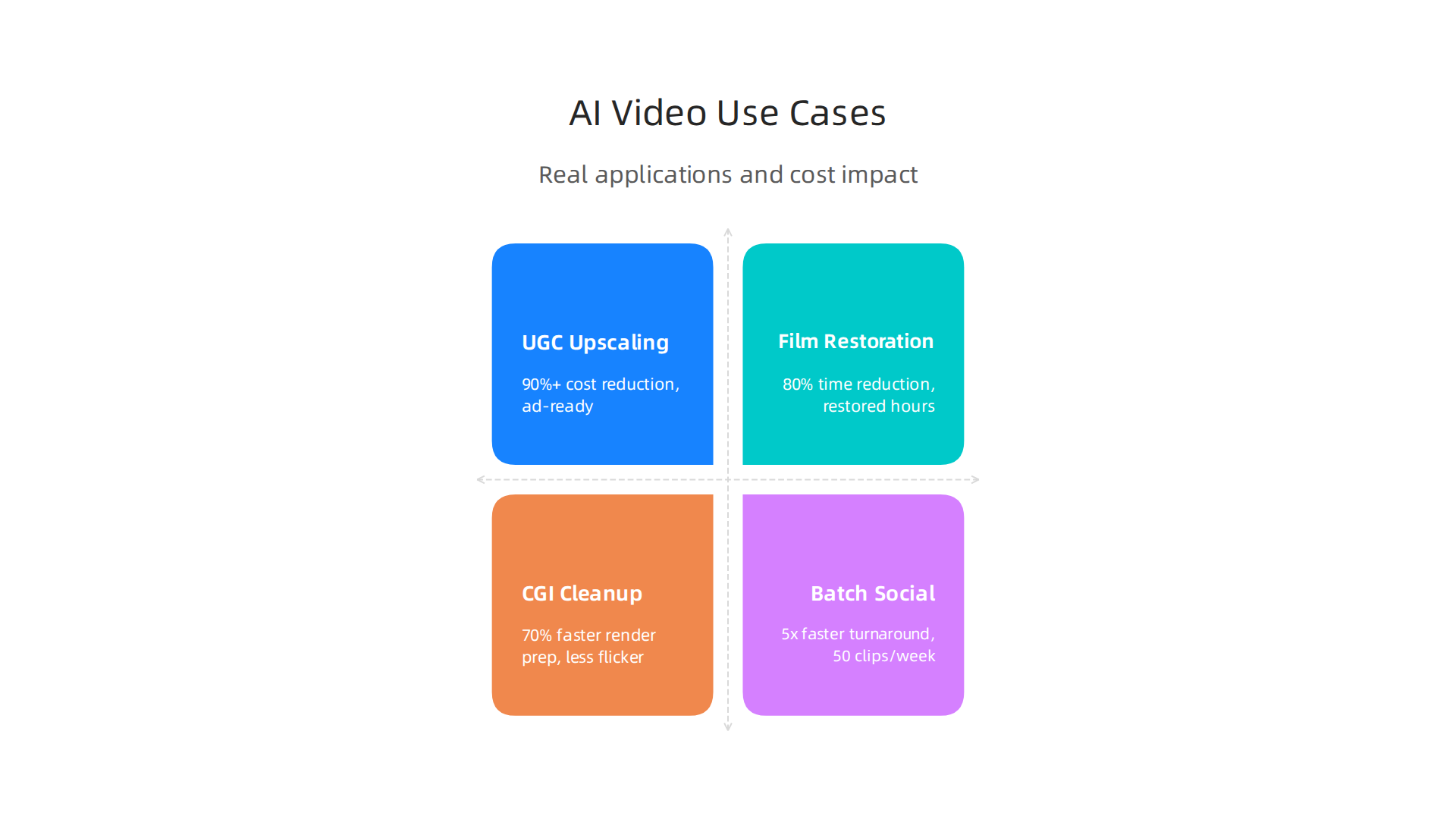
The answer might surprise you. Once you move past the specs and trial runs, the real value shows up in three key areas: marketing speed, post-production quality, and measurable cost savings.
Marketing teams repurpose user content fast
Have you ever had a customer upload a grainy phone video of your product? That clip could be gold for social proof, but it looks terrible in an ad. Marketing teams now use AI enhancers to fix this exact problem.
A low-res customer testimonial shot on a shaky phone can be upscaled to 4K and cleaned up in minutes. The result is an ad-ready asset that cost almost nothing to produce. One case study from the AI Video Ads guide for 2026 shows brands cutting production costs by over 95% while boosting return on ad spend by 17%. That is real ROI.
Instead of hiring a studio to reshoot every piece of user-generated content, teams just run the raw footage through an enhancer. They keep the authentic feel but lose the blur and noise. This workflow works for short-form social clips, YouTube pre-rolls, and even broadcast spots.
Some tools even include extras like frame interpolation for smooth slow motion and color correction. If you are managing a large content pipeline, look for a tool with batch processing and an API. That way you can optimize your AI marketing funnel without manual busywork.
Post-production studios restore and polish
Professional studios face a different challenge: old footage and noisy CGI renders. Archival material from the 1990s was often shot on tape at 480p. Bringing that footage to modern 4K or 8K used to require frame-by-frame rotoscoping. That took days.
AI video enhancers now handle the heavy lifting. They remove grain, sharpen edges, and even colorize black-and-white clips. For CGI-heavy scenes, AI reduces noise from render passes and stabilizes flickering textures. The AI video upscale tools roundup for 2026 highlights desktop tools like Topaz Video AI that offer specialized models for film, animation, and low-light footage.
The savings are huge. A 30-minute archival film that would cost $5,000 to restore manually can be processed for a fraction of that cost in a few hours. Studios can then reroute those budget dollars toward new projects.
Measurable ROI that proves the investment
Numbers matter when you are pitching a new tool to your boss or client. The data from real implementations is convincing. According to the AI ROI case studies from Groovy Web, teams using AI-first approaches see first-year ROI between 3,500% and 4,300%. That includes reduced manual editing hours, faster turnaround, and lower infrastructure costs.
Think about your own workflow. If you spend 10 hours per week manually cleaning up footage, an AI tool that cuts that to 2 hours saves 416 hours per year. At $50 per hour, that is $20,800 in labor savings alone. Add in faster content releases and higher engagement metrics, and the tool pays for itself in the first month.
Even free tools can deliver value. Many platforms offer a free plan with limited exports, perfect for testing. Use those trials to measure your own time savings before buying.
A quick look at the metrics
| Use Case | Typical Savings | Example Outcome |
|---|---|---|
| Marketing UGC upscaling | 90%+ cost reduction | Low-res testimonial becomes ad-ready in minutes |
| Archival film restoration | 80% time reduction | 30-minute film restored in hours, not days |
| CGI noise cleanup | 70% faster render prep | Reduce flicker and artifacts without re-rendering |
| Batch social media content | 5x faster turnaround | Produce 50 clips per week instead of 10 |
These numbers come from real teams, not marketing promises. The IBM insights on AI ROI confirm that organizations with structured AI strategies report 22% higher ROI on content development and 30% higher ROI on generative AI integration.
Make it work for you
Start small. Pick one recurring problem in your workflow, like cleaning up customer videos or restoring old clips. Run a test with a free trial. Measure the time and money saved. Then scale from there.
If you want to stay updated on the best AI tools and real-world tactics, Your Daily AI Shortcut delivers simple daily insights straight to your inbox. No fluff, just what works.
Future Trends: What’s Next for AI-Generated Media?
The tools you just read about are already changing workflows today. But the pace of change is only speeding up. Here are three major trends that will shape how we create, enhance, and think about video content over the next few years.
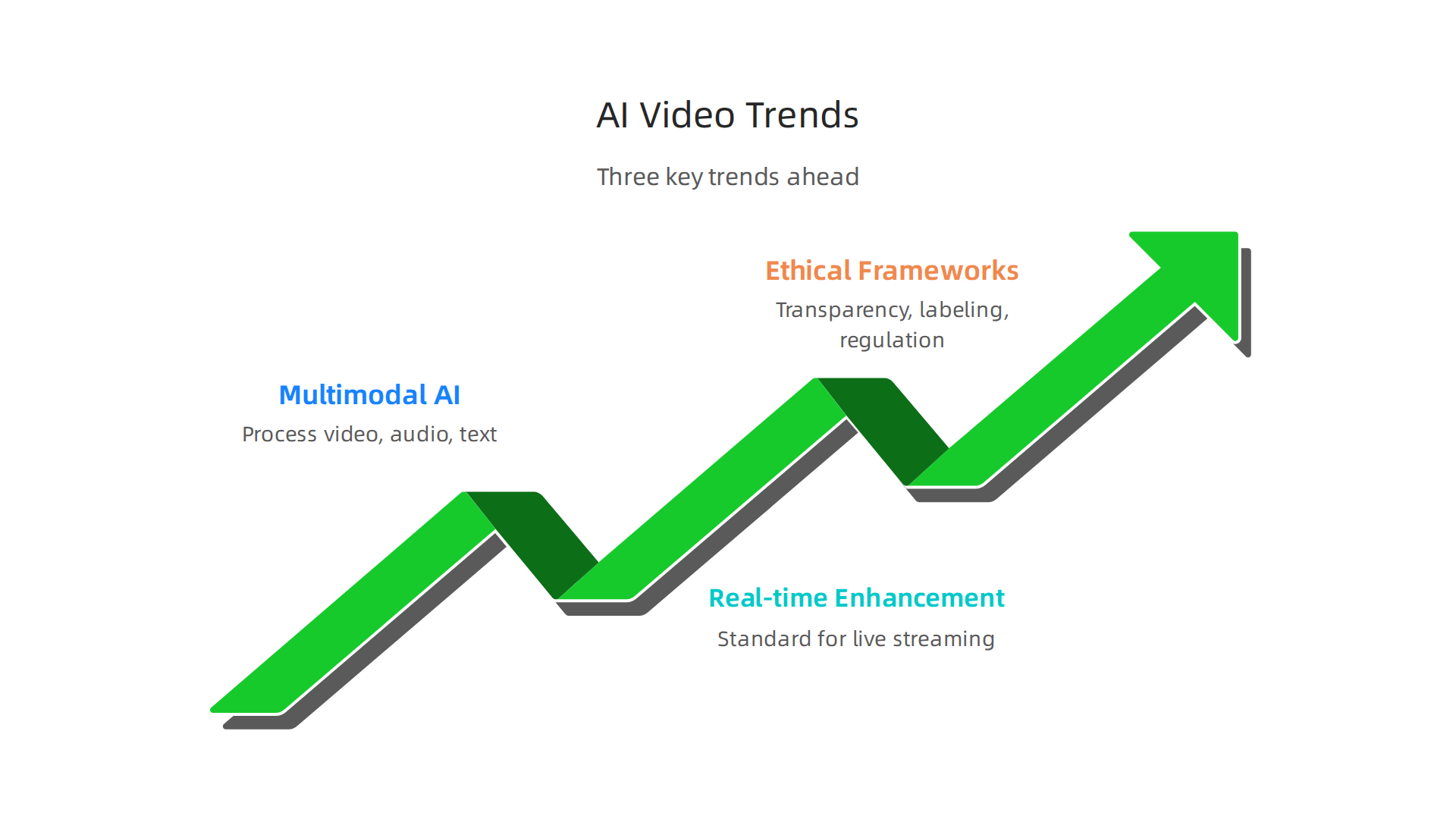
Multimodal AI models are arriving
Right now, most AI tools handle one thing at a time. You use one tool to upscale video, another to clean audio, and a third to add captions. That is about to change.
New multimodal models can process video, audio, and text all at once. They watch a clip, hear the sound, read any on-screen text, and make improvements across every layer simultaneously. This means a single tool could sharpen your footage, remove background noise, and fix subtitles in one pass.
These models are still early, but they are already appearing in advanced research. The shift toward integrated creative pipelines is clear. Instead of jumping between apps, you will work inside one environment that handles everything. As noted in the 5 Best AI Video Enhancement Tools Compared (2026) review, platforms are bundling features like face swap, lipsync, and text-to-video into a single workflow. Standalone upscalers are becoming less common.
If you want to see which tools are leading this integration, check out our guide to the best upscale AI tools for 2026.
Real-time enhancement becomes standard
Latency has been the big hurdle for live applications. But that is changing fast. By late 2026, real-time AI video enhancement for live streaming will become common thanks to advances in hardware and software.
Tools like NVIDIA Maxine already deliver sub-second denoising and relighting on modern GPUs. New diffusion-based models are processing frames at 40 to 60 milliseconds on high-end chips. That is fast enough for live broadcasts, virtual events, and even real-time webcam enhancement.
What does this mean for you? Imagine streaming a live product launch and having your video automatically upscaled to 4K, stabilized, and color-corrected on the fly. No waiting for post-production. The audience sees polished footage the moment it is captured.
This trend matters for anyone doing live sales, webinars, or remote presentations. The gap between raw feed and final output is disappearing.
Ethical and regulatory frameworks are evolving
With great power comes great responsibility. The same AI tools that enhance video can also create convincing deepfakes. Regulators around the world are paying attention.
In 2026, we are seeing more requirements for transparency. Standards like C2PA and Content Credentials allow viewers to verify where a video came from and whether it was altered by AI. Some platforms now require watermarking on AI-generated content. The European Union and several US states are moving toward laws that mandate clear labeling of AI-enhanced media.
This affects tool adoption. Companies that ignore provenance risk losing trust. Tools that bake in ethical safeguards from the start will have a competitive edge. For creators, understanding these rules is just as important as knowing how to use the software.
Staying current with these changes helps you make smarter choices. The landscape is moving fast, and the tools you choose today need to work within tomorrow’s rules.
Summary
This article explains how to choose the right AI video enhancer amid a crowded 2026 market by focusing on the features that actually matter: output quality, processing speed, platform compatibility, API access, and total cost of ownership. It compares leading tools—desktop heavyweights like Topaz Video AI and fast cloud options like Vmake—showing which fit studio restoration, social creators, or budget teams. You’ll learn a practical evaluation framework (test with three real clips, check temporal consistency, measure speed), trade-offs between cloud and local processing, and how to factor in hardware and licensing costs. The guide also covers real-world ROI examples from marketing and archival work, and flags future trends such as multimodal models, real-time enhancement, and evolving provenance rules. After reading, you’ll know which tools to trial, how to run meaningful side-by-side tests, and what to check before buying to match a tool to your workflow and budget.