

In 2026, artificial intelligence, or AI, is changing the world very quickly. Every day, it seems like there are new AI tools and big ideas popping up. This fast pace can make it really hard to keep up. It’s like trying to understand a very fast conversation where new words are added all the time! Because of so much new information, business leaders and smart people often find it tough to know what is truly important and what is just talk. This is especially true when they try to understand the many different types of AI.
It’s super important to know the different types of AI because AI isn’t just one single thing. There are many ways AI works, and getting a clear picture of an AI taxonomy helps make sense of it all. For example, some AI, like LLM AI, helps computers talk and write like people. Other AI, called edge AI, makes devices smart right where they are, without needing to connect to the internet all the time. Each type has its own special uses and benefits. Without a clear idea of these different types of AI, it’s hard to make smart choices for your company. How can you pick the best AI tools, plan new products, or handle possible risks if you don’t really know what each kind of AI can do?
This guide is here to help you. We will clearly explain the main types of AI. We will show what each type of virtual intelligence means for making new products, setting up your business plans, and keeping things safe. By understanding these different kinds of AI, you can easily cut through all the confusing information. This will help you use AI in smart ways to make your work better and help your business grow.
If you want to stay updated on all the fast changes in AI, you should check out The AI Newsletter Worth Reading.
Core Definitions: AI, Machine Learning, and Related Terms
First, let’s clear up what we mean when we talk about artificial intelligence. Think of AI as a really big umbrella.
Under this umbrella, you have many different ways computers can act "smart." In simple terms, AI is when computers can do things we usually think only humans can do. This includes seeing, thinking, learning, talking, solving problems, and even being creative.
One of the most important parts under the AI umbrella is called Machine Learning, or ML. Imagine you want a computer to learn how to tell the difference between pictures of cats and dogs. Instead of telling the computer every single rule, you show it many pictures of cats and dogs. The computer then figures out the rules itself. This is what machine learning does: it uses data to find patterns and learn from them without being told exactly what to do. Artificial Intelligence (AI) in Academia confirms that machine learning is a part of AI where computers learn from data and improve over time.
Now, within Machine Learning, there’s an even more advanced way of learning called Deep Learning. If Machine Learning is like teaching a child from a picture book, Deep Learning is like letting the child explore a huge library and learn on their own, finding much deeper connections. Deep learning uses special computer networks called neural networks. These networks are made to work a bit like the human brain, with many layers helping them understand very complex patterns. Think of systems that can write stories or answer questions, or even systems that make smart devices work in real time. Many of these use deep learning. A helpful overview can be found in Deep Learning: A Comprehensive Overview on Techniques.
Before ML and deep learning became popular, computers sometimes used simpler "statistical models." These models are like using math rules to make predictions or find connections. They are still useful today, but they don’t learn and adapt in the same complex ways that modern machine learning models do.
It’s also good to know the difference between an AI "model" and an AI "system."
- An AI model is like the brain of the AI. It’s the part that has learned to do a specific task, like recognizing a cat or writing a sentence.
- An AI system is the whole body around that brain. It’s the model plus all the other parts that make it work, like the cameras that feed it images, the software that controls it, and the screens that show its answers.
Another important difference is "training" versus "inference."
- Training is when you teach the AI model. You feed it lots of data so it can learn. This takes a lot of computer power and time.
- Inference is when the trained AI model is actually doing its job. It’s using what it learned to make predictions or create new things. This is usually much faster than training.
Understanding these core definitions is the first step to truly grasp the different types of AI models that transform industries and how they can help your business. Knowing these basics helps business leaders make smart decisions about using AI tools and planning for the future. If you’re interested in how these learning processes work, you might find our guide on mastering the data science process very helpful.
A practical taxonomy of AI types (narrow, general, superintelligent) and subcategories
Now that we know what AI is and how it learns, let’s look at the different types of AI. Thinking about the main kinds of AI can help us understand what they can do and what they might do in the future. Experts often group AI into categories to make it easier to talk about, as shown in various AI taxonomy discussions.
Narrow AI (Weak AI)
This is the kind of AI we see all around us in 2026. Narrow AI, sometimes called weak AI, is very good at doing just one specific task. It can play chess better than any human, recognize faces in photos, or give you directions. But it can’t do other things, like write a poem or hold a conversation about many topics, unless it was specifically trained for those tasks. Think of your phone’s voice assistant or the programs that recommend movies to you online. These are great examples of narrow AI. They have a kind of "virtual intelligence" for their single job. Many useful AI tools you use every day, like those that power personal AI assistants, fall into this category. The power of these tools comes from their focused ability, not from being generally smart.
General AI (AGI)
General AI, or Artificial General Intelligence (AGI), is very different. This type of AI would be able to understand, learn, and apply intelligence to any intellectual task that a human can do. It wouldn’t just be good at one thing. It could switch between tasks, learn new skills, and solve problems creatively, just like a person. Right now, in 2026, AGI is still mostly a dream or a goal.

We don’t have true AGI yet, but many researchers are working towards it.
Superintelligent AI
Beyond AGI is superintelligent AI. This would be an AI that is much smarter than the smartest humans in every way. It would be better at science, art, problem-solving, and social skills. This kind of AI is still a concept for the distant future and raises many questions about what it would mean for humanity.
Important AI Subcategories for Businesses Today
While AGI and superintelligence are future ideas, there are important subcategories of narrow AI that are changing businesses right now.
- Foundation Models: These are very large AI models, like many modern
llm aitools, that have been trained on huge amounts of data. They learn a lot of general knowledge and can be adapted to many different tasks. Imagine a single powerful brain that can be taught a new job quickly. They are called "foundation" because many other AI applications can be built on top of them. - Specialized Models: These are AI models built or adjusted for a very specific job within a business. They might be a foundation model that has been fine-tuned, or a model built from scratch to, say, predict equipment failures in a factory or personalize customer service messages.
- Embedded AI: This refers to AI that is built right into devices. Think of smart cameras that can tell the difference between a person and an animal, or robots on a factory floor that can sense their environment and make decisions without a human telling them every step.
- Edge AI: This is a special kind of embedded AI. Instead of sending data to a central computer or the cloud for processing, edge AI does its thinking right on the device itself. This makes it faster and more private. For example, a smart doorbell using edge AI can decide if it sees a person without sending the video to a company’s servers first. Edge AI in 2026 brings real-time intelligence to devices everywhere, making many smart devices even smarter.
Understanding these different types of AI helps business leaders choose the right tools and plan how to use AI in their own companies. To make good choices, it’s essential to know how to choose AI tools for maximum business impact.
Now that we’ve explored the main categories of AI, it’s also helpful to look at how different types of AI work under the hood. AI systems often use different "brains" or ways of thinking to solve problems. Experts often sort these methods into symbolic, statistical, and neural approaches.
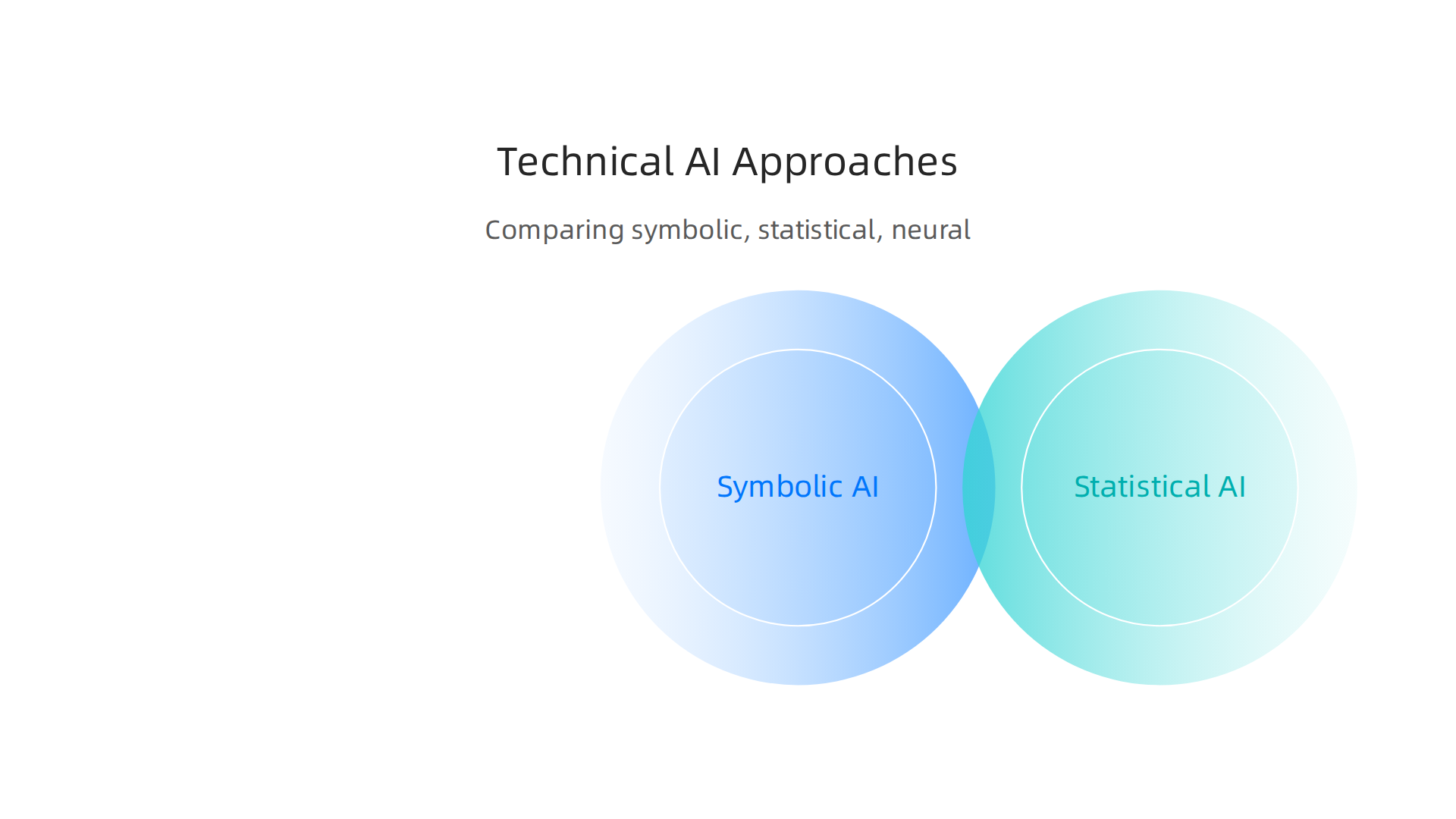
These technical distinctions help us understand how AI processes information, what kind of data it needs, and where it might struggle.
Symbolic AI: The Rule-Follower
Imagine AI as a very smart robot that follows a detailed instruction manual. That’s a good way to think about symbolic AI. This type of AI uses clear rules and logic to make decisions. For example, you might tell it: "IF the light is red, THEN stop." Or "IF a customer asks for a refund AND they have a receipt, THEN approve the refund."
- How it works: It uses symbols to represent things and rules to connect them. It’s like putting together a puzzle where every piece has a clear shape and fits in only one spot.
- What it needs: It works best when the rules are clear and the information is well-organized. It doesn’t need a huge amount of data to learn, just good rules.
- Where it struggles: If the world is messy, or the rules are too many and change often, symbolic AI can get stuck. It also can’t learn things it wasn’t specifically programmed for. This approach gives a kind of focused
virtual intelligencebut lacks flexibility.
Symbolic and statistical methods represent different ways AI "thinks" or processes information, as outlined in discussions about how these approaches map out AI methods.
Statistical AI: The Pattern Finder
Statistical AI is like a detective looking for clues and patterns in a big pile of evidence. Instead of being told exact rules, it learns from many examples. For instance, if you show it thousands of pictures of cats and dogs, it learns to tell them apart by finding common patterns in the images.
- How it works: It uses math and probability to find relationships in data. It looks at how often things happen together or what usually leads to a certain outcome.
- What it needs: Lots and lots of data. The more examples it sees, the better it gets at finding patterns. Experts note that statistical methods can learn well from smaller data sets compared to some other methods, but they still benefit from data to find patterns.
- Where it struggles: If the data is bad or biased, the AI will learn bad patterns. It might also struggle with totally new situations that don’t match anything in its past data.
Neural Approaches: The Brain-Inspired Learner
Neural approaches, especially deep learning, are a very powerful type of statistical AI. They are inspired by how the human brain works, with many interconnected "neurons" that pass information around. These are the engines behind many modern llm ai tools and image recognition systems.
- How it works: These systems build complex layers to find even deeper patterns in data. Think of it like teaching a child to recognize faces. They see many faces, learn small features (eyes, nose, mouth), and then combine those to recognize a whole face.
- What it needs: A huge amount of data. Neural networks are very "data hungry" to become accurate. Many complex models, like transformers used in deep learning, need massive datasets for training.
- Where it struggles: It can be hard to understand why a neural network made a certain decision. It’s often called a "black box" because the inner workings are so complex. Also, training these models takes a lot of computing power. You can learn more about how to manage all this data and process it in your guide to mastering the data science process.
When to Use Each Type
Choosing the right approach depends on the problem:
- Symbolic AI is great for tasks with clear rules and logic, like scheduling, legal analysis, or medical diagnosis where specific conditions lead to specific outcomes.
- Statistical AI is good for predicting things based on past data, like customer behavior, stock prices, or simple classifications.
- Neural Approaches shine with very complex data like images, sounds, and natural language. They are perfect for facial recognition, voice assistants, and powerful content creation tools. These models are also used in
edge aidevices for faster processing.
Sometimes, the best solution is to combine these approaches. This is called neuro-symbolic AI, where the clear rules of symbolic AI meet the powerful learning of neural networks. These different types of AI are transforming various industries in 2026, and understanding their strengths helps businesses find the best AI tools 2026 for your specific needs.
Within the broad categories of AI we just looked at, there are many specific "brains" or tools called models and algorithms. These are like different kinds of engines that power the various types of AI. Understanding them helps us see why some AI is simple and easy to understand, while other AI is very powerful but harder to figure out.

Here are some common types of AI models:
Decision Trees
Imagine a flow chart that helps you make a choice. That’s pretty much a decision tree. It asks a series of simple "yes" or "no" questions to get to an answer.
- How it works: It splits data into smaller groups based on rules. For example, "Is the customer over 30? If yes, then look at their income." This is very much in line with symbolic AI, where rules guide the process.
- Good for: Making clear choices, like deciding if a loan should be approved or which email is spam. They are easy to understand.
- Things to know: They are simple to use and don’t need huge computers. But for very complex problems, they might not be as powerful.
Probabilistic Models
These models are all about chances and likelihood. They guess outcomes based on what usually happens.
- How it works: They use math to figure out the probability of something. For instance, if it often rains after a cloudy morning, a probabilistic model will learn that connection. This falls under statistical AI, as it relies on patterns in data.
- Good for: Predicting things like customer actions, weather forecasts, or if a machine part will break soon.
- Things to know: They can work well with less data than some other models, but their predictions are based on likelihood, not certainty.
Convolutional Neural Networks (CNNs)
CNNs are a special kind of neural approach, really good at looking at pictures and finding things in them.
- How it works: They break down images into small pieces and learn patterns like edges, shapes, and colors. Then, they put these pieces together to understand the whole picture. They are a powerful part of deep learning.
- Good for: Finding faces in photos, self-driving cars seeing the road, or medical scans finding problems.
- Things to know: CNNs need a lot of data and computer power to learn well. They can be hard to "see inside" and understand why they made a certain choice. Many deep learning models, including CNNs, are discussed in a Comprehensive Survey of Deep Learning Models Across …
Transformers
These are the big stars behind many advanced AI tools today, including llm ai (large language models). They are also a type of neural approach.
- How it works: Transformers are very good at understanding long pieces of information, like sentences or paragraphs. They pay attention to how different parts of the text relate to each other, even if they are far apart.
- Good for: Chatbots, translating languages, creating new stories, and helping with code. They are even being used in
edge aidevices for faster processing right where data is gathered. - Things to know: These models are very complex and need enormous amounts of data and computing power to train. For example, reports on CNNs, RNNs, and Transformers in Real-World Applications show that Transformer-based models often have higher computational costs. This makes them a "black box" where it’s tough to explain their exact decisions. For leaders who want to ensure they pick the right tools for their business, it’s important to understand these differences. You can learn more about how to make these choices in our guide on how to choose AI tools 2026 for maximum business impact.
Choosing the Right Model
The model you pick changes a lot of things.
- Interpretability: How easy is it to understand why the AI made a decision? Decision trees are very clear, like giving a clear set of reasons. Neural networks, like those behind
llm ai, are often less clear, sometimes called "black boxes" because their inner workings are so complex. - Compute Cost: How much computer power and money does it take to run? Simple models are cheap. Big neural networks, especially those for
virtual intelligencetasks like generating text or images, can be very expensive. - Deployment Complexity: How hard is it to set up and use the AI in the real world? Simpler models are easier. Complex
types of AIoften need expert teams to make them work correctly and safely in 2026.
Understanding the different types of AI models isn’t just for tech people. For leaders and teams, knowing how these models work helps make smart choices for your business. It impacts everything from what products you can build to how you keep things legal and safe.
Here’s what each types of AI means for different roles:
For Executives and Strategy Leaders
You’re looking at the big picture. When choosing AI, you need to think about:
- Return on Investment (ROI): Simple models like decision trees are cheaper to build and run. They give quick, clear answers for common tasks like approving loans or sorting emails. More complex
llm aimodels, like Transformers, cost a lot more to create and use. But they can bring huge value by automating customer service, generating content, or creating new designs. You need to weigh the cost against the potential gain. Reports in 2026 show that companies are widely adopting AI, with many embedding AI capabilities into enterprise software platforms already, showcasing the widespread push for digital transformation driven by AI innovation State of Applied AI — April 2026 Report. - Risk and Compliance: With AI, especially
virtual intelligencethat makes decisions on its own, you need to ensure fairness and transparency. Decision trees are easy to understand, so it’s clear why they made a choice. Neural networks, on the other hand, can be "black boxes." This makes it harder to explain their decisions, which can be a problem for legal and ethical reasons. Keeping up with AI safety and governance is very important in 2026, as discussed in the International AI Safety Report 2026. - Strategic Fit: Which
types of AIwill truly help your business grow? Are you looking to improve customer service, automate a factory, or create new products? The models you choose will shape your long-term plans. You can also explore how AI models in 2026 are transforming every major industry.
For Engineers and Builders
You’re the ones making the AI work. Your concerns include:
- Data Needs: Powerful models like CNNs and Transformers need huge amounts of data to learn. Simple models need less. You’ll need good ways to collect, store, and clean this data.
- Compute Power: Training and running advanced AI needs a lot of computer power. This impacts your budget and how you design your IT systems. Sometimes, running
edge airight on devices can help save money on big cloud servers. - Deployment and Monitoring: Getting AI into the real world and making sure it keeps working well is a big task. You need to watch it closely for any issues. A new report highlights key Challenges to the Monitoring of Deployed AI Systems, which is something every engineering team needs to consider.
For Product and Operations Teams
You focus on the user and keeping things running smoothly.
- User Experience: How will the AI interact with people? If it’s a chatbot using
llm ai, is it helpful and easy to talk to? If it’s a system for sorting images, is it accurate enough for your users? - Maintenance and Updates: AI models can change over time as they see new data. You’ll need ways to keep them updated and performing at their best. Monitoring is key to ensuring your AI systems continue to function as intended.
- Scalability: Can your chosen AI grow with your business? If you have more customers or more data, will the system still work well, or will it break down?
Staying on top of all these changes can feel like a lot. But understanding the implications of different types of AI for your business is crucial in 2026.
Get clear daily AI updates from The Deep View Newsletter.
The AI Newsletter Worth Reading
Understanding the types of AI also means knowing about the tricky parts: keeping them safe, making sure they follow rules, and handling risks when you use them. This is super important for all kinds of AI, from simple ones to complex llm ai.
Safety Risks of Different AI Types
Each kind of AI has its own challenges when it comes to safety:
- Misuse: Some
types of AI, especially powerful ones likevirtual intelligencethat can create images or words, might be used for bad things. Think about making fake videos or writing misleading stories. Strong rules are needed to prevent this. - Hallucination: This is a big problem with
llm ai. It means the AI makes up facts or answers that sound real but are not true. If an AI gives wrong information, it can cause big problems for businesses or people relying on it. - Robustness Failures: Sometimes AI systems just don’t work as expected, especially in new situations. For example, an
edge aisystem on a factory floor might struggle if the lighting changes a lot or if a new type of product appears. It needs to be tough and reliable.
The goal is to understand these dangers so you can put safeguards in place. It’s a key part of thinking about the real dangers of AI in 2026.
Governance Needs for AI
Good governance means having clear rules and ways to check that AI is fair and safe.
- Explainability: Simple AI models are usually easy to understand. You can see how they make decisions. But with advanced neural networks, it’s often like a "black box" where it’s hard to see why it made a choice. This makes it harder to ensure fairness and to meet legal requirements. The International AI Safety Report 2026 talks about how important it is to manage these risks.
- Fairness and Bias: AI learns from data. If the data has unfair patterns, the AI will learn those too. This can lead to biased decisions. Companies need to be careful about the data they use and constantly check their AI for unfairness.
- Transparency: Everyone involved, from the people building the AI to those using it, needs to know how it works and what its limits are. This helps build trust and makes sure the AI is used in a good way. Businesses in 2026 need to develop adaptable compliance frameworks to stay ahead of these changes Artificial Intelligence in 2026: our top ten trends to watch.
Monitoring, Testing, and Mitigation Strategies
Once an AI system is deployed, the work isn’t over. You need ongoing steps to keep it safe and effective.
- Continuous Monitoring: You need to watch AI systems all the time. This means checking if they are still working right, if their decisions are fair, and if there are any new security threats. Reports show that monitoring helps organizations find issues before they get worse Responsible AI monitoring. Companies should also track important metrics like accuracy and how much computer power the AI uses AI Monitoring: 5 Keys to 2026 Competitive Survival.
- Thorough Testing: Before and after launching, AI models need deep testing. This includes trying to find ways the AI could fail or be misused. For
llm ai, this often means "red-teaming," where experts try to make the AI produce harmful or wrong outputs to see its weaknesses. - Mitigation Strategies: When problems are found, you need ways to fix them. This could mean updating the AI with new data, changing how it makes decisions, or even pulling it back if it’s too risky. Having a plan for what to do when something goes wrong is key for all
types of AI. Building sustainable oversight programs for AI requires continuous monitoring AI Continuous Monitoring: Build Sustainable Oversight Programs.
Overall, managing the safety and rules around AI is a team effort. It’s about being smart and proactive with every new AI tool you use in 2026.
Staying Current: Practical Resources and Strategies to Track AI Types and Advances
After learning how to manage AI risks, the next big step is to keep up with all the new things happening in AI. The world of AI is always changing very fast, especially in 2026. New ideas and tools pop up all the time. Knowing how to keep track of these changes is key for anyone using AI today.
Your Smart Plan for Monitoring AI
To keep track of all the different [types of AI] and new ideas, you need a smart plan. It’s like having a good system for finding what you need in a big library.
- Set Up Smart Alerts: First, you can set up special alerts that look for specific kinds of AI news. This is called a "taxonomy-driven" approach. It means you tell your tools to only show you updates about certain things, like new breakthroughs in [llm ai], improvements in [edge ai], or fresh ideas about [virtual intelligence]. This helps you focus on what matters most to you.
- Pick Trustworthy Sources: Next, make sure you get your news from places you can trust. There are many experts who share good insights on how AI is growing. Some groups even study and track big predictions about how AI will change over time. For example, experts often share their forecasts on key AI progress indicators, which can help you stay ahead Insights from Waves 1, 2, and 3 – Longitudinal Expert AI Panel.
- Take Time for Deep Dives: Don’t just skim headlines. Make sure you set aside time to really dig into new topics. These "deep dives" help you understand if a new AI tool is just a small improvement or if it’s a whole new kind of [types of AI] that could change things a lot. Companies should follow best practices for monitoring their AI systems to make sure they’re working well and staying secure AI Agent Monitoring: Best Practices and Tools for 2026.
It’s also very helpful to know what the biggest companies are doing. Keeping up with specific company news, like openai news 2026 key developments that matter for ai users, can give you clues about future trends.
How to Tell if a New AI is Really New
When you hear about a new AI model or tool, how do you know if it’s truly a game-changer or just a slightly better version of what we already have?
- Look for Category Shifts: A truly new AI often changes how we define a category. For example, if a new [virtual intelligence] system can do something no other AI could do before, it might be a big deal. If it’s just faster or more accurate at an old task, it’s probably just an improvement.
- Check the Core Method: Think about how the AI learns or works. If it uses a completely different way to solve problems, it could be a new "type" of AI. If it just tweaks an existing method, it might not be. Evaluating AI systems in real-world settings is an important part of understanding their true impact and capabilities Evaluation Framework for AI Systems in "the Wild". This helps you decide if it is truly new or just an improved version of an older system.
- Consider Its Impact: Does this new AI open up completely new uses or solve old problems in a totally new way? If so, it might be more than just an update. Learning how to choose ai tools 2026 for maximum business impact involves understanding these differences.
Staying on top of AI can feel like a lot of work. That’s why many people find it helpful to have trusted sources deliver the most important updates directly to them. To get clear daily AI updates right to your inbox, you should consider The AI Newsletter Worth Reading. This helps you stay informed without feeling overwhelmed.
Summary
This guide breaks down the many types of AI in plain language so business leaders and teams can cut through the hype and make smarter choices. It explains core concepts—AI, machine learning, and deep learning—then maps the practical taxonomy used today: narrow AI, the aspirational AGI and superintelligence, and useful subcategories like foundation models, specialized models, embedded AI, and edge AI. The article also contrasts symbolic, statistical, and neural approaches and outlines common models (decision trees, probabilistic models, CNNs, transformers) to show strengths, data needs, and costs. It then translates those technical differences into business implications for executives, engineers, and product teams, covering ROI, deployment, and workforce impact. Finally, it covers safety risks (hallucinations, misuse, robustness), governance needs, monitoring and testing best practices, and practical ways to stay current with rapid AI advances in 2026.