

Why Strategic AI Adoption Matters Now
Imagine you are trying to keep up with a fast-moving train. That’s a lot like trying to keep up with AI today, especially if you lead a business. Things are changing so quickly that it’s hard to know what’s truly important and what’s just noise. Every day, new AI tools and ideas pop up, making it tough for business leaders to decide where to put their time and money.
Actually, worker access to AI went up by 50% in 2025 alone, which means more and more people are using these tools at work. Companies also expect to put many more AI projects into action very soon, showing how fast things are moving along, according to a 2026 AI report from Deloitte. This quick growth brings a lot of new options, but it also brings a lot of confusion.
It’s easy to feel lost with so much information. You might wonder which AI ideas are really going to help your business grow and which ones are just fads.

This can make it hard to choose the best AI tools for data analysis or even pick the right general AI for business projects. You might worry about missing out on something big or investing in something that won’t work out.
This is why having a clear plan for using AI is more important than ever. We’re here to help. This article will give you a simple, clear roadmap. It will show you how to find and pick AI projects that truly make a big difference for your business. You’ll learn how to cut through the clutter and focus on what really helps your company move forward.
Staying on top of all the fast-changing news can be a lot. If you want clear, daily updates on artificial intelligence without the overwhelm, consider checking out The AI Newsletter Worth Reading. It can help you get the important news delivered straight to you.
1) Building an AI Strategy That Aligns with Business Outcomes
A clear plan is like a good map for any trip. When it comes to using AI for business, a map helps you get to where you want to go. This means you need a strong AI strategy. It’s not just about using cool new AI tools. It’s about picking projects that truly help your business meet its main goals.
Think about what your business wants to achieve most. Do you want to make more money? Save money? Avoid big problems or risks? Or do you want your customers and employees to have a better experience? These are your main business outcomes. Every AI project you consider should link directly to one or more of these goals.
For example, if your goal is to save money, you might look at AI that can help automate simple tasks. If you want to make customers happier, maybe AI can improve your customer service. For each goal, you need a way to measure success. These are called Key Performance Indicators, or KPIs. A KPI for saving money could be "reduce how much we spend on customer support by 15% this year." For better customer experience, it might be "increase customer satisfaction scores by 10%." Many companies are quickly putting AI into action, with some reports showing that a good number of AI projects are moving to full use in businesses, including those focusing on data analysis and content creation 2025 AI Adoption Report: Gen AI Fast-Tracks Into the Enterprise.
Once you know your goals and how you’ll measure them, it’s time to pick which AI projects to work on first. You can’t do everything at once. A simple way to choose is to think about two things for each idea:
- Feasibility: How easy or hard is it to do this project? Do we have the right people and tools, like a good data platform, to make it happen? Is the AI technology ready for this?
- Impact: How much good will this project do if it works? Will it really help us reach our big business goals?
You can even give each project a simple score for how easy it is and how much impact it will have. Projects that are easier to do and have a big impact should be your top choices. This helps you focus your efforts on the right kind of AI for business growth. Learning about the different kinds of AI can also help you choose wisely. You can explore more about these by checking out how to master the key types of AI for business growth in 2026. This careful planning makes sure your AI efforts truly move your company forward, instead of just trying out the latest trends.
Choosing the right AI projects means looking at where AI can make the biggest difference for your business. Let’s look at some common ways companies are using AI in 2026 to get great results. These examples cover different parts of a business and different kinds of companies.
We can put these high-impact AI uses into a few groups:
Cost-Saving Automation
This type of AI helps businesses save money by doing tasks that people used to do over and over again. It makes things faster and often more accurate.
- For Customer Service: Imagine AI chatbots that answer common customer questions instantly. This helps banks handle many calls or online stores quickly solve simple problems.

It means fewer human agents are needed for basic tasks, saving money and making customers happier with quick answers.
- For Office Work: AI can help sort emails, organize documents, or create basic reports. Many industries, from law to healthcare, can use this to free up employees for more important work.
Revenue Acceleration
This kind of AI helps businesses earn more money. It finds new chances to sell things or helps sell more to existing customers.
- For Sales and Marketing: AI can look at what customers like and then suggest products they are more likely to buy. Think of online shopping sites that know what you want before you do. For example, a good data platform can help collect information for tools like Amplitude Analytics to give clear insights. AI can also help create personalized ads that reach the right people at the right time, leading to more sales.
- For Pricing: In travel or hospitality, AI can change prices in real-time based on how many people want a service or how much a competitor is charging. This helps sell more rooms or tickets at the best possible price.
Product Enhancement
AI can make a company’s products or services better, smarter, and more useful.
- For Smart Products: Many new apps and devices use AI to learn from you and improve over time. A fitness tracker using AI might give you better health tips based on your daily habits.
- For Manufacturing: AI can watch machines in a factory and predict when they might break. This means repairs can happen before a big problem starts, saving time and money, and keeping production smooth. Many companies are making AI a key part of their work, with worker access to AI tools increasing by 50% in 2025 alone, showing its strong integration into businesses in 2026 The State of AI in the Enterprise – 2026 AI report | Deloitte US.
Risk and Compliance
This use of AI helps companies stay safe, follow rules, and avoid big problems.
- For Banks and Finance: AI is very good at spotting strange money moves that could be fraud. This protects both the bank and its customers.
- For Cybersecurity: AI can detect unusual activity on computer networks that might mean someone is trying to hack in. This helps protect important information.
- For Legal Teams: AI can quickly read through many contracts and documents to find mistakes or make sure everything follows the law.
To make these AI projects work well, companies need to pick the best AI tools for data analysis and have a good system for managing their data. Knowing these different uses of AI for business can help you see where your company can start getting real value.
Want to keep up with the latest AI trends and how they impact businesses like yours every day? Stay informed. Get clear daily AI updates from The AI Newsletter Worth Reading.
To truly get value from AI for business, it’s not enough to just know what AI can do. You also need to understand how to bring AI into your daily operations. This means thinking about your data, the AI models you’ll use, and how your systems are built. It’s all about making AI work safely and smoothly within your company.
Practical Integration: Data, Models, and Engineering Patterns
Bringing AI into your business involves careful planning. You need to create smart ways to use AI models, whether they are ones your team makes or ones you get from other companies. This also means making sure your data is ready and that you’re investing in the right tools and setups, especially when you’re just starting out with AI projects.
Safely Connecting AI Models
Think of building a strong framework for your AI, known as MLOps. This approach helps you manage the entire life of an AI model, from when you first get data to when the model is working and being watched in real-time. Good MLOps helps companies set up a system where AI models, both those built in-house and those from outside, can work together safely and effectively. This often means designing systems where requests go through a special path: from the request, through an API, to the AI model, and then back with a response, all happening very fast MLOps System Design: Reference Architecture for 2026.
It’s really important to keep these systems secure. Just like protecting your regular computer systems, you need to think about security practices for AI pipelines to prevent problems like unusual data access or wrong predictions Top CI/CD Pipeline Security Best Practices for AI-Powered. When choosing the right tools for your AI setup, you’ll find different options that offer different benefits, depending on your company’s specific needs Choosing Your Enterprise MLOps Stack in 2026.
Getting Your Data Ready for AI
Before any AI project can take off, your data needs to be in good shape. This is called data readiness.
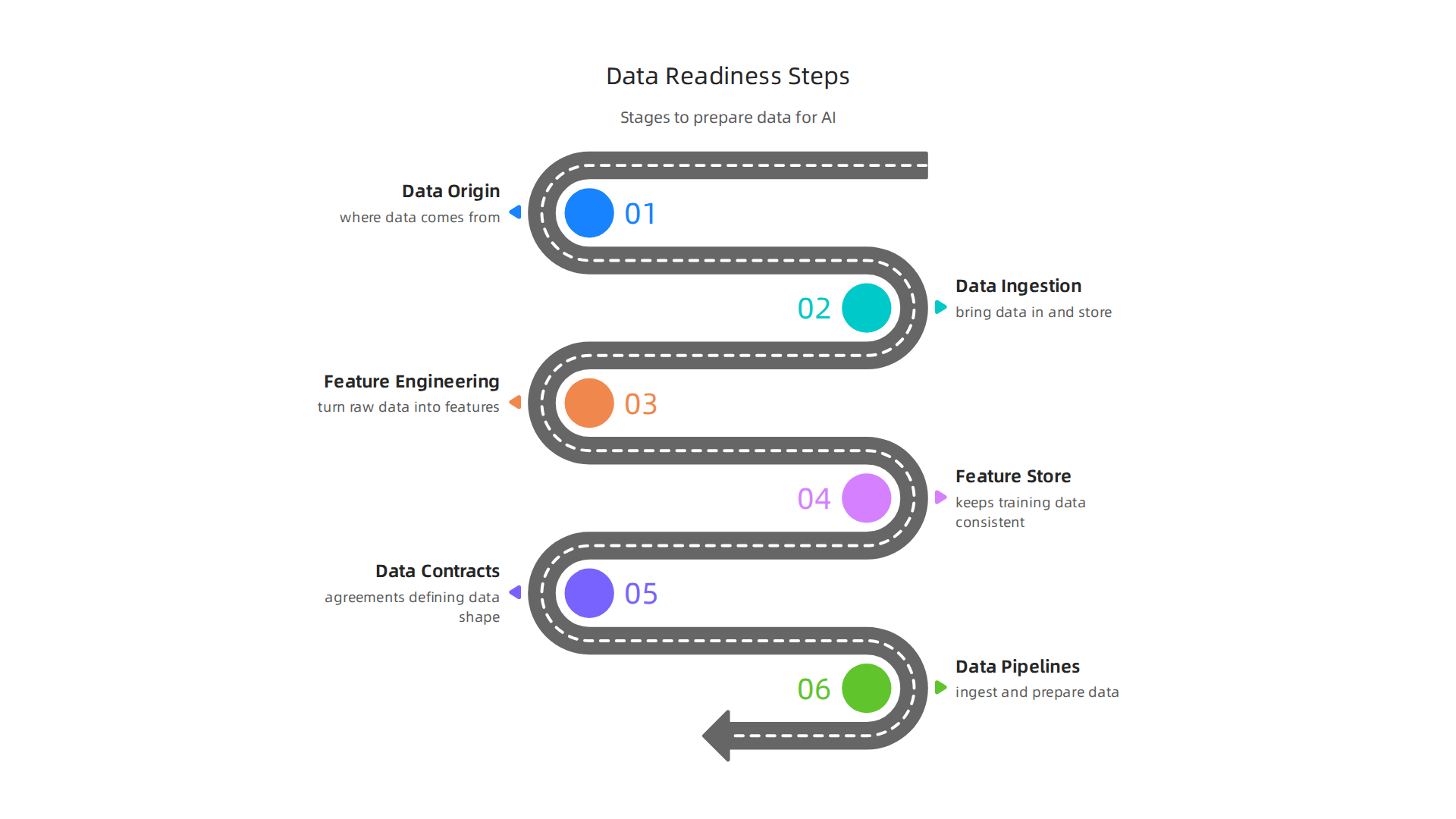
It means knowing where your data comes from, how it’s collected, and where it’s stored. Data can come from many places, like your daily business systems or special data storage areas. Then, you need ways to bring this data in and save it.
After that, you’ll often need to prepare the data for the AI model to use. This step, called feature engineering, turns raw data into useful "features" that the AI can learn from. For smoother operations, many companies use something called a "feature store." This is not just a place to save data, but a whole system that helps keep your training data and live data consistent, even with things like late data or changes to how data is structured Advanced MLOps Practicum: Feature Stores, Registry & Rollback. To manage all this data, companies use data contracts, which are like agreements that define what the data should look like, how fresh it needs to be, and who owns it Data Contract – MLOps Dictionary – Hopsworks.
A strong focus on your data means having solid pipelines that bring data into your AI systems and prepare it for use. These pipelines make sure your AI models always have the right information MLOps Architecture: End-to-End Design for Production. Actually, having data specialists who know how to prepare and manage this data is more important than ever for good AI. To learn more about this, check out why Data Specialists Are More Critical Than Ever in the Age of AI.
Small Steps for Big AI Wins
When you’re first trying out AI for business, you don’t need to build everything at once. Starting with small projects, called early pilots, can help you see quick results without a huge upfront investment. For these pilots, it’s key to set up simple ways to watch how your AI models are doing. This is called monitoring and observability.
You’ll want to watch out for things like "model drift," which is when an AI model starts to perform less accurately over time because the real-world data it sees changes Detecting Model Drift in Production: RAG and Agent Monitoring. By monitoring how well your model predicts things and if its data inputs are changing, you can fix issues before they become big problems. Many tools and practices exist to help you keep an eye on your AI models and automatically trigger actions like retraining if needed Production ML Pipeline with Feature Store and Model Registry.
For any company, building good AI needs careful planning around data, system design, and continuous monitoring. This makes sure that your AI projects deliver real value and keep working well into the future. It’s how businesses in 2026 are truly integrating AI into their core operations.
Bringing AI into your business isn’t just about making models work. It’s also about making sure they work in a way that is safe, fair, and follows all the rules. This is called AI governance, and it helps your company use AI smartly and responsibly.
Figuring Out AI Risks
When you use AI, there can be some bad things that happen. These are called "model harms." For example, an AI model might make unfair choices if it was trained on data that wasn’t balanced. It could also share private information by mistake or just make plain wrong predictions.
Companies need a way to understand and list all these possible problems. This is like creating a "risk roadmap" for AI. It helps you see where dangers might be hiding. The government, through groups like the National Institute of Standards and Technology, has even created a special AI Risk Management Framework to help businesses handle these risks. It’s super important to think about these dangers when planning how to use AI for business. To learn more about the downsides, you can read about the real dangers of AI in 2026.
Keeping Data Safe and Legal
Another big part of AI governance is making sure your data is safe and follows the law. This means being careful about how you collect, store, and use any data that feeds your AI models. You need to make sure you’re keeping people’s information private. Bad data privacy and cybersecurity are big worries for many companies using AI today, as noted in a Global AI Pulse Q1 2026 report.
This also means setting up secure "data platform" systems. These systems help you manage all your company’s data carefully. Strong security for your data stops bad things from happening, like someone getting access to information they shouldn’t have.
What Happens When AI Fails?
Sometimes, even the best AI can make a mistake or stop working right. These are called "operational failure modes." Your business needs a plan for what to do if an AI system crashes or gives wrong answers. Having a clear plan helps you fix problems fast and keep your business running smoothly, even if AI takes a stumble.
Setting Up How AI Is Managed
To handle all these risks and rules, companies need clear ways of working. This is called a "governance workflow." It means deciding:
- Who does what: Who is in charge of checking AI models? Who approves them?
- Approval steps: What steps does an AI project need to go through before it can be used?
- Watching AI: How do you keep an eye on AI models to make sure they are still working well and not causing problems? This is like checking their health often.
- Fixing problems: What happens if an AI model causes an issue? Who fixes it and how?
Many government groups are pushing for this. For example, the General Services Administration (GSA) wants companies to set up AI governance boards and make public plans for using AI responsibly, as outlined in their guidance on Accelerating Responsible Use of Artificial Intelligence at GSA. By putting these things in place, businesses can make sure their use of AI is strong, safe, and helpful for a long time.
Staying on top of all the new AI rules and best practices can be tough. But getting daily, clear updates can make it easier.
The AI Newsletter Worth Reading
After setting up all the rules and checks for AI, the next big step is to see if your AI projects are actually doing any good.

You need to know if they are making money, saving time, or helping your business in other ways. This is all about proving the value of your AI work and figuring out its return on investment, or ROI.
How to Measure AI’s Real Impact
It’s not always easy to tell if a new AI tool is truly helping or if something else is causing a change. To find out, businesses need to set up smart experiments.
One common way is called A/B testing. This is like comparing two groups. One group gets the new AI experience, and the other group, called the "control group," does not. By comparing what happens to both groups, you can see the true effect of the AI. For example, if you’re using AI for business to recommend products, you’d show some customers AI-powered recommendations and others the old way, then see which group buys more. Many studies highlight the importance of careful A/B testing to measure impact reliably A/B testing: A systematic literature review.
Another great way is to use "holdout" groups. This means you keep a small group of customers or operations completely separate from the AI changes. This holdout group helps you measure the impact of the AI by showing what would have happened without it. This kind of careful comparison helps you truly calculate the revenue lift from AI, as explained in guides on how to calculate the revenue impact of better AI recommendations. You can even use methods like geo-holdouts, where AI campaigns are run in some areas but not others, to measure marketing impact accurately Using Causal Inference for Measuring Marketing Impact: How BBC Studios Utilises Geo-Holdouts.
You also need to set clear goals, called Key Performance Indicators (KPIs), before you start. These are like scorecards that tell you exactly what to watch. For AI for business, KPIs might include:
- How much more money customers spend.
- How much time employees save on a task.
- How many fewer mistakes are made.
- How much happier customers are.
Establishing these baselines before deploying AI is super important, as you can’t compare to "nothing" later on Measuring AI Impact With Statistical Confidence.
Figuring Out AI’s ROI: Short and Long Term
Calculating the full ROI of AI isn’t just about quick wins. Some AI projects might show value right away, like an AI chatbot that helps customers faster. This is your short-term ROI. But other AI projects might take longer to show big results, like an AI system that improves how your whole supply chain works. That’s your long-term ROI.
When you calculate ROI, you look at the extra money or savings AI brings in, and then you subtract all the costs of the AI project. The formula is often simple: (Incremental Profit – Total AI Cost) ÷ Total AI Cost. This helps businesses understand if their AI investment is truly worthwhile Methods To Validate Ai.
Tools for amplitude analytics or other best ai tools for data analysis can help you track these KPIs and see how your AI models are doing. They work with your data platform to give you a clear picture of performance.
Once you see that an AI project is bringing real value, that’s when you know it’s time to make it bigger. You can scale up your efforts, meaning you use the AI in more parts of your business, reaching more customers, or handling more tasks. This growth helps you get even more out of your initial AI investment. If you want to dive deeper into how different AI tools can improve your business analytics, check out our guide on AI-driven business intelligence software unlocks smarter decisions.
Once you know that your AI project is truly helping your business, the next big step is to get everyone on board and use it widely. This is called adoption and scaling. It means making sure all parts of your company use the AI tools, not just a small team. Actually, getting people to change how they work can be harder than building the AI itself.
Getting Everyone to Use AI and Make It Grow
For ai for business to really take off, it’s not enough to just buy the best AI tools for data analysis or set up a fancy data platform. You need everyone in the company to understand and accept the new ways of working with AI. Many companies find this part tricky. In 2026, reports still show that not having enough skilled workers is a huge problem for bringing AI into everyday work The State of AI in the Enterprise – 2026 AI report.
Here’s how to make sure AI sticks and grows:
- Everyone Needs to Be on the Same Page: This means leaders, managers, and regular employees all need to agree on why AI is important. They need to see how it helps them and the company. When everyone understands the goals, it’s easier to make changes. Businesses that plan out their AI strategy carefully are three times more likely to get real value from AI AI Adoption & Impact Study: AI in the Enterprise June 2026.
- Training and Learning New Skills: People might be worried about AI changing their jobs. It’s important to teach them how to work with AI, not against it. This might mean new training programs.

Giving employees incentives, like chances to learn and grow, can make them more open to new AI-driven ways of working. Remember, technology is becoming a partner, not just a tool McKinsey’s 2026 Report: AI Adoption and Organizational Change. You can explore how AI-powered learning platforms are the future of corporate training in 2026.
- Making Feedback Loops Work: AI models are not perfect from day one. They get better over time by learning from how people use them. This means setting up a way for users to give feedback easily. If an AI tool makes a mistake or could be better, employees should be able to tell someone. This feedback helps the AI team improve the models and also helps change company rules to fit the new AI tools. It’s about treating AI deployment as a systems challenge that includes both technical and human aspects The 2026 State of AI Agents Report.
The truth is, many AI projects don’t grow beyond a small test because of issues with people, processes, and company culture, not because the technology itself is bad. Thinking about how people will use AI from the start is key to making sure your ai for business investments pay off in the long run Change Management for AI Adoption: A 2026 Playbook.
To stay on top of all the latest AI trends and how they impact business strategies, make sure you’re always informed.
The AI Newsletter Worth Reading: Get clear daily AI updates from The Deep View Newsletter
Summary
This article explains why strategic AI adoption is urgent and how business leaders can turn AI from noise into measurable value. It shows how to create an AI strategy that links projects directly to business outcomes, how to score initiatives by feasibility and impact, and which common use cases (cost-saving automation, revenue growth, product enhancement, risk management) tend to deliver results. The guide walks through practical integration steps—data readiness, feature stores, MLOps patterns, monitoring for model drift—and outlines governance needs like risk mapping, privacy and operational failure plans. You’ll also learn how to measure AI impact with A/B tests, holdouts and clear KPIs, calculate short- and long-term ROI, and scale adoption through training, feedback loops and change management. After reading, you’ll have a clear roadmap to pick the right pilots, run them safely, prove value, and expand AI across your organization.