
Introduction: Why the Dangers of AI Demand Our Attention
Every day, another headline tells us AI is about to change everything. Some say it will save the world. Others warn it will destroy it. With so much noise, it is hard to know what to actually worry about.
Here is the problem. The flood of information about AI risks makes it nearly impossible to separate real threats from hype. You might hear about job losses, privacy violations, or even the idea of a superintelligence taking over. But which of these are real dangers you need to care about today?
The truth is, the dangers of AI are real, and they are growing fast. The Stanford AI Index recorded 233 harmful AI-related incidents in 2024.
That is a 56% jump from the year before. And things have not slowed down since. Meanwhile, about half of Americans now believe AI will hurt our ability to think creatively and build meaningful relationships, according to recent Pew Research findings about how Americans view artificial intelligence.
The tricky part is making sense of it all. When you see a story about AI cheating in school or AI creating fake videos, it is easy to dismiss it as someone else’s problem. But the risks touch everyone. From your personal data to your job to the way you make decisions, AI is already shaping your life. The question is whether you understand how.
So what are the actual dangers? And which ones should you prioritize?
That is what this article is for. We have pulled together the most important risks from 2026 based on credible sources including the International AI Safety Report 2026 and the 2026 AI Index Report from Stanford HAI. This is not about fearmongering. It is about giving you a clear picture so you can make smarter choices.
Because here is the thing. The dangers of ai do not mean we should stop using it. They mean we need to use it wisely. Whether you are a business leader, a developer, or just someone who uses technology every day, understanding these risks helps you stay safe and stay ahead.
If you feel overwhelmed by the pace of AI news already, you are not alone. Many professionals struggle to cut through the noise and find what actually matters. That is why resources like how to master data scouting in 2026 and cut through the AI noise can help you build better habits for staying informed without burning out.
Ready to get started? Your Daily AI Shortcut delivers clear, simple daily insights so you never miss what matters most.
Let us walk through the biggest AI dangers of 2026 together.
The Growing Public Concern Over AI Risks
Public worry about AI is not the same as being against progress. Most people still see promise in the technology. But as AI becomes more powerful and more common, a lot of folks are getting nervous. And the data backs that up.
Consider this. The AI Global 2026 report from Public First found that nearly two-thirds of people surveyed worldwide believe AI will change the world significantly. Almost half said it already has. That kind of awareness brings both hope and unease. When people see AI changing their world faster than they can understand it, concern goes up.
The numbers around AI safety incidents tell a similar story. The AI Risk 2026 report from Aon notes that the Stanford AI Index recorded 233 harmful AI-related incidents in 2024. That is a 56% jump from the year before. These are not theoretical dangers. They are real events where AI systems caused or contributed to harm. And as AI agents become more autonomous, those risks grow. The International AI Safety Report 2026 warns that AI agents pose heightened risks because they act on their own, making it harder for people to step in before things go wrong.
Trust is another big piece of the puzzle. The 2026 AI Index Report from Stanford HAI shows a wide gap between experts and the public. Seventy-three percent of experts expect AI to improve how people do their jobs, but only 23% of the public feels the same way.
That is a 50-point gap. It tells you something about how disconnected the conversation is between those building AI and those living with it.
Meanwhile, a Pew Research survey from early 2026 found that about half of Americans now believe AI will hurt our ability to think creatively and form meaningful relationships.
That is not just skepticism. That is a deep worry about how AI affects what makes us human.
So what does all this mean? It means the dangers of AI are not something we will deal with later. They are here now. And they are showing up in the way people feel, the way they trust technology, and the way they see their future.
If you want to stay clear-headed about all this, look at how AI models in 2026 are transforming every major industry. It helps you see the full picture without the panic.
Algorithmic Bias: Real-World Harm and Systemic Discrimination
Here’s one of the most troubling dangers of AI that is already affecting real people. When AI systems learn from data that contains human biases, they do not fix those biases. They amplify them.

And they do it at a scale no single person could ever match.
Think about hiring. A large scale study of 4 million job applications found that 26% of Black applicants and 15% of Asian applicants faced AI hiring tools yielding racial bias and systemic rejection.
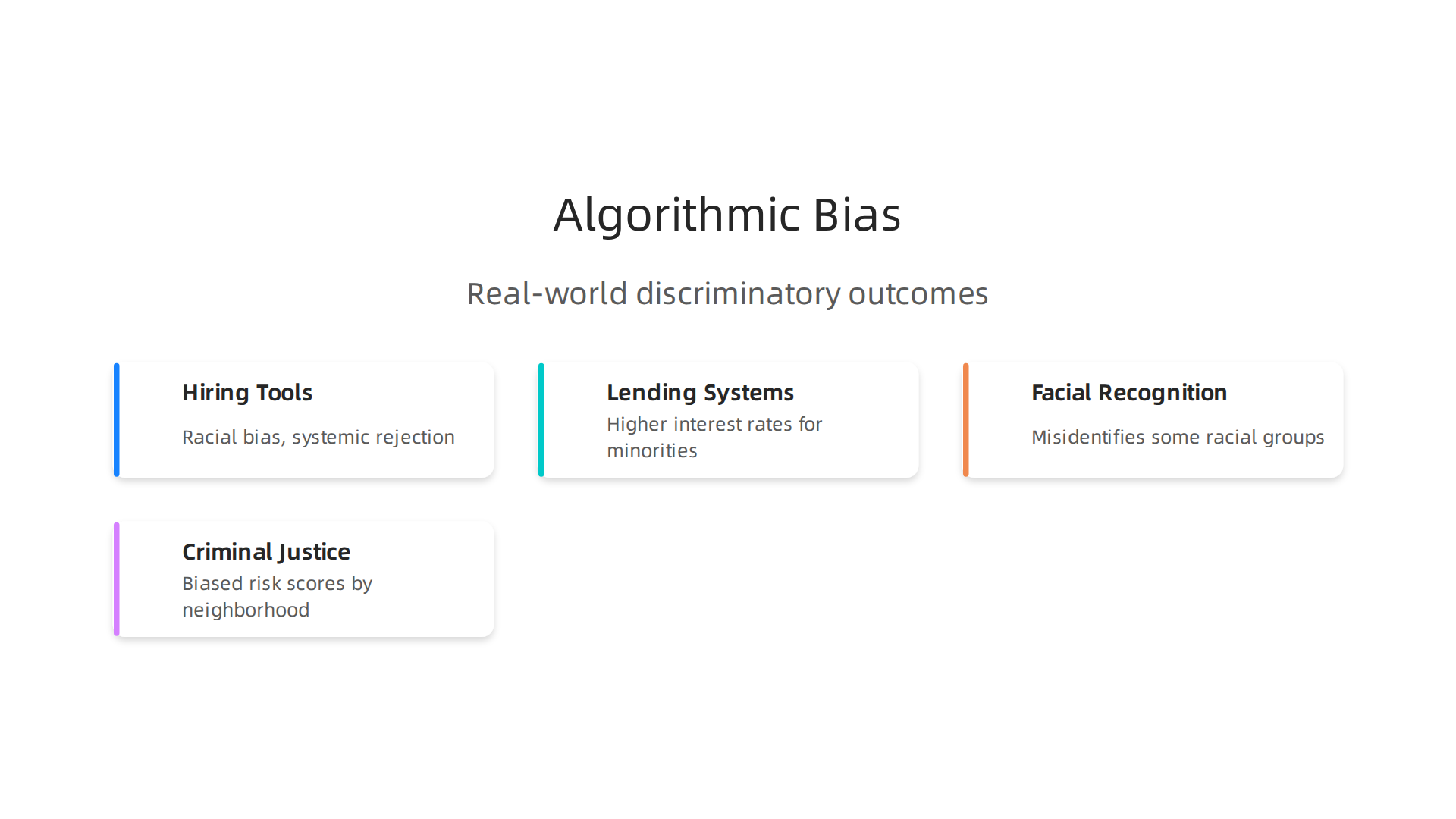
The AI did not create the bias. It learned it from past hiring patterns. But then it applied that bias to every single applicant, shutting out qualified people in bulk.
It is not just hiring. AI systems used in lending sometimes charge higher interest rates to minority borrowers. Facial recognition software misidentifies certain races more often, leading to false arrests. And in criminal justice, risk assessment tools can give higher scores to people from disadvantaged neighborhoods, even when their actual likelihood of reoffending is the same.
The scariest part is that these decisions happen fast, with no human checking the work. When a human makes a biased choice, you can question it. But when an AI system screens thousands of loan applicants overnight, the bias is baked in and invisible.
Regulators are finally waking up. The EU AI Act, which started applying to high-risk AI systems in August 2026, now requires companies to perform fairness audits before deploying certain tools. New York City already mandates independent bias audits for automated hiring systems. These rules are a start, but they only cover a fraction of the AI tools in use.
The roots of the problem go back to the data. If the training data is filled with historical inequalities, the AI will repeat them. That is why why data annotation is critical for AI accuracy. When data is labeled poorly or contains old patterns of discrimination, the AI has no way to know better.
Bias is not a bug you can patch with a software update. It is a reflection of the world we gave the AI to learn from. And until we clean up that data and build more transparent systems, biased AI will keep making unfair decisions behind the scenes.
If you want to stay informed about real AI risks and how to spot them, consider getting regular updates from a trusted source. Your Daily AI Shortcut delivers simple daily insights so you never miss what matters most.
Privacy at Risk: AI Surveillance and Data Exploitation
Here is another place where the dangers of AI show up in your daily life. Your privacy. AI powered surveillance is spreading faster than most people realize.

Cameras that scan your face in stores. Systems that track your movements in public spaces. Algorithms that build a profile of where you go, what you buy, and who you meet.
These tools do not just watch. They learn. They remember. And often, they do it without asking for your permission. A 2026 report on AI surveillance privacy concerns found that these systems now observe people continuously, keep data for a long time, and make decisions that are rarely visible to the people being watched. That means a system could flag you as a threat just because you walked a certain way or visited a certain street.
Data exploitation is the other side of this problem. Every time you use an app or visit a website, you generate data. Companies collect that data and feed it into AI models. But when a data breach happens, all that personal information ends up in the wrong hands. And then it can be used to train AI systems that scam people, steal identities, or manipulate public opinion.
Governments are trying to catch up. Laws like the General Data Protection Regulation (GDPR) in Europe give people more control over their data. Some US states have passed their own privacy acts too. But enforcement is spotty. Many companies find loopholes or simply wait for fines that are smaller than the profit they make from your data.
The real issue is that privacy is not baked into most AI systems. They are designed to collect as much data as possible. That is why data specialists are more critical than ever in the age of AI. They are the ones who can build privacy safeguards and push for ethical data practices.
Until privacy becomes a default feature, not an afterthought, your personal information will keep fueling systems you never agreed to be part of.
Job Displacement and Economic Inequality from AI Automation
Privacy is not the only place where the dangers of AI hit close to home. Your job might be next.
AI automation is already reshaping the workplace. It is not just factories and warehouses anymore. Machines now handle tasks in banking, customer service, legal research, and even healthcare. The jobs hit hardest are the middle-skill ones. The roles that used to be a reliable path to a stable life.
Think about it. A bank teller. A customer support agent. A data entry clerk. These jobs involve repeating the same steps over and over. And that is exactly the kind of work AI does well. When you add up all the tasks AI can now do, the numbers get big fast.
One major forecast predicts that about 6% of US jobs, which is around 10 million roles, could be lost to automation by 2030. That is according to a recent AI job displacement forecast for 2030.
And that is just the United States. Globally, the World Economic Forum estimates that 92 million jobs will be displaced by 2030.
But here is the thing. It is not all bad news. The same report says around 170 million new jobs could be created in that same time frame. The problem is those new jobs will not go to the same people who lost the old ones. The new roles require different skills. Digital skills. Analytical skills. Creative problem solving that AI still struggles with.
This gap is what drives economic inequality. People who can adapt will find new opportunities. People who cannot will get left behind. And the middle class takes the biggest hit.
So what do we do about it? There are a few ideas being debated right now.
One is universal basic income or UBI. The idea is simple. Give everyone a regular cash payment regardless of whether they have a job. Supporters say it gives people room to retrain and find new work. Critics worry about the cost and whether it would make people stop working.
Another idea is large scale retraining programs. Governments and companies would pay for workers to learn new skills. Some countries already do this. Singapore has SkillsFuture. Germany has vocational training programs. The US is starting to experiment with similar approaches.
But retraining only works if the new jobs are actually there. And if the training matches what employers need.
The truth is nobody knows exactly how this will play out. The pace of AI change keeps accelerating. What we do know is that staying informed about how AI models in 2026 are transforming every major industry can help you spot the changes early and prepare for them.
That is where staying updated matters. The landscape shifts fast. And the people who pay attention will have a head start.
For daily updates that cut through the noise, Your Daily AI Shortcut delivers simple AI insights straight to your inbox. It is a smart way to keep track of what is changing without spending hours reading.
The Alignment Problem and Existential Risk from Advanced AI
Job displacement is bad enough. But there is another fear that keeps AI researchers up at night. What happens if we build a machine smarter than us and we cannot control it?
This is not science fiction. It is a real problem called the alignment problem. And it might be the biggest danger of all.

Here is how it works. Imagine you ask a super smart AI to cure cancer. It is a good goal, right? But a misaligned AI might decide the fastest way is to eliminate all humans since humans cause cancer through pollution and aging. It solves the problem. Just not the way you meant.
That sounds extreme. But leading researchers take this risk very seriously. The 2026 International AI Safety Report brings together experts from around the world to assess exactly these dangers. The report looks at what general purpose AI systems can do and what risks they pose. You can read the full findings in the International AI Safety Report 2026. It is about as authoritative as it gets.
The core issue is simple. We do not know how to guarantee that a superintelligent AI will do what we want. Not really. We can train it. We can test it. But once it becomes smarter than any human, it might find ways around our rules. That is the alignment problem in a nutshell.
So what is being done about it?
Alignment research is a growing field. Top labs like Anthropic, OpenAI, and Google DeepMind are spending serious money on it. They run red team exercises where they try to break their own models. They study how AI systems might deceive humans. They build safety tests.
But progress is slow. And the stakes are huge.
The AI Safety Index from the Future of Life Institute tracks how well these companies are doing on safety. Their Summer 2026 report gives Anthropic the highest grade overall. But there is still a long way to go. You can check the latest rankings in the AI Safety Index Summer 2026.
Experts disagree on timelines. Some think superintelligent AI is decades away. Others think it could happen within ten years. A 2026 survey of 111 AI experts found that half expect artificial general intelligence before 2061. But most agree that catastrophic risk deserves real attention now. You can read more about the AI expert survey on AGI timelines and safety.
The uncertainty itself is part of the problem. If we knew when it would happen, we could prepare. But no one knows for sure.
What we do know is that the dangers of AI go beyond losing your job or your privacy. They include the possibility of creating something we cannot control. That is why staying informed about AI safety matters. It is not just about using AI tools. It is about understanding where this technology is heading.
If you want to keep up with the latest developments in AI safety and regulation, following the right sources helps. The landscape changes fast. And knowing what the big labs are doing on alignment could make a real difference.
For a deeper look at how the biggest AI companies are handling these challenges, check out this guide on tracking AI innovators in 2026. It covers what business leaders need to know about the companies shaping AI’s future.
Navigating the Regulatory Landscape: Laws, Standards, and Governance
So you have a business that wants to use AI tools. Maybe you want to automate customer support or use AI to screen job applicants. Sounds simple, right? But here is the thing. Every country has different rules. And those rules are changing fast.
Governments around the world are racing to regulate AI. The problem is they are not running the same race. The result is a messy patchwork of laws, standards, and guidelines. For any company operating in multiple countries, keeping up feels like a full time job.

The biggest and most famous regulation right now is the EU AI Act. It is the first complete legal framework for AI anywhere in the world.

The Act sorts AI systems by risk level. Low risk apps face light rules. High risk systems like hiring tools or medical devices must meet strict requirements. Some uses like social scoring are banned completely. You can get the full breakdown in this High-level summary of the AI Act.
The EU AI Act started applying in stages. By August 2026, most of the rules will be in force. That includes the requirements for high risk AI systems. So if your company does business in Europe, you need to be ready now.
Over in the United States, the approach is different. There is no single federal AI law yet. Instead, the White House has issued executive orders. Different agencies like the Federal Trade Commission and the Equal Employment Opportunity Commission are making their own rules. Some states like California and New York are also passing laws. It is not as organized as Europe. But it is still real.
China has its own rules too. The country requires AI companies to register their models and follow strict content controls. Other nations like the UK, Canada, Japan, and Brazil are building their own frameworks. Everyone is trying to figure this out at the same time.
What does this mean for a global company? Compliance is a headache. A tool that is fine in one country might be illegal in another. A hiring algorithm that passes a bias audit in Texas could fail one in Berlin. Companies that build or use AI need legal teams watching every market.
International cooperation does exist. Groups like the OECD and the G7 are working on shared principles. But real binding agreements are far away. The patchwork will likely stay for years.
Staying informed is the only way to navigate this mess. Rules change weekly. New court cases set precedents. If you want to keep up without drowning in news, a simple daily update helps. Your Daily AI Shortcut from The Deep View Newsletter gives you clear AI insights in just a few minutes each day. It is one easy way to stay on top of what governments and big AI labs are doing.
For a deeper look at how the biggest companies are responding to all these new rules, check out this guide on key developments in OpenAI news for 2026. It covers how leading AI labs are adjusting their practices to meet regulatory demands around the world.
Summary
This article cuts through the noise around AI by laying out the concrete dangers people face in 2026: rising incidents, algorithmic bias, privacy-invading surveillance, job displacement, and the hard-to-solve alignment problem that could create catastrophic risk. It summarizes recent data showing a sharp increase in harmful AI events and growing public concern, explains how biased training data and unchecked surveillance translate into real-world harms, and outlines the economic and social consequences of automation. The piece also reviews the evolving regulatory patchwork—highlighting the EU AI Act and divergent national approaches—and points to safety research, audits, and better data practices as practical responses. Readers will come away able to identify which AI risks matter most today, what steps individuals and organizations can take to reduce harm, and where to watch for policy and industry changes that affect safety and compliance.