

Introduction
You have probably seen the headlines. Every single day, a new AI model launches, a fresh tool promises to change your workflow, and another company claims its algorithm is the smartest yet. It is exciting. But here is the thing: behind all that buzz, one quiet process makes every single one of those systems work. That process is data annotation.
Data annotation tech is the unsung hero of modern artificial intelligence. At its simplest, it means labeling raw information so that machines can understand it. Think of it like teaching a child to recognize animals. Without clear examples and labels, the child gets confused. The same is true for AI models. Without properly annotated data, even the most advanced algorithm will stumble. As the data annotation market growth shows, the industry is projected to jump from about $1.89 billion in 2024 to over $10 billion by 2032. That is a clear sign of how critical this work has become.
Here is the challenge you face today. With so much information coming at you from every direction, it is hard to separate the signal from the noise. You need reliable, driven data to make smart decisions. Whether you are an intelligence analyst trying to spot patterns or a business leader evaluating the latest AI tools, the quality of your data matters more than ever. Platforms like Google Data Studio can help you visualize that data, but the foundation always comes back to the labels and structure underneath.
This guide will walk you through the core principles of data annotation tech. You will learn what makes good annotation, why quality matters so much, and how to apply best practices in your own projects. By the end, you will have a clear roadmap for turning messy, unstructured data into a powerful asset for your AI systems.
By the way, staying on top of this fast-moving field is tough. That is exactly why data specialists are more critical than ever in the age of AI. And if you want a simple, daily way to keep up with the latest breakthroughs without the noise, you can Your Daily AI Shortcut.

It delivers clear insights straight to your inbox.
Let us get into the basics first.
What Is Data Annotation?
Let us strip away the jargon and get straight to it. Data annotation tech is simply the process of labeling raw data so that machine learning models can understand it. You take a picture, a sentence, an audio clip, or a video frame, and you add a label that tells the computer what it is looking at or listening to.
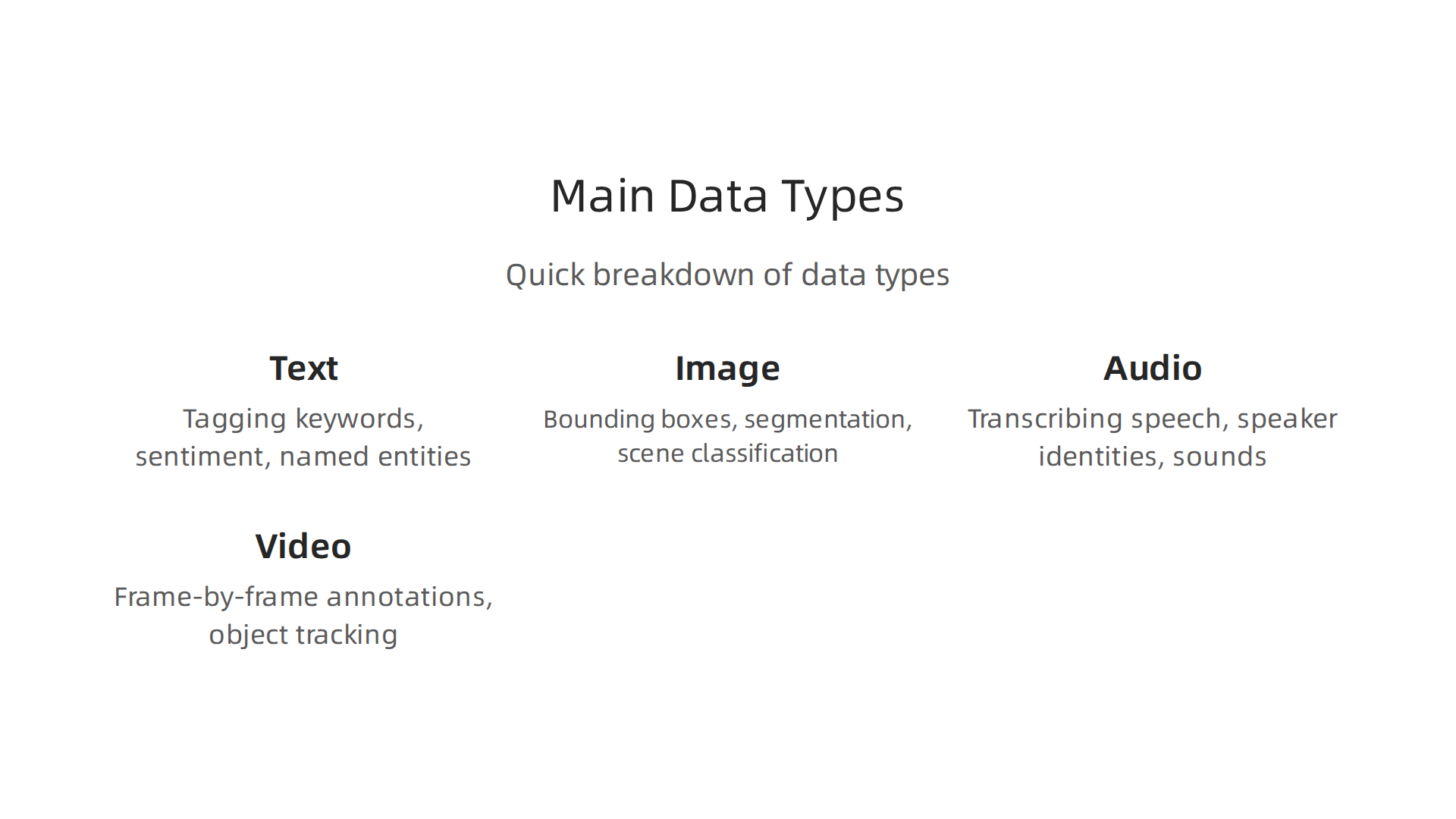
Here is a quick breakdown of the main data types you might work with:
| Data Type | What Annotation Looks Like |
|---|---|
| Text | Tagging keywords, marking sentiment (positive or negative), or identifying named entities like people and places |
| Image | Drawing boxes around objects (bounding boxes), labeling parts of an image (segmentation), or classifying the whole scene |
| Audio | Transcribing speech, tagging speaker identities, or marking specific sounds |
| Video | Applying image annotations frame by frame and tracking objects as they move |
Think of annotation as translation. You are translating the messy, unstructured world into a language that algorithms can read. This process is a core part of supervised learning, where models learn from labeled examples. Without those labels, the model has no way to know what is right or wrong. It is like trying to learn a new language without ever seeing a translation.
That is why the accuracy of your labels matters so much. When annotations are sloppy or inconsistent, the model learns bad habits. It starts seeing patterns that are not really there or missing the ones that are. As this guide on building reliable AI systems explains, high-quality annotation helps reduce errors and creates systems that behave predictably in the real world.

A model trained on garbage labels will produce garbage predictions, no matter how fancy the algorithm is.
If you are just getting started with the broader workflow, checking out this guide on mastering the data science process will help you see where data annotation fits in the bigger picture of building AI systems.
The bottom line is simple: clean labels lead to smart models. Messy labels lead to frustration. And every minute you spend getting the annotation right upfront saves you hours of debugging later.
The Critical Role of Data Annotation in AI Model Performance
Now that you know what data annotation tech is, let us explore how it directly shapes how well your AI model performs. Every label you add is a vote for what the model should learn. Get the labels right, and your model learns the right patterns. Get them wrong, and you are teaching your model bad habits that show up as poor precision and recall.
A model’s precision tells you how many of its positive predictions were actually correct. Recall tells you how many of the actual positives it managed to catch. Both depend on the accuracy of your training labels. When labels are inconsistent or incomplete, the model cannot reliably separate signal from noise. As Why Quality Dataset Annotation Is Key to Machine Learning explains, inaccurate annotations create unreliable training data that directly harms a model’s accuracy and ability to generalize to new situations.
Poor annotation also introduces bias. If your image dataset for a self-driving car mostly labels pedestrians with light skin tones but ignores others, the model learns a skewed version of reality. It might fail to detect pedestrians with darker skin.

That is not just a performance problem. It is a safety risk. The same goes for medical AI. If a tumor detection model is trained on scans where some malignancies were never labeled, it will miss cancers in real patients. Properly annotated, diverse data helps prevent these dangerous blind spots from forming in the first place.
The stakes are high, and the best way to improve model performance is to improve your data from the start. That is why human annotators and data specialists play such a vital role. To learn more about this growing demand, check out this piece on how data specialists are more critical than ever in the age of AI.
If you want to keep learning about how quality data drives better AI, staying informed is key. Join The Deep View Newsletter for simple daily AI insights. It is a quick way to stay up to date without the noise.
Accuracy vs. Scale Trade-offs
Here is a real tension in data annotation tech. You need lots of labeled data to train powerful models. But when you rush to label more data just to hit a larger volume, quality often drops. Bad labels slip in. That hurts accuracy.
Think of it like a factory. You can produce more units per hour, but if you cut corners on inspection, more defective products leave the line. In annotation, defects mean inconsistent labels that confuse your model. You end up with a lot of data, but not a lot of signal.
So how do you balance speed and quality? Two strategies help a lot.
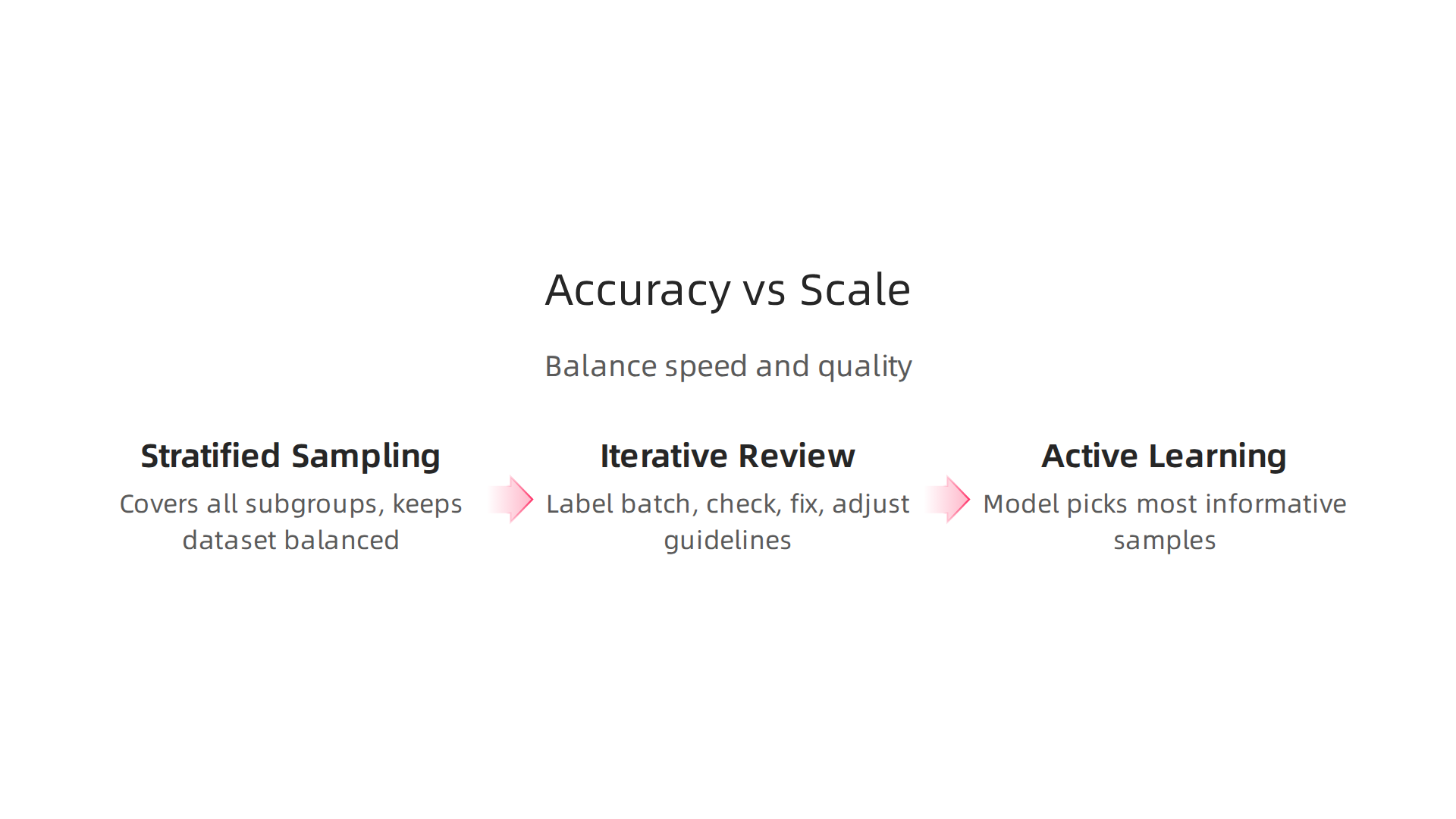
Stratified sampling means you make sure your annotation effort covers all the important subgroups in your data. Instead of labeling random chunks, you intentionally pull samples from each category you care about. This keeps the dataset balanced even when you scale up.
Iterative review means you do not label everything and call it done. You label a batch, check the accuracy, and fix mistakes before moving on. This cycle helps you catch drift early. It also lets you adjust annotation guidelines as you learn what types of data the model struggles with.
These approaches connect directly to the idea of annotation throughput versus consistency. Throughput is how many labels you produce per hour. Consistency is how often those labels agree with each other and with ground truth. Pushing throughput too high usually hurts consistency. Smart strategies like stratified sampling and iterative review let you keep consistency strong even as throughput grows.
One powerful method to manage this trade-off is active learning. Instead of labeling all your data, you let the model pick which samples would teach it the most. That way you focus expert annotators on the hardest or most uncertain cases. As this guide on human-in-the-loop annotation for accurate models explains, active learning can cut the number of labels you need by 50 to 80 percent while keeping model performance high. You get better accuracy with less wasted effort.
If you want to dig deeper into the data science workflows that make this possible, check out this guide to mastering the data science process. It walks you through the full pipeline from raw data to deployed model.
Key Data Annotation Techniques and Technologies in 2026
Now let us look at the main methods people use to label data in 2026. The landscape has three broad buckets: manual annotation, automated pre-labeling, and semi-supervised approaches.
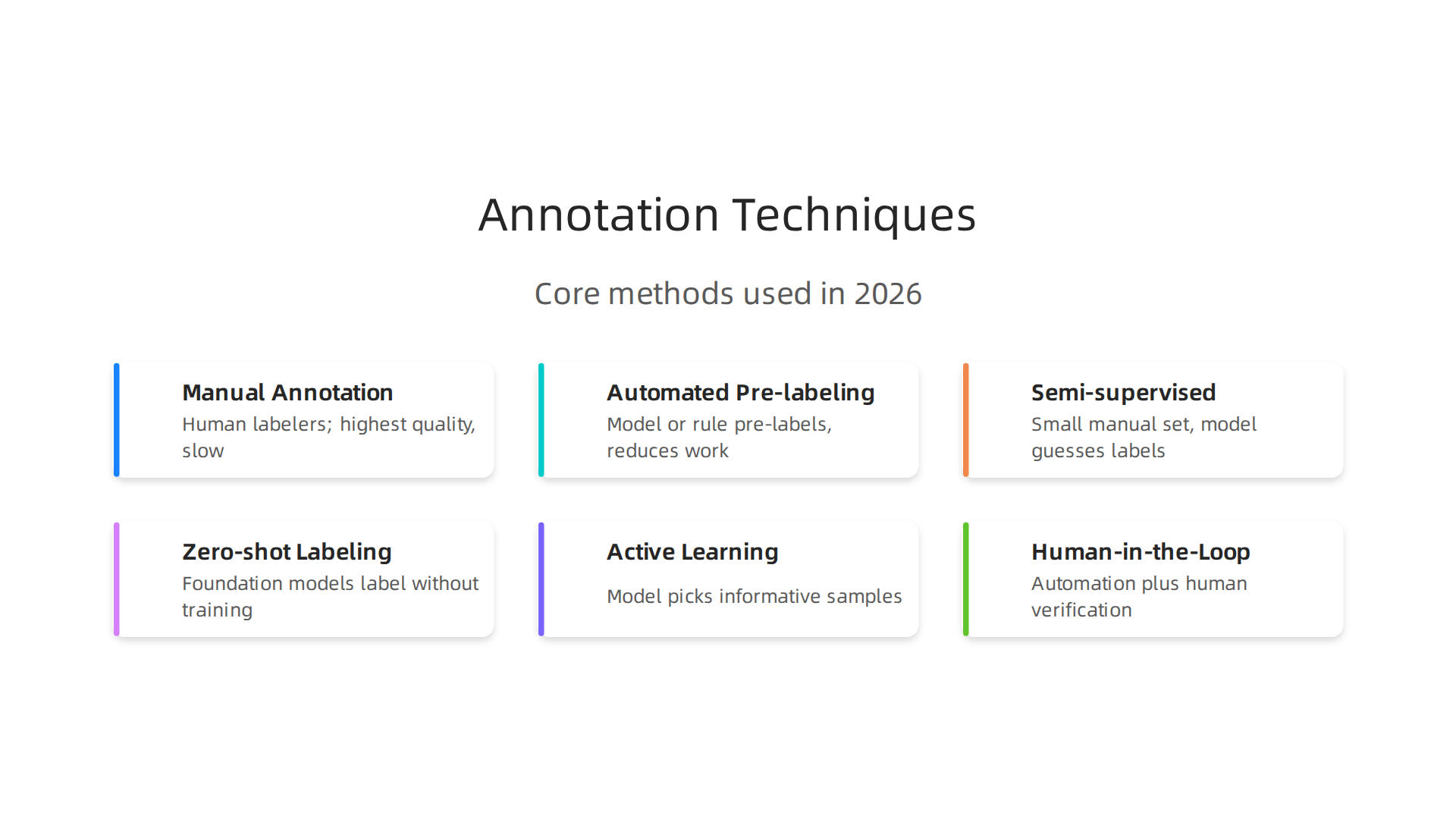
Manual annotation is the oldest method. Human annotators look at each data point and assign labels by hand. It is slow and expensive, but it gives the highest quality when done right. Many teams still use manual annotation for small datasets or for edge cases where mistakes matter most.
Automated pre-labeling uses rules, patterns, or weak models to generate labels without human input. For example, regex patterns can label documents quickly. The 2026 data labeling guide for enterprises explains how organizations combine AI-assisted processing with human-in-the-loop verification to reach accuracy levels that neither humans nor machines achieve alone. This blend reduces the total amount of manual work.
Semi-supervised approaches fall in between. You start with a small set of high-quality manual labels, then let a model guess labels for the rest of the data. You review only the guesses the model is least sure about.
In 2026, foundation models have changed everything. Models like GPT-4 and its successors can do zero-shot labeling. This means you give them a prompt describing the label categories, and they label new data without any prior training examples. Zero-shot labeling is fast but not always reliable. It works best for simple tasks and gets tricky with complex or domain-specific labels.
Active learning remains a core part of the best systems. As this guide on active learning machine learning for reducing labeling costs points out, active learning can cut labeling effort by 30 to 70 percent. The model picks which data points to send to human annotators. This way, humans only work on the hardest or most informative samples.
Human-in-the-loop systems bring it all together. They combine automation with human judgment at key decision points. The machine handles the easy, high-volume labeling. The human steps in for edge cases, validation, and corrections. Research on efficient human-in-the-loop active learning frameworks shows that this method can achieve high performance with far fewer manual labels than random sampling.
Data annotation tech moves fast, and what worked last year may already be outdated. That is why data specialists are more critical than ever in the age of AI. They bridge the gap between raw data and smart models.
For simple daily insights on top of the AI world, including new annotation tools and workflows, join Your Daily AI Shortcut which delivers quick, useful updates straight to your inbox.
Manual vs. Automated Annotation
When you look at data annotation tech, the first big choice is manual versus automated. Manual annotation relies on human labelers. It is slow and expensive but delivers the highest quality for complex or sensitive data. Automated annotation uses rules, pattern matching, or AI models to label data fast and at scale. It saves time but can introduce errors, especially with subtle or domain-specific content.
Most teams in 2026 find the best results by blending both. A hybrid approach sends straightforward data to automated pipelines and routes tricky cases to human reviewers. For text annotation, large language models (LLMs) can handle simple categorization automatically, while humans handle ambiguous or nuanced text. As the 2026 data labeling guide for enterprises explains, combining AI-assisted processing with human-in-the-loop verification reaches accuracy levels that neither humans nor machines achieve alone.
The goal is not to pick one method over the other. It is to use the right tool for each part of your driven data pipeline. A smart intelligence analyst knows when to trust automation and when to bring in human eyes. If you want to understand how annotation fits into the bigger picture, check out this guide to mastering the data science process.
Active Learning and Human-in-the-Loop
So how do you decide which data points need human eyes and which ones automation can handle? That is where active learning comes in. Instead of labeling everything at random, the model itself tells you which samples it is most unsure about. It scores each unlabeled data point by how much information that sample would add. Then it sends only the highest scoring items to a human annotator. As this guide on active learning for reducing labeling costs explains, this targeted approach can cut annotation effort by 30 to 70 percent while maintaining the same model performance.
Think of it like studying for a test. You would not reread every page of your textbook. You would focus on the chapters you understand the least. Active learning does the same thing for your driven data pipeline.
Human-in-the-loop is the quality check that runs alongside active learning. Every time the model flags an uncertain sample, a real person reviews it. This catches edge cases, corrects mistakes, and handles tricky scenarios that automation misses. The loop runs continuously: the model predicts, the human verifies, the training set grows, and the model improves.

An intelligence analyst overseeing this workflow sees accuracy climb faster because every annotation actually moves the needle.
If you want to stay updated on how AI annotation workflows are evolving, check out this guide on AI-powered learning platforms for 2026. And for a quick daily briefing on AI trends that affect your annotation strategy, join The Deep View Newsletter for simple insights you can use right away.
Data-Driven Principles: Ensuring Quality and Consistency
Active learning and human-in-the-loop get you a lot of mileage. But once the annotations start rolling in, you need a way to measure whether they are actually any good. That is where data annotation tech comes into play: tools and processes that help you track quality at scale. The core idea is simple: treat annotation like any other data pipeline and use metrics to guide improvements.
The most important quality metric is inter-annotator agreement (IAA) . IAA measures how often two or more annotators give the same label to the same piece of data.
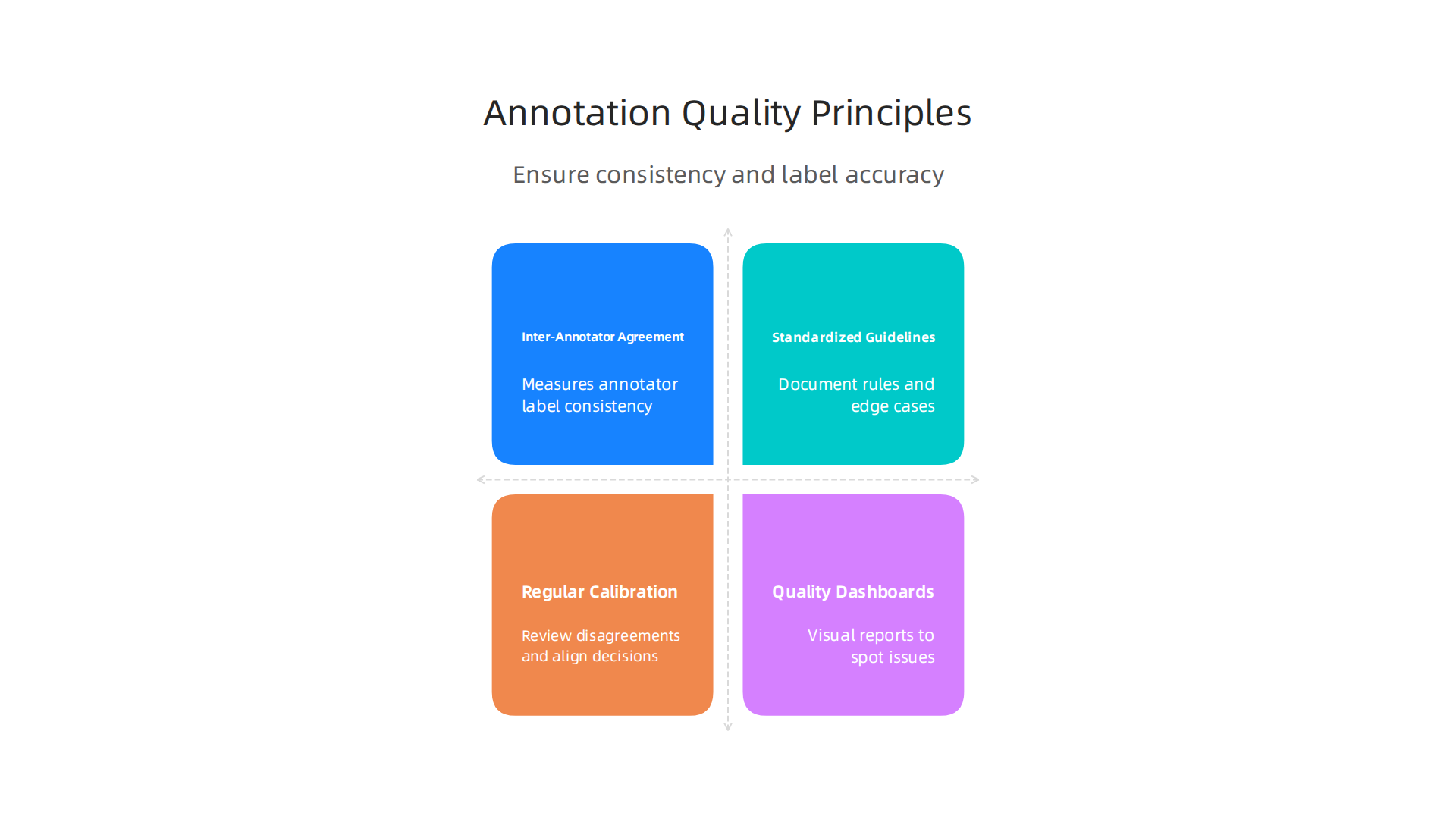
If your annotators disagree a lot, your training data is inconsistent, and your model will learn those contradictions. As this guide on inter-annotator agreement as a key quality metric explains, common statistical measures like Cohen’s Kappa and Krippendorff’s Alpha help you quantify agreement. A score above 0.8 usually means strong reliability. When you see lower scores, it is a sign that your annotation guidelines need clarification.
That brings us to the second principle: standardized annotation guidelines. Vague instructions create variance. Every edge case, every ambiguous label, every borderline decision should be documented in a living rulebook. Annotators need to read the same instructions and apply them the same way. Regular calibration sessions where annotators review disagreements together help keep everyone on the same page. Over time, this reduces noise in your driven data and boosts model accuracy.
Many teams track these metrics using dashboards built in tools like Google Data Studio. You can set up visual reports that show per-label agreement, per-annotator drift, and trend lines over time. An intelligence analyst reviewing these dashboards can spot problem areas quickly: maybe one label category consistently scores low, which means the guidelines for that category are ambiguous. Fix the guidelines, not the annotators.
If you want to go deeper on how human experts fit into this picture, check out this guide on why data specialists are more critical than ever in the age of AI. Quality annotation is a team sport, and the right metrics keep everyone playing the same game.
Quality Metrics and Inter-Annotator Agreement
Now that you understand why IAA matters, let us look at the specific metrics you should track. The most common one is Cohen’s Kappa. It measures agreement between two annotators while adjusting for chance. So if two people label 100 images, Cohen’s Kappa tells you how much they agree beyond random guessing. This is especially useful for binary tasks like marking whether a photo contains a cat or not.
Another metric is Fleiss’ Kappa. This works when you have more than two annotators. It handles multiple raters at once and is great for complex labeling projects where many people annotate the same dataset. As the Inter-annotator Agreement glossary explains, Fleiss’ Kappa is suitable for categorical data with multiple raters.
Simple percentage agreement is the easiest metric. You just count how many items all annotators labeled the same way. But this metric does not account for chance agreement, so it tends to overestimate quality. Use it as a quick check, but trust Cohen’s or Fleiss’ Kappa for real decisions.
So what thresholds should you aim for? It depends on task complexity. For straightforward tasks like binary classification, an IAA above 0.8 is strong. For tough tasks like medical image segmentation, scores around 0.6 to 0.7 might be acceptable. The key is to set your target based on the difficulty of the work.
To calibrate annotators, use gold standard datasets. These are small groups of items already labeled by experts.

Annotators label these items first, and you compare their results to the expert labels. If someone misses the mark, you retrain them or clarify the guidelines. This approach catches drift early and keeps your data annotation tech pipeline running smoothly. For a deeper look at building reliable data workflows, check out this guide on mastering the data science process.
For more practical insights on using data annotation tech to build better models, join our daily newsletter for AI professionals in 2026. Your Daily AI Shortcut
The Data Annotation Tech Landscape: Tools and Platforms
The data annotation tech market is growing fast in 2026. Industry reports show the global data annotation tool market could reach $14.26 billion by 2034, with yearly growth above 26%. This surge comes from AI demand across healthcare, self-driving cars, and finance. So what tools should you consider?
Open-source vs. commercial platforms. Open-source tools like CVAT give you full control and zero licensing costs. They work well if your team has strong technical skills and wants to customize every step. But you miss out on built-in support, quality dashboards, and enterprise security. Commercial platforms like Scale AI, Appen, and Labelbox offer polished, all-in-one experiences. They include collaboration features, version control, and automation tools ready from day one. According to the Data Annotation Tool Market report for 2026, cloud-based tools hold about 60% of the market because they scale easily and support remote teams.
Key features to look for. Real-time collaboration lets multiple annotators work without stepping on each other’s work. Version control tracks every change so you can roll back if needed. Automation integration handles repetitive tasks like pre-labeling, which saves your team hours. Quality assurance dashboards give you live IAA scores so you catch drift early.
Market trends in 2026. Two big shifts are happening. First, consolidation. Large players like Scale AI are buying smaller tools to create end-to-end solutions. Second, specialization by domain. Autonomous vehicle teams need LiDAR and video annotation tools. Healthcare teams require DICOM image labeling with HIPAA compliance. Even agricultural AI has its own annotation needs. This specialization means you can now find a platform built exactly for your industry.
If you are setting up a driven data pipeline for the first time, understanding this landscape helps you pick the right foundation. For a broader look at building data workflows, check out this guide on choosing data analysis tools for AI professionals.
Comparison of Leading Annotation Platforms
Now let’s compare the top platforms head to head. Based on the latest data, here is how five leading tools stack up for your data annotation tech needs.
| Platform | Best For | Key Strength |
|---|---|---|
| Scale AI | Large enterprises | Biggest market share at 16% with deep automation |
| Surge AI | Frontier LLM alignment | RLHF and preference ranking for top labs |
| iMerit | Regulated industries | Credentialed domain specialists like pathologists |
| Labelbox | Mid-market teams | Polished interface with built-in quality dashboards |
| Toloka | Quick crowdsourcing | Low-cost text tasks at high volume |
Scale AI leads the pack in revenue and recently partnered with Meta. If you need enterprise-grade scale and automation, it is a safe bet.
Surge AI focuses on LLM alignment work. Top labs including OpenAI and Google use it for aligning frontier models. The top data annotation companies in 2026 list from Lightly AI confirms Surge’s leadership in this niche.
iMerit uses board-certified specialists for healthcare and autonomous vehicle data. This matters when accuracy is non-negotiable.
Labelbox gives you a clean, easy-to-learn interface with strong version control. It works well for teams that want to get started fast.
Toloka is the budget option. It handles simple text tasks at scale without breaking your budget.
Watch out for vendor lock-in. Many platforms store your labeled data in proprietary formats. If you want to switch tools later, you might lose your work. Always ask about data export policies before you commit.
Our recommendations:
- Small teams or startups: Start with Labelbox or Toloka to keep costs low.
- Mid-size companies building driven data pipelines: Try Surge AI for LLM work, or iMerit for regulated healthcare data.
- Large enterprises: Scale AI handles volume, compliance, and multi-modal annotation well.
For a broader look at building your data career, check out this guide on landing remote data analyst jobs in 2026.
And if you want a quick daily update on AI tools and trends, Your Daily AI Shortcut delivers simple daily insights straight to your inbox.
Best Practices for Implementing Data Annotation Pipelines
Choosing the right platform is only half the battle. The real success of your data annotation tech comes from how you build the pipeline around it. Even the best tool fails if your process is messy. Here are three practices that separate good projects from great ones.
Start with clear annotation guidelines that evolve. Your guidelines are the single most important piece of your pipeline. They must define every class, boundary rule, and edge case with text and visual examples. Think of them as a living document. Update them constantly as you discover new edge cases. The Annotera guide on data annotation accuracy shows that ambiguous rules are the top reason labels become inconsistent. Spend extra time here upfront.
Invest in annotator training and regular audits. Your annotators need more than one day of training. Run calibration sessions where everyone labels the same 20 items and you compare results. Discuss disagreements as a group. Then do periodic audits to catch drift. The Scale AI guide on data labeling best practices recommends using benchmark tasks mixed into the workflow to measure quality over time. This catches problems before they poison your model.
Use version control and metadata tracking for reproducibility. In 2026, driven data pipelines demand full traceability. You need to know who labeled what, when, and under which guidelines version. Track metadata like annotator ID, project round, and confidence scores. This helps you debug model failures later. It also makes your work reproducible for audits or regulatory checks. If you want to see how this fits into a bigger workflow, check out this guide on mastering the data science process.
Following these practices will save you from re-labeling entire datasets. Start with solid guidelines, train your team, and track everything. Your model will thank you.
Summary
This article explains data annotation tech—the process of labeling raw text, images, audio, and video so machine learning models can learn from examples—and shows why high-quality labels are the foundation of reliable AI. It covers core annotation methods (manual, automated pre‑labeling, and semi‑supervised), modern workflows like active learning and human‑in‑the‑loop, and how those choices affect model accuracy, bias, and safety. You’ll learn practical trade-offs between scale and quality, which metrics to track (for example inter‑annotator agreement and Cohen’s Kappa), and how to set up reproducible pipelines with clear guidelines, training, and version control. The guide also compares leading platform types and recommends process-focused best practices so you can choose tools, measure annotation quality, and build a driven data pipeline that improves model performance while controlling cost and risk.