

Introduction
You know that feeling. You see job postings demanding data analysis skills everywhere. AI is changing industries fast, and companies need people who can actually make sense of all that information. But when you search for certifications, the options feel endless. Google Data Analytics Professional Certificate. IBM Data Analyst Professional Certificate. CompTIA Data+. Microsoft Certified Power BI Data Analyst Associate. The list keeps going.
Here is the thing. The rapid rise of AI has made data analysis skills more critical than ever for career growth and organizational success. According to recent industry analysis, professionals with validated analytics expertise are in high demand across nearly every sector. But that is only true if you pick the right certification for your goals.
So how do you choose?
The sheer number of certifications and courses creates real confusion.

You might wonder if you should focus on data collection methods first or jump straight into a tool-specific course. Maybe you have considered exploring information science as a broader field. Others look into the best online data science courses hoping to find a shortcut. The problem is not a lack of options. The problem is a lack of clarity.
That is where this guide comes in.
This article provides a research-backed roadmap to selecting and pursuing data analysis certifications in 2026. We looked at trusted sources. We compared programs by cost, time commitment, skill level, and career outcomes. Whether you are just starting out or looking to level up, you will find a clear path forward here.
If you want to understand how top tech companies structure their data roles, check out our guide on how to become a Meta data scientist in 2026 and beat information overload. It gives you a practical look at what employers actually want.
And if you are still deciding which tools to learn, our breakdown of how to choose data analysis tools in 2026 for AI professionals can help you match the right platform to your career goals.
Ready to cut through the noise and find your certification? Let us get started.
Why Data Analysis Certifications Matter in the Age of AI
Here is the truth about AI in 2026. Every smart model, every clever chatbot, every predictive tool runs on one thing: data. But not just any data. It needs clean, well-organized, and properly analyzed data. Without skilled humans behind the scenes, even the most advanced AI is just a fancy calculator with bad inputs.
That is where data analysis comes in. It is the backbone of everything AI does. Think about it. A machine learning model learns from the data you feed it. If that data is messy or biased, the model learns the wrong lessons. According to recent research, the demand for data analysis skills is skyrocketing because organizations realize that AI success depends on quality data and human interpretation.

You cannot just set it and forget it. You need people who know how to collect, clean, and question the numbers.
Data analysis starts with good data collection methods. Without a solid plan for gathering information, your entire analysis falls apart. And to make sense of it all, you need to understand information science how data flows, stores, and connects. These are the foundations that every certification program should teach.
So where do certifications fit in? They act as a signal. In a crowded job market, a certification tells employers, "This person knows what they are doing." It is a standardized proof of competence. The best data analytics certifications in 2026 are designed to test real skills, not just textbook knowledge.
They cover everything from SQL and Python to statistical thinking and data storytelling.
Employers are paying attention. Many job postings now list certifications as either preferred or required, especially for roles on AI teams. A review of popular data analytics certifications shows that programs from Google, IBM, and Microsoft are widely recognized by hiring managers.
And if you are wondering what skills to focus on, the core stack in 2026 includes strong SQL, Python, and a basic grasp of machine learning concepts.
Certifications also help you stand out when you are switching careers. If you come from a different field, a certification shows you have made the effort to learn the trade. Pair that with your transferable skills like analytical thinking and problem solving, and you become a strong candidate. Many professionals turn to the best online data science courses to build these skills, but a certification adds that formal validation employers want.
For a real-world look at how top companies like Meta structure their data teams and what they look for in candidates, check out our guide on how to become a Meta data scientist in 2026 and beat information overload. It gives you a behind-the-scenes view of the skills and certifications that actually matter in a big tech environment.
The bottom line is this. AI is not going to replace data analysts. It is going to make them more valuable. But only if they have the right credentials to prove they can handle the responsibility. A certification is your ticket to being taken seriously in a world that runs on data.
Top 10 Data Analysis Certifications for AI Professionals in 2026
So you know why a certification matters. Now comes the hard part: picking the right one. With dozens of options out there, the choice can feel overwhelming. To make it easier, I have rounded up the top 10 data analysis certifications that AI professionals should consider in 2026. They fall into two buckets: vendor-neutral certifications that focus on core methodology, and platform-specific ones that teach you a particular tool or cloud ecosystem.
The table below gives you a side-by-side comparison of cost, time, and best use case.
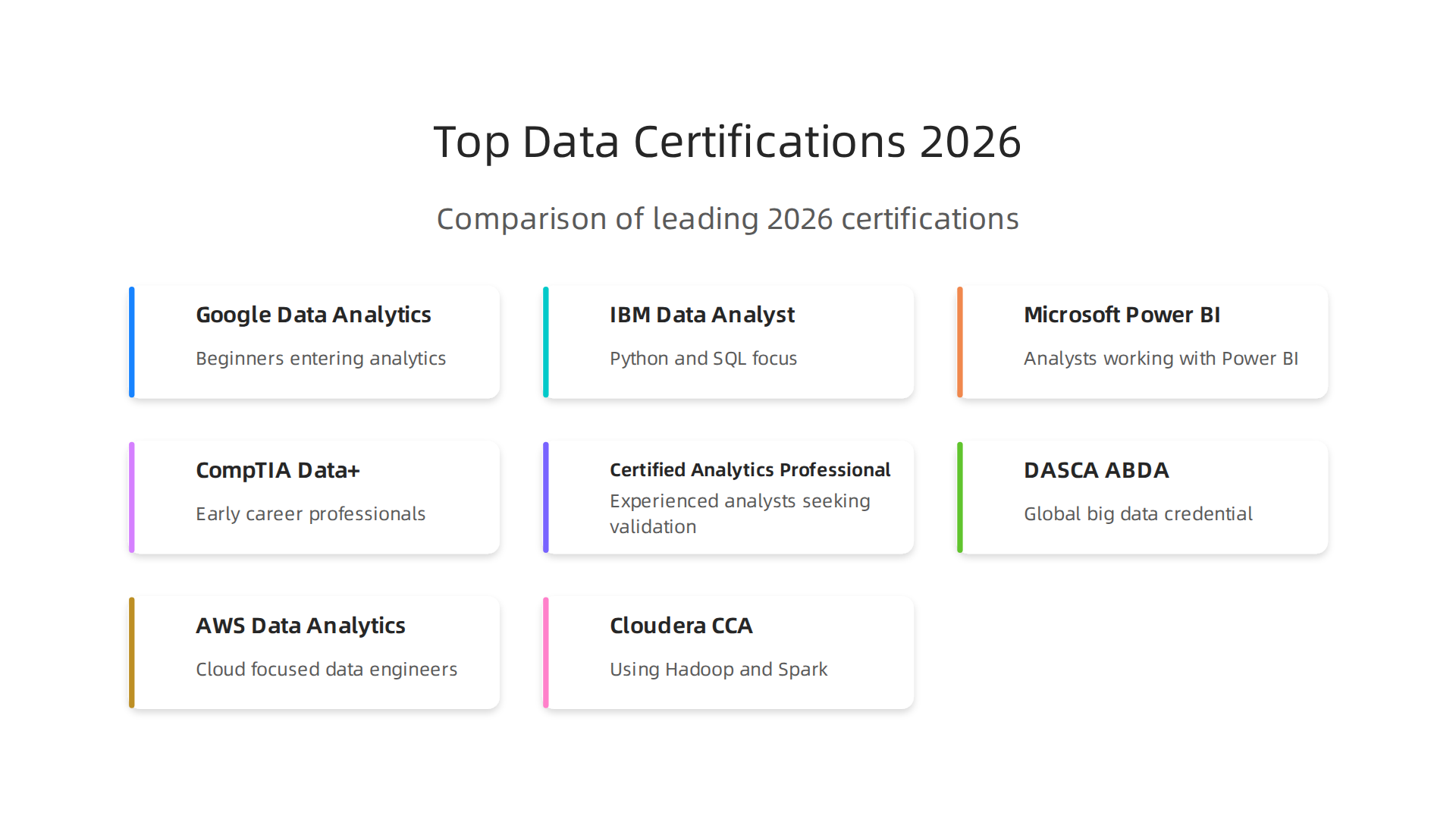
Use it as your starting point. After the table, I break down how to choose based on your career goals.
Data Analysis Certification Comparison (2026)
| Certification | Vendor / Type | Approximate Cost | Time Commitment | Best For |
|---|---|---|---|---|
| Google Data Analytics Professional Certificate | Google (platform specific) | $49/month (Coursera) | 3-6 months | Beginners entering analytics |
| IBM Data Analyst Professional Certificate | IBM (platform specific) | $39/month (Coursera) | 2-6 months | Beginners who want Python and SQL focus |
| Microsoft Certified: Power BI Data Analyst Associate | Microsoft (platform specific) | $165 exam fee | 2-3 months | Analysts working with Power BI |
| CompTIA Data+ | CompTIA (vendor neutral) | $246 exam fee | 3 months | Early career professionals needing a strong foundation |
| Certified Analytics Professional (CAP) | INFORMS (vendor neutral) | $495 exam fee | 4-6 months | Experienced analysts seeking senior validation |
| DASCA Associate Big Data Analyst (ABDA) | DASCA (vendor neutral) | $500-$700 (exam + materials) | 6-12 months | Professionals aiming for global big data credential |
| AWS Certified Data Analytics Specialty | Amazon (platform specific) | $300 exam fee | 2-3 months | Cloud focused AI and data engineers |
| Cloudera Certified Associate (CCA) Data Analyst | Cloudera (platform specific) | $295 exam fee | 2-3 months | Data professionals using Hadoop and Spark |
| SAS Certified Data Scientist | SAS (vendor specific) | $180 exam fee | 3-6 months | Statistically minded analysts in enterprise settings |
| PW Skills Data Analytics with AI Course | PW Skills (hybrid) | ₹6,000 (roughly $75) | 3 months | Budget conscious beginners in India |
A quick note on sources. The costs and timeframes above come from reviews by Dataquest and Coursera, which regularly update their comparisons. The Certified Analytics Professional remains the gold standard for vendor neutral methodology, while the DASCA certification holds weight for global big data roles.
How to Choose the Right Certification for You
Your choice should depend on three things: your current skill level, your budget, and where you want to work.
For total beginners: The Google Data Analytics Professional Certificate is still the best entry point in 2026. It covers the full pipeline from collection to presentation. The IBM Data Analyst Professional Certificate is a close second, especially if you want hands on Python projects. Both are affordable and self paced.
For mid career analysts: If you already know SQL and basic statistics, go for a platform specific certification like Microsoft Power BI or AWS Data Analytics. These validate practical tool skills that hiring managers love. The CompTIA Data+ is a solid vendor neutral option if you want to prove you understand the fundamentals without being tied to one tool.
For senior AI professionals: The CAP or DASCA credentials show you can handle complex, cross functional analytics. They test methodology, not just tool clicks. If you are aiming for a data science lead role at a company like Meta, these carry weight. Speaking of that, our guide on how to become a Meta data scientist in 2026 breaks down exactly what certifications the top tech employers look for.
Beyond the Certificate: Skills That Stick
Certifications open doors. But they only work if you actually learn the material. The best certification programs teach strong data collection methods and a solid grasp of information science how data is stored, connected, and queried. Without these foundations, you will struggle in real world AI projects.
I recommend pairing any certification with hands on practice. Build a portfolio with real datasets. Write SQL queries daily. Use Python to clean messy spreadsheets. Many of the best online data science courses include capstone projects that give you this experience. A certification plus a portfolio is a powerful combination.
Now that you have a clear picture of the top 10 options, you can make a smart choice. Next, let us look at how to prepare effectively for your chosen exam.
What to Look for in a Data Analysis Certification Program
You have your list of top certifications. But how do you know which one will actually deliver value? Here is the truth. Not every certification program is built the same. Some teach you real skills. Others just teach you how to pass a test. Before you spend your time and money, you need to evaluate each program carefully.
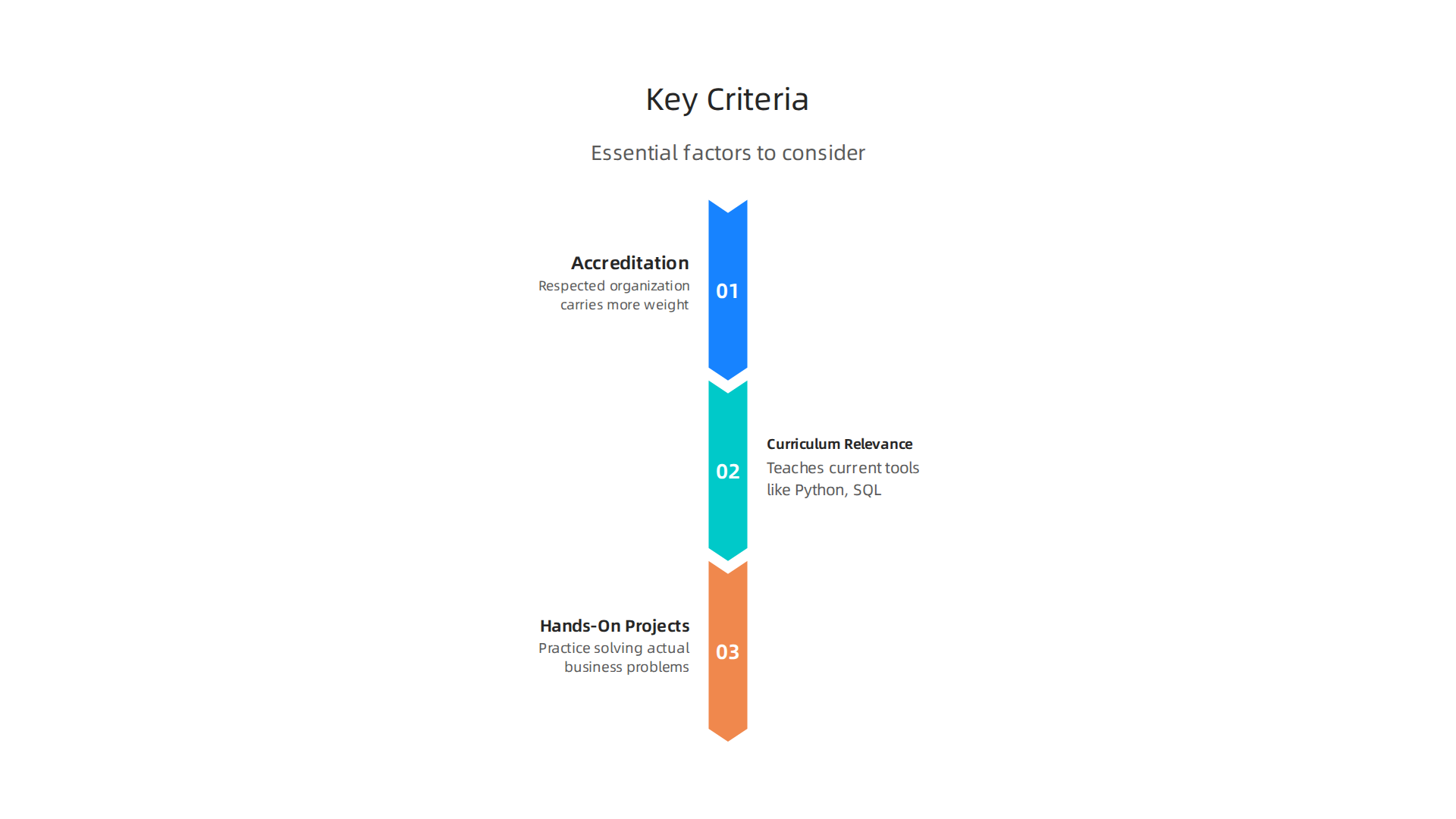
Here are the three most important things to look for.
Accreditation and Industry Backing
First, check who stands behind the certification. A credential from a respected organization carries more weight with employers. Programs backed by major tech companies or professional bodies have better longevity. They update their content regularly. They do not disappear after a year.
For example, the DASCA certification is benchmarked against global standards.
Employers worldwide recognize it. The CompTIA Data+ is vendor neutral and trusted by hiring managers across industries. When a certification has real institutional backing, it signals that the program meets a certain quality bar. It also means the curriculum has been reviewed by industry experts.
Look for certifications that have been around for a while or come from organizations with a strong track record. Avoid new, unproven programs with no clear sponsor.
Curriculum Relevance to Modern Tools
Here is the thing. A certification that teaches outdated tools is a waste of time. In 2026, the core toolkit for data analysis includes Python, SQL, and cloud platforms like AWS or Google Cloud. If a program does not cover these, keep looking.
The best programs focus on practical, current skills. They teach you how to clean data with Python. They show you how to query databases with SQL. They give you experience with real world datasets. The Google Data Analytics Professional Certificate and the IBM Data Analyst Professional Certificate both cover these essential tools. They are updated frequently to match what employers actually need.
Also pay attention to how the program teaches data collection methods and information science concepts. You need to understand how data moves from source to insight. Programs that focus only on one tool can leave you with gaps in your knowledge.
If you are still deciding which tools to focus on, check out our guide on how to choose data analysis tools in 2026 for AI professionals. It breaks down which tools match different career paths.
Hands-On Projects and Real-World Case Studies
You cannot learn data analysis by just watching videos. You have to do it. The best certification programs include hands on projects, capstone assignments, and real world case studies. These give you practice solving actual business problems.
Why does this matter? Because employers want to see what you can do, not just what you know. A portfolio of projects from your certification proves you have applied the skills. Many of the best online data science courses include these practical elements. The Dataquest platform is built entirely around hands on learning with real datasets. The PW Skills Data Analytics with AI Course includes industry projects that help you build experience while you learn.
When you evaluate a program, look for details about projects. Ask yourself: Will I get to write real code? Will I work with messy, real world data? Will I create dashboards or reports that I can show to employers? If the answer is no to any of these, think twice.
A good rule of thumb is to pair your certification with independent practice. Use the skills you learn to analyze datasets you find online. Build a portfolio on GitHub. This combination of a strong certification and a solid portfolio is what sets you apart.
One More Thing to Watch For
Do not just look at the certificate. Look at what you will actually learn. Some programs promise a lot but deliver very little. Read reviews from people who have completed the program. Check platforms like Reddit or LinkedIn for honest feedback.
Also consider the time commitment. A program that claims to teach you everything in two weeks is probably skipping important depth. Quality takes time. The programs listed in the comparison table earlier range from two to twelve months for a reason. That time investment leads to real understanding.
Start Your Journey Today
Now you know what to look for. Accreditation shows credibility. A modern curriculum teaches the right tools. Hands on projects build real skills. Use these three criteria to evaluate every certification you consider.
Your next step is to pick one program and start learning. The Data Analyst Roadmap 2026 from Codebasics can help you plan your learning path step by step. Combine it with the right certification and you will be ready for your next role faster than you think.
Curriculum Deep Dive: Core Competencies for Modern Data Analysts
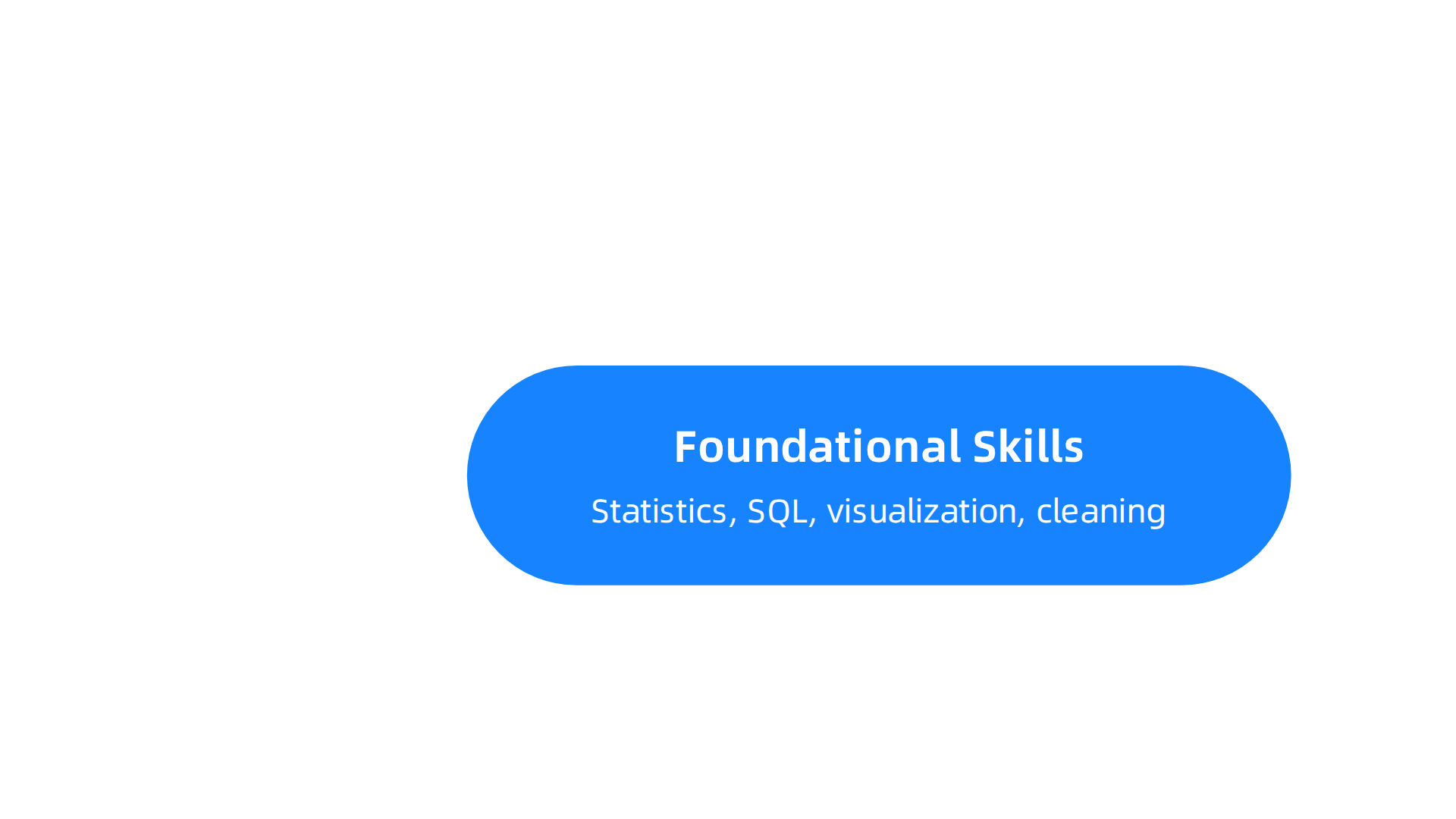
Now you know how to pick the right certification program. But what skills will you actually learn? Every solid data analysis certification covers three buckets of skills.
You need all three to succeed in 2026.
Foundational Skills
Every data analyst needs a strong base. This starts with statistical analysis. You must understand averages, distributions, and probability. You also need SQL. SQL is the universal language for pulling data from databases. The UAGC guide on data analytics skills calls SQL a must-have for any business professional.
Next comes data visualization. You need to turn numbers into charts and dashboards that tell a story. Tools like Tableau or Power BI help with this. And do not forget data cleaning. Real world data is messy. You must know how to fix missing values, remove duplicates, and standardize formats.
These foundational skills also cover data collection methods. You have to know where data comes from and how to gather it properly. This ties into information science concepts about organizing and managing data. The SkyVia comparison of top certifications shows that most programs teach these core areas first.
Advanced Skills
Once you have the basics down, you move to advanced skills. In 2026, machine learning fundamentals are becoming important for many data analysts. You do not need to be a data scientist, but you should understand basic models like regression and classification.
Big data tools are also on the rise. Tools like Spark and Hadoop let you work with massive datasets. Cloud analytics platforms like AWS, Google Cloud, and Microsoft Azure are now standard. The Microsoft Learn data analyst path covers cloud-based tools and is a great example of what to look for.
If you are wondering which tools to focus on, check out our guide on how to choose data analysis tools in 2026 for AI professionals. It helps you match tools to your career goals.
Soft Skills
Technical skills are only half the story. You also need soft skills. Business acumen helps you understand what stakeholders actually need. Communication lets you explain your findings clearly to non-technical teams. And ethical data use is more important than ever. You must know how to handle sensitive data, avoid bias, and follow privacy rules.
The IIBA Certification in Business Data Analytics focuses on this combination of analytical and business skills. Many best online data science courses also include modules on ethics and communication.
When you build all three buckets, you become a well-rounded data analyst. That is what employers want in 2026.
How Employers View Data Analysis Certifications: Salary & Demand Insights
You have learned what skills certifications teach. But does that piece of paper actually help your career? The short answer is yes. In 2026, employers see data analysis certifications as proof that you can do the job. And they are willing to pay more for it.

Certified professionals earn more
Let us talk money. According to a 2026 salary report from Robert Half, holding a relevant certification can boost your pay by 10 to 20%. Another study by SkillUp found that salary premiums range from 10% to 25% depending on the credential. That is a huge difference.
What does that look like in real numbers? A Skillify analysis of data analyst salaries in 2026 shows mid-level analysts earning around $97,000 per year. With a certification, that could jump to over $115,000. For entry level roles, the range is about $58,000 to $81,000. A certification helps you start at the higher end.
Demand is booming in key industries
Certifications also open doors in the fastest growing sectors. Healthcare, finance, and technology are leading the pack. These industries rely on data for everything from patient outcomes to fraud detection to product recommendations. Employers in these fields often list a data analysis certification as a preferred or required qualification. StarAgile calls this demand a "direct result of the growing importance of data-driven decision-making."
If you want to work in one of these high growth areas, a certification can be your ticket. For example, understanding data collection methods and information science is critical in healthcare, where data accuracy and privacy rules are strict. Certifications that teach these topics make you more attractive to hospital systems and insurance companies.
Certifications unlock senior roles
Beyond salary and demand, certifications help you climb the ladder. They signal to employers that you have gone the extra mile. Many companies use certifications as a filter for senior analyst and specialized positions. For instance, the IIBA Certification in Business Data Analytics (CBDA) is designed for professionals who want to bridge the gap between data and business strategy. That is exactly what gets you promoted from junior to senior.
If you are aiming for a top tier role like a data scientist at a major tech company, check out our guide on how to become a Meta data scientist in 2026 and beat information overload. It covers how certifications fit into that path.
The bottom line
Employers in 2026 want proof, not promises. A data analysis certification gives you that proof. You earn more, you get noticed by fast growing industries, and you qualify for better roles. Whether you are just starting or looking to move up, the numbers are clear: certification pays off.
From Certification to Career: Advancing Your Data Analysis Role
So you have a certification in your hand. Or maybe you are close to finishing one. Now what? A certification is a great start, but it is just one piece of the puzzle. In 2026, the people who move up fastest are the ones who combine formal learning with real work. Let us talk about how to turn that credential into an actual career boost.
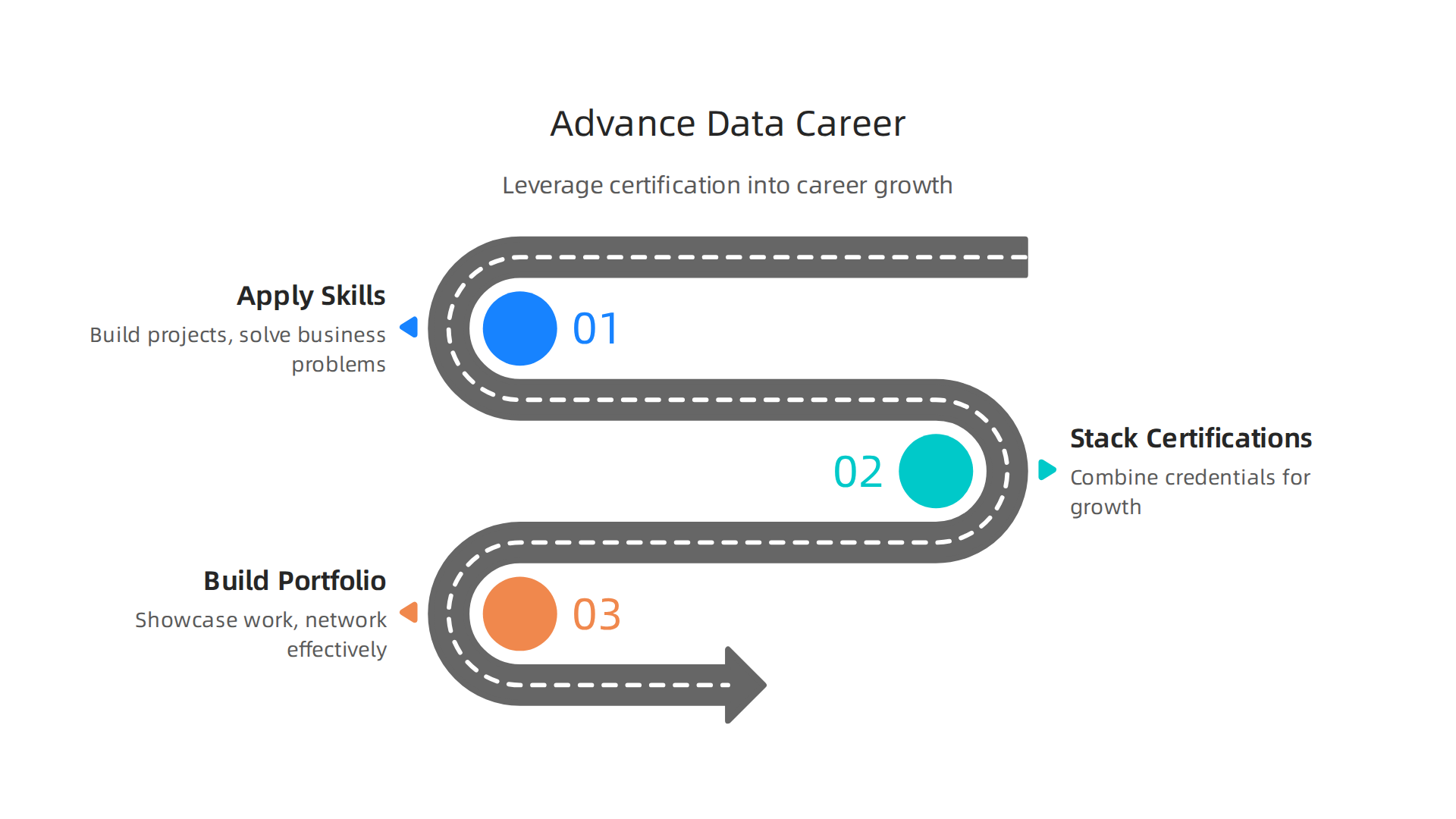
Apply your skills with real projects
Here is the thing. Certifications teach you the theory. They cover data collection methods, information science, and the core concepts behind data analysis. But employers want to see that you can use those skills in the real world. The best way to prove it is by building projects.
Think about it this way. A hiring manager sees two candidates. Both have a Google Data Analytics certification. But one also has a portfolio with three projects. That person wins every time. Why? Because projects show you can handle messy data, draw insights, and communicate findings.
You do not need a fancy job to build projects. Use public data sets from government websites or platforms like Kaggle. Analyze trends in your own hobbies. Volunteer to help a local business with their numbers. Each project becomes a story you can tell in an interview. As the 2026 data analyst salary trends from Robert Half show, skills plus certification lead to higher pay. Projects prove you have those skills.
Stack certifications to accelerate your growth
Another smart move is to stack multiple credentials. Start with a beginner friendly certification like Google Data Analytics. That gives you a solid base in data analysis and data collection methods. Then add a more specialized one, like AWS Certified Data Analytics, to show cloud skills. This combination makes you stand out in a crowded field.
The numbers back this up. A SkillUp analysis found salary premiums of 10% to 25% for certified professionals. Stacking gets you on the higher end. Plus, it signals to employers that you are serious and willing to invest in yourself. If you are eyeing a role at a company like Meta, check out our guide on how to become a Meta data scientist in 2026 and beat information overload. It covers exactly how stacking certifications fits into that path.
Build a portfolio and network the right way
Your certification goes on your resume. But your portfolio goes in front of hiring managers. Create a simple website or a GitHub profile that shows your best work. Include clear explanations of what you did and what you learned. This is where concepts from information science come to life.
When choosing what tools to use for your portfolio, make smart choices. Our article on how to choose data analysis tools in 2026 for AI professionals can help you pick the right ones for the projects you build.
And do not forget to network. Join LinkedIn groups for data analysts. Attend local meetups or virtual conferences. Share your projects and ask for feedback. Many roles in high growth industries like healthcare and finance get filled through referrals. A certification opens the door. A referral walks you through it.
Your action plan
Here is a simple way to think about it. Certification gives you the roadmap. Projects, stacking, and networking are the vehicle that drives you forward. In 2026, employers want proof of what you can do. Give them that proof, and watch your career grow.
Future Trends in Data Analysis Education (2026–2030)
So you have your certification, you are building projects, and you are stacking credentials. Good. But do not stop there. The way people learn data analysis is changing fast. In 2026, the world of education looks very different than it did just five years ago. And the next few years will bring even bigger shifts. Let us look at what is coming between now and 2030 so you can plan ahead.

Microcredentials and stackable certificates are taking over
Traditional long-form programs, like four year degrees or year long bootcamps, are slowly losing their grip. Why? Because they are too slow and too expensive for most people. Instead, students are turning to microcredentials and stackable certificates. These are short, focused courses that you can combine over time to build a full skill set. You learn one piece at a time, apply it, and then add another.
A recent analysis from D2L predicts that higher education institutions will keep scaling microcredentials and embedding them into credit pathways. That means you can earn a full certificate by stacking smaller ones. The future of data analysis education is modular. You take a course on SQL, then one on statistics, then one on machine learning. Each one gives you a verifiable credential. No more sitting through a two year program before you can start working.
AI is reshaping how you learn
Another huge trend is the integration of AI into the curriculum itself. We are not just talking about learning about AI. We are talking about AI that teaches you. Platforms are now using AI tutors, auto grading systems, and personalized learning paths that adapt to your pace. If you struggle with data collection methods, the system gives you extra practice. If you excel at information science, it moves you ahead faster.
According to the e-learning experts at LearnWorlds, tools like AI, mobile apps, and learning experience platforms are making training more engaging and accessible. The OECD Digital Education Outlook 2026 also highlights how generative AI is being used to create innovative teaching tools. For data analysis students, this means you can learn more efficiently. You get instant feedback and lessons tailored exactly to your level. That is a huge leap from the old one size fits all model.
Employers are co-creating the curriculum
Here is something exciting. Employers are starting to work directly with certifying bodies to design course content. They want to make sure you learn the exact skills they need. In 2026, some of the best online data science courses are built in partnership with companies like Meta, Google, and Amazon. These courses teach the tools and methods that actually get used on the job.
This trend is accelerating. Employers want job ready candidates, not graduates who need six months of on the job training. When you choose a program that has employer input, you know the material is relevant. It is a win win. You get skills that lead to a job faster, and employers get hires who can contribute from day one.
How to ride the wave
So what does all this mean for you? It means you have more options than ever. You can build your data analysis education piece by piece with microcredentials. You can use AI powered platforms to learn faster. And you can trust that the curriculum is built for real jobs. To make the most of these trends, focus on picking programs that partner with employers and offer stackable credentials. And don’t forget to choose the right tools for your learning path. Our guide on how to choose data analysis tools in 2026 for AI professionals walks you through exactly what to look for as these trends take shape.
The next four years will make data analysis education more flexible, more personalized, and more connected to the real world. If you pay attention to these trends, you will be ready for whatever comes next.
Summary
This guide helps you choose and use data analysis certifications in 2026 so you can build a career around AI-driven data work. It explains why certifications matter, compares the top 10 credentials by cost, time, and best use case, and shows how to match a program to your skill level, budget, and target industry. You’ll learn what to look for in a quality program—accreditation, modern tool coverage, and hands-on projects—and which core competencies (SQL, Python, statistics, data collection, and soft skills) employers expect. The article also covers how certifications affect salary and demand, practical steps to convert credentials into jobs (projects, stacking, portfolios, networking), and emerging trends like microcredentials and AI-powered learning. After reading, you’ll be able to pick a certification that fits your goals and follow a clear plan to prepare and showcase your skills.