

Why the History of AI Matters Today
It feels like artificial intelligence (AI) is everywhere in 2026, changing how we work, learn, and live. With new AI tools popping up daily, it can be hard to keep up. But to truly understand where AI is going, it helps to look at where it came from.

The history of AI is not just a bunch of old facts. It shows us how big ideas from the past shaped the amazing AI we see today.
Learning about the journey of AI helps us understand its current abilities and why certain technologies became so important. From early thinkers dreaming of smart machines to today’s powerful systems like GPT-4, Gemini, and Claude, each step built upon the last. For example, the very idea of a "thinking machine" was talked about by people like Alan Turing long before computers were even small enough to fit in a room [^1]. These early ideas set the stage for everything that followed. You can find out more about the very start of this journey in a detailed Timeline of artificial intelligence.
For business leaders, understanding the history of AI is key. It helps you see the difference between real, lasting trends and just temporary hype. By knowing the shifts that happened over time, you can make smarter choices about which AI technologies to invest in for your company. It also gives you a better idea of what AI can truly do and what challenges it still faces. This big picture helps you unlock true business value with smart AI choices. To get a basic grasp of AI for business, check out this guide on Artificial Intelligence Basics Non Technical Introduction For Business Leaders.
The path of AI has had its ups and downs, from big promises to "AI winters" when progress slowed down. But each period taught us valuable lessons that led to breakthroughs. Knowing this past lets us approach new AI ideas with wisdom and a clear head. It’s how we move forward without repeating old mistakes.
[^1]: Source: AI Tools and Resources: AI History. Retrieved from https://guides.lib.usf.edu/AI/history
The idea of machines that could "think" or act smart didn’t just appear out of nowhere. Long before computers looked like what we know today, smart people imagined how logic and math could make machines do amazing things. This early thinking laid the groundwork for the entire history of AI. It’s where the journey of artificial intelligence truly began.
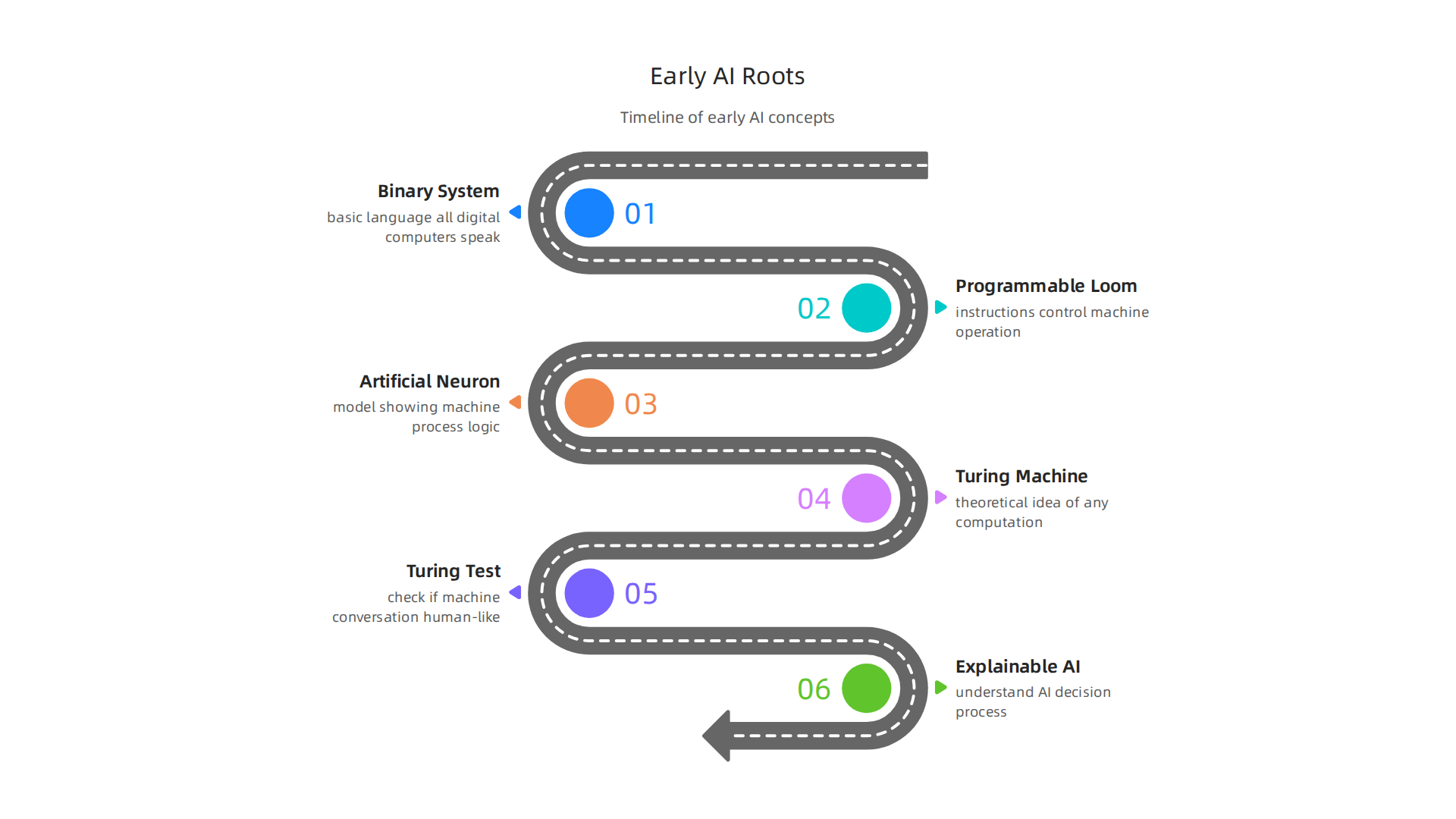
Think about the very first building blocks. People like Gottfried Wilhelm Leibniz in the 1700s helped create the binary number system, which is the basic language all digital computers speak. This was a huge step for any future machine that would process information. Then, in the early 1800s, Joseph Marie Jacquard made a special loom that could weave patterns using punched cards. This machine was programmable, a very early example of how instructions could tell a machine what to do Timelines of AI. These early ideas about rules and automatic actions were vital.
Later, in the 1940s, scientists started to think about how our brains work. They tried to make simple models of brain cells, or neurons, using math. For example, Warren McCulloch and Walter Pitts created a mathematical model of an artificial neuron in 1943, showing how a machine could process logic just like a brain cell might AI Timeline — The Complete History of Artificial Intelligence. This kind of research helped set the stage for how computers could "learn" later on.
But perhaps the biggest leap in thinking came from Alan Turing. In 1937, he introduced the "Turing machine," a theoretical idea of a machine that could perform any computation if given enough time and memory. This was a blueprint for all computers. Later, in 1950, he wrote a famous paper asking, "Can machines think?" In this paper, he also proposed the "Turing Test," a way to check if a machine’s conversation was so human-like that you couldn’t tell if it was a machine or a person AI Watch Historical Evolution of Artificial Intelligence. This question about thinking machines pushed researchers to explore how to make AI that wasn’t just fast, but smart in a way we could understand. It also started early discussions around the idea of explainable AI, meaning we want to know how a smart machine came to its answers.
These foundational ideas from formal logic and automata theory were not just abstract thoughts. They directly guided the first steps in building AI.
Early researchers asked questions like: How can we make a machine follow rules to solve problems? How can we get a machine to process information and make decisions based on it? Understanding these roots helps us see why today’s AI systems are built the way they are. If you’re interested in how this early processing of information connects to modern challenges, you can learn more about how we organize and use information in a guide to mastering the data science process. The very basics of thinking about data and logic are still central to what we call data mining today.
2. Symbolic AI, Expert Systems, and the First Wave of Industry Hype
After the very first ideas about smart machines and how they could process logic, the journey of artificial intelligence moved into a new phase. This next chapter in the history of AI focused on what we call "symbolic AI." Imagine teaching a computer like you teach a child: by giving it clear rules and facts.
In the 1950s and 1960s, researchers thought that if they could give computers enough symbols (like words or ideas) and rules about how these symbols relate, the computers would become truly smart. For example, early symbolic programs included things like the Logic Theorist, which could prove math theorems, and ELIZA, a program that could chat with people almost like a therapist. These programs showed how computers could use rules to solve problems or even have simple conversations, tracing the development of AI from its early symbolic roots to more modern models Tracing the Evolution of Artificial Intelligence: A Review of ….
This way of thinking led to something called "expert systems" in the 1970s and 1980s. These were computer programs designed to act like a human expert in a very specific field. For instance, an expert system might help doctors figure out diseases or help geologists find oil. They worked by asking a series of questions and then using a huge collection of "if-then" rules to come up with an answer or advice.
These expert systems caused a lot of excitement. Businesses spent millions of dollars, hoping AI could solve many tricky problems. This was the first big wave of hype around AI, and it promised that intelligent machines would soon change everything. Many companies were created, and a lot of money was invested.
However, the promises turned out to be bigger than what the technology could actually deliver at the time. Expert systems were great for very narrow tasks with clear rules, but they struggled with anything that was complex, unclear, or needed common sense. They were hard to build, expensive to keep updated, and couldn’t learn new things on their own very easily.
Because the systems didn’t live up to the high expectations, people became disappointed. Funding for AI research dried up, and public interest cooled down.

This period, from the late 1980s to the mid-1990s, is known as the first "AI winter." It was a time when the dreams for AI seemed to freeze over. Yet, even during this chilly period, important groundwork was being laid, and lessons were learned that would help future generations of AI researchers. If you’re interested in learning more about how AI works in simpler terms, consider an artificial intelligence basics non technical introduction for business leaders. This helped researchers see that different approaches were needed for AI to truly advance.
3. Statistical Learning, Probabilistic Models, and the Rise of Data-Driven Methods
The time after the "AI winter" showed that teaching computers with just rules wasn’t enough. It was like trying to teach a child everything they need to know about the world by giving them a giant book of "if-then" statements. The world is too messy for that! So, people started looking for a different way to make smart machines. This led to a big change in the history of AI, moving from strict rules to understanding information from lots of examples.
This new way of thinking focused on "statistical learning" and "probabilistic models." Instead of giving a computer a rule like "if it has fur and meows, it’s a cat," researchers began to give computers many, many pictures of cats and other animals. The computer would then learn to find patterns in the data itself. It would figure out, on its own, what makes a cat look like a cat. This meant the computer could learn from examples, much like how we learn from experience.
Think about it like this: A probabilistic model doesn’t say "this is definitely a cat." Instead, it might say, "there’s a 98% chance this is a cat, and a 2% chance it’s a small dog." It uses chances and likelihoods to make guesses, rather than fixed rules. This helped AI deal with things that weren’t perfectly clear. Early on, these ideas were very important for the field of "machine learning" which is all about computers learning from data.
One popular approach was using "Bayesian methods." These allow a computer to update its guesses as it gets more information. For example, if it first thinks a fuzzy shape might be a cat, but then sees it wag its tail, it can update its guess to "probably a dog." This way, the AI becomes smarter over time with new data. This shift was a big step towards more flexible and useful AI, helping to lay the groundwork for what we see in 2026. Experts have explored these ideas, offering a Brief Tour of Deep Learning from a Statistical Perspective.
These data-driven methods helped AI get much better at practical tasks that were once very hard. Suddenly, computers could start to understand human speech more reliably and recognize objects in pictures with better accuracy. Before, computers struggled to tell the difference between a dog and a wolf if they only had a few rules. But with lots of pictures, they could learn subtle differences. This marked the true rise of what is data mining in the field of AI, using large datasets to find hidden patterns and make predictions.
This shift brought AI out of the "winter" and into a period of steady progress. It showed that for AI to truly work in the real world, it needed to be able to learn from the real world’s complexity, not just a set of simple commands. Understanding how to manage and make sense of all this information is a key skill. If you’re interested in learning how to work with data, explore your guide to mastering the data science process. This era really set the stage for the powerful AI systems we interact with today, showing that data was going to be the new fuel for intelligent machines.
4. The Deep Learning Era: Architectures, Scale, and Milestone Models
After AI learned to understand patterns from data, a new and exciting time began. This was the "Deep Learning Era," a big step in the history of AI. It took the idea of computers learning from examples and made it much more powerful. Imagine those earlier computer brains, called neural networks, as having just a few layers to process information. Deep learning made these networks much "deeper," adding many more layers. This allowed them to understand even more complex things.
Think of it like peeling an onion. A "shallow" network might only peel the first layer. A "deep" network peels many layers, getting to the core of the problem. This meant AI could find hidden connections in data that were impossible to see before. This huge leap in how AI models were built and trained truly changed everything. It moved past simple data analysis and into more advanced problem-solving, further expanding on what is data mining by finding much deeper insights.
What made this deep learning boom possible? A few big things came together:
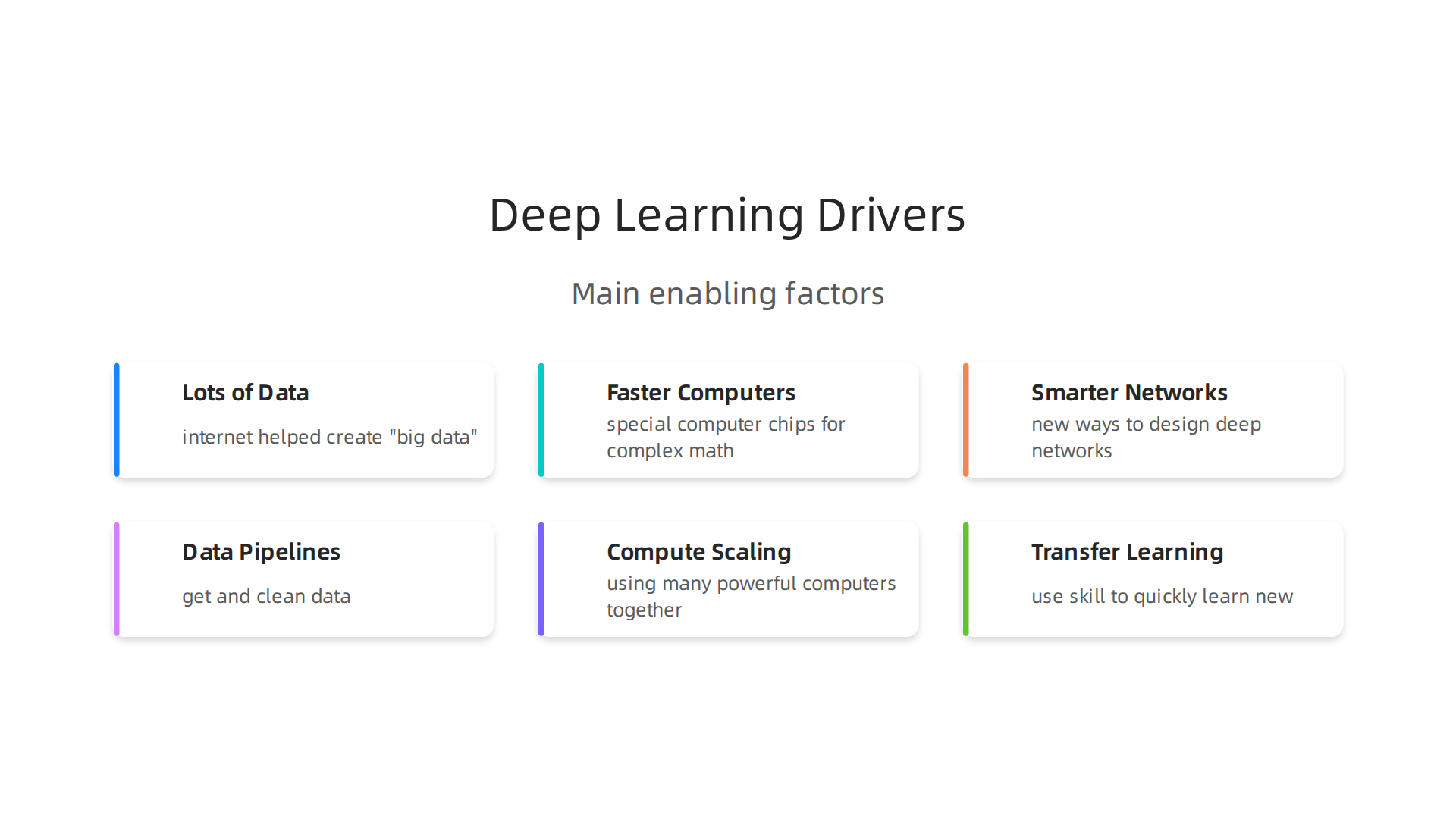
- Lots and Lots of Data: Just like a child learns more by seeing many examples, deep learning models needed huge amounts of data. The internet helped create this "big data," giving AI systems countless images, texts, and sounds to learn from.
- Faster Computers: These deep networks needed a lot of raw power to train. Special computer chips, often used for video games, became very good at handling the complex math needed. This meant training times got much shorter.
- Smarter Ways to Build Networks: People found new ways to design these deep networks. For example, some designs became super good at looking at pictures, like finding faces in photos. Others excelled at understanding language, which paved the way for chatbots. This historical progression of deep learning from its early ideas to today’s powerful systems is a fascinating journey documented by experts in their historical overview of deep learning.
To make these complex deep learning models work, engineers had to develop new skills and practices. They built "data pipelines" to get and clean all the massive amounts of information. They also learned "compute scaling," which is about using many powerful computers together to train giant models. Another smart trick was "transfer learning." This is like teaching a student how to read general books, and then using that skill to quickly learn a specific new book. An AI model trained on millions of images could then quickly learn to spot specific types of disease in medical images with less new training.
These engineering practices made it possible to create "milestone models" that could do amazing things. Suddenly, AI could recognize speech almost as well as humans, translate languages fairly well, and even beat world champions at complex games. The size and ability of these models kept growing, leading to the advanced AI we see in 2026. However, as models became more complex, understanding why they made certain decisions became harder. This challenge led to a growing interest in "explainable AI," so we can better understand how these powerful systems think.
The deep learning era continues to evolve rapidly. Staying updated on the latest breakthroughs, model launches, and how these systems are used in the real world is key for anyone involved with AI.
Stay Ahead with Daily AI Insights
The world of AI is moving incredibly fast. Don’t get left behind. Get concise, comprehensive daily updates on new models, research, tools, and trends delivered straight to your inbox.
Sign up for The AI Newsletter Worth Reading and make informed decisions in 2026 and beyond.
As we look at the amazing progress in AI, from basic rules to deep learning, it’s clear that the path to mastering AI is also evolving. Learning the right skills is more important than ever. If you are looking to deepen your understanding and career in this fast-paced field, explore Mastering AI in 2026: Key Skills, Learning Paths, and Career Strategies. This era truly set the stage for the next wave of AI advancements, leading directly to the powerful generative AI and large language models that are making headlines in 2026.
The amazing progress from deep learning didn’t stay locked away in labs. Soon, it started making its way into the real world, changing how businesses work. This shift from smart ideas to actual products and services is called "Industrial Adoption." It’s where AI moved from cool prototypes to systems used every day.
In 2026, many companies are using AI in big ways. For example, in manufacturing, 84% of factories are already getting real value from AI. They use it to keep an eye on machines, making sure they don’t break down without warning. This is called predictive maintenance, and it’s the most popular use of AI in manufacturing today. Companies that have used AI for machine monitoring for over a year report much less unplanned downtime, sometimes reducing it by almost half. This shows how AI models are truly transforming every major industry.
AI is also used to:
- Make customer service better through smart chatbots.
- Help doctors find problems in X-rays or scans.
- Suggest products you might like when you shop online.
- Manage huge networks of data for big companies.
The Real-World Hurdles for AI
Getting AI to work in a lab is one thing. Getting it to work reliably, all the time, in a busy factory or a customer service center, is another.

Businesses faced some big challenges when bringing AI into their daily operations.
- Reliability Problems: Sometimes, AI systems don’t work as expected. They might give wrong answers or stop working. This can happen if the real-world data they see is different from the data they learned from. It’s like teaching a child with only pictures of cats and then asking them to identify a dog. This is called "distribution shift" and it can make AI less accurate over time without anyone noticing, leading to silent accuracy decay.
- Monitoring and Data Care: Companies need special tools to watch their AI systems. They need to know if the AI is still doing a good job or if something has gone wrong. They also need to make sure the data feeding the AI is clean and correct all the time. Keeping data pipelines running smoothly and monitoring AI performance is a complex task.
- Infrastructure Gaps: To make AI work well in real physical environments, companies need strong computer networks and secure systems. Many organizations found that their old computer setups weren’t ready for the demands of industrial AI, especially for things that need to happen very fast. New research in 2026 shows that industrial AI has truly moved from being a future idea to being used in daily physical tasks, but requires better infrastructure to support it.
- Complex Failures: When AI systems don’t work, it’s not always a simple fix. There are many ways AI can fail in the real world, from making repeated mistakes to not knowing when a task is truly finished. Some experts say that about 88% of AI projects don’t even make it to the "production" stage because of these kinds of problems, often due to issues like messy data. Understanding why these agents fail in production is a key challenge in 2026.
Despite these challenges, companies are still moving forward with AI. More and more businesses expect to have many AI projects running daily. Learning how to successfully put AI into action is now a key skill. If you want to know more about making smart choices with AI, learning about how to choose the best enterprise AI platform for your organization can be very helpful. This focus on making AI reliable and useful in the real world is a big part of the ongoing history of AI. The next big step would be figuring out how AI could become even smarter and more generally helpful.
As AI grew bigger and became a part of our daily lives, people started to think more about what this really meant. They wondered about how AI might affect our safety, fairness, and privacy.
This look at the rules and guidelines for AI is a crucial part of the ongoing history of AI.
Concerns Grow as AI Gets Smarter
In the early days of AI, people worried about simple things, like if a robot might take someone’s job. But as AI systems became more complex, able to learn from huge amounts of information (which is like what is data mining), new concerns came up.
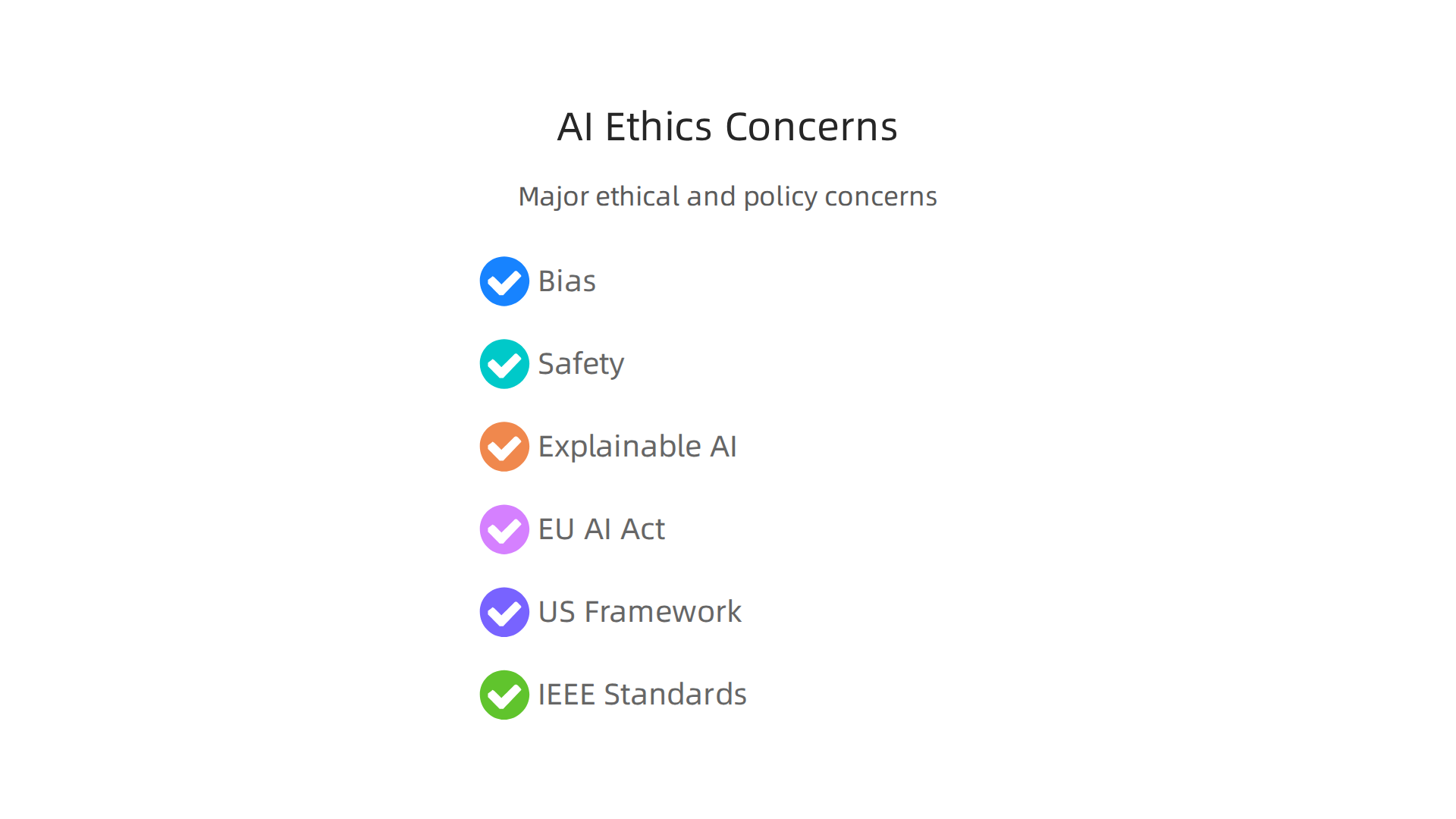
One big worry is bias. AI systems learn from data that humans create. If that data has unfair patterns, the AI can learn those bad patterns too. This means the AI might make unfair decisions, like in hiring or loan applications. To fix this, people talk about "explainable AI." This means we need to understand why an AI made a certain decision, not just what the decision was. This way, we can check for fairness and catch any biases.
Another concern is safety. What if an AI in a self-driving car makes a mistake? Or what if a medical AI gives wrong advice? These are serious issues that need careful rules and testing.
Setting the Rules: Governance through the Ages
Because of these worries, governments and organizations worldwide have started to create rules and standards for AI. These rules are known as "governance." They help make sure AI is developed and used in a way that is good for everyone.
For example, in 2026, many new laws and guidelines are coming into play. The European Union’s "AI Act" has started to take effect, setting strict rules for high-risk AI systems, with transparency rules beginning in August 2026 and other prohibitions in December 2026 to ensure safe and trustworthy AI use across Europe AI Act | Shaping Europe’s digital future. In the United States, the White House released a National Policy Framework for Artificial Intelligence in March 2026. This framework gives ideas for how the government can make laws about AI. States in the US are also making their own AI laws that are taking effect this year, focusing on things like child safety and community protections AI legislation in the US: A 2026 overview.
Organizations like the Institute of Electrical and Electronics Engineers (IEEE), which is home to the IEEE Computational Intelligence Society, also create important standards. These standards are like best practice guides for companies to follow when building AI systems. They cover things like ethical development and how to make AI systems accountable.
These rules matter a lot for companies using AI. They help businesses know what they should and shouldn’t do. They make sure AI is used safely and fairly, which builds trust with customers and the public. These efforts to make AI trustworthy show a growing understanding that smart technology needs smart rules.
7. Future Trajectories: Structural Shifts, Risks, and Opportunities
Looking back at the history of AI shows us how much it has changed over time. From simple ideas to complex systems, AI has grown incredibly. Now, with new rules like the EU’s AI Act and various US policies in place for 2026, we can expect the future of AI to be shaped by both amazing new tech and a focus on keeping things safe and fair. These smart rules will help guide AI as it keeps getting smarter.
The Rise of Artificial General Intelligence (AGI)
One of the biggest ideas for the future is Artificial General Intelligence, or AGI. This is about AI that can think, learn, and do almost any task a human can, perhaps even better. Many experts are talking about when AGI might arrive. Some, like Dario Amodei, think AI could reach human-like abilities for many tasks, even Nobel Prize-level research, by 2026 or 2027. Others, like Demis Hassabis, suggest AGI might have a 50% chance of being here by 2030. Leaders in the AI world, including those from Google DeepMind and Anthropic, debated these timelines and the impact of AGI at the World Economic Forum in 2026, recognizing a clear path to it is emerging Google’s Demis Hassabis, Anthropic’s Dario Amodei Debate the World After AGI. This discussion shows us that AGI is not just a dream, but a serious possibility we need to prepare for.
Coming Shifts and Ongoing Needs
As AI moves forward, we will see big changes in many areas. Industries will keep transforming, and our daily lives will get even more intertwined with AI. This means we must keep working on ethical AI. It is important to design AI systems that are fair and trustworthy from the start, following approaches like "Ethics by Design" to make sure they do good, not harm Ethics By Design and Ethics of Use Approaches for Artificial Intelligence. The need for explainable AI, where we can understand how AI makes decisions, will become even more crucial. Standards from groups like the IEEE will continue to guide developers in building responsible AI.
Preparing for What’s Next
For business leaders, investors, and developers, understanding these future paths is key.

The risks we talked about before, like bias and safety concerns, will still be important. In fact, understanding the real dangers of AI in 2026 will help us avoid problems. But there are also huge opportunities. Companies that focus on building AI responsibly and thinking ahead will be the ones that succeed.
This means:
- Staying Informed: Keep up with the latest AI trends, research, and policy changes.
- Ethical Development: Invest in tools and practices that ensure AI is fair, safe, and transparent.
- Innovation: Look for new ways AI can solve big problems and create value.
- Skills: Train teams to work alongside AI, focusing on uniquely human skills like creativity and problem-solving.
By looking at past patterns and understanding current efforts, we can better prepare for the exciting yet complex future of AI. To stay ahead, leaders should be actively tracking AI innovators and adapting their strategies.
The future of AI is full of possibilities, but it demands careful thought and action from all of us.
Staying on top of the rapid changes in AI can be tough. Get clear daily AI updates to help you make smart decisions.
The AI Newsletter Worth Reading
Summary
This article traces the history of artificial intelligence to explain why that history matters for today’s leaders, developers, and businesses. It walks through the origins—from early logical ideas and Turing’s foundational work—into symbolic AI and the expert system boom that led to early hype and subsequent AI winters. The piece then describes the shift to statistical learning and probabilistic methods, the deep learning era driven by data and compute, and how those advances enabled widespread industrial adoption. It highlights real-world deployment challenges like distribution shift, monitoring, and infrastructure gaps, and it covers growing concerns about bias, safety, and governance as laws and standards emerge in 2026. Finally, the article discusses future trajectories including AGI debates and practical steps for organizations to invest responsibly, build skills, and prepare for the next phase of AI development.