

Introduction – Why AI Platforms Are the Backbone of Modern Enterprise Strategy
You look at the list and your head starts to spin. There are dozens of AI platforms out there. Every vendor claims to be the best. Some focus on building chatbots. Others promise to run your whole business. And each one uses buzzwords like "agentic," "sovereign," and "edge AI."
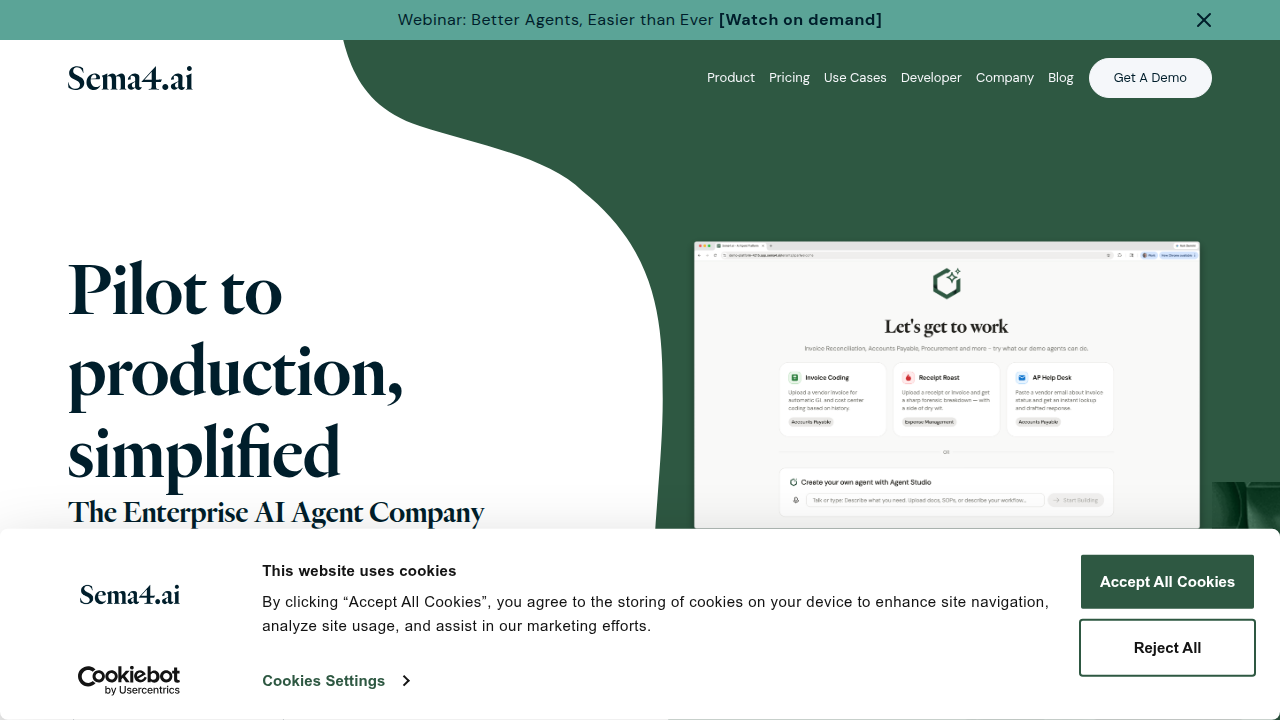
Here’s the truth: AI platforms have become the central operating system for modern enterprises. They are not just nice-to-have tools anymore. They are the engine that helps organizations automate processes, make faster decisions, and scale AI across every department. According to the enterprise AI platform guide from Sema4.ai, a good platform brings together building, deploying, governing, and monitoring all in one place.
That sounds great. But picking the right one feels impossible.

The problem is information overload. You read one article about the top 10 platforms. Then another pops up with a different list. Then a third says the market is shifting toward specialized models and autonomous agents. Your colleagues have opinions too. The CTO wants something secure. The data team wants flexibility. The marketing team just wants something that works today.
In 2026, enterprise AI spending is projected to hit $2.53 trillion according to Gartner, as cited in a breakdown of enterprise AI trends for 2026 on Synvestable. That is a huge amount of money. And it means the stakes are high. Choose the wrong platform and you waste time, budget, and trust. Choose the right one and you gain a real competitive edge.
That is why this guide exists. We are going to walk through a structured approach to understanding, evaluating, and implementing AI platforms. No fluff. No hype. Just practical steps you can use to cut through the noise and find the best fit for your organization.
We will cover what to look for in an enterprise AI platform, how to compare top contenders, and how to avoid common pitfalls. Along the way, we will also point you to useful resources. For example, if you are curious about which companies are leading the charge, check out our overview of the fastest growing AI companies reshaping industries.
And because the AI world changes fast, staying up to date matters. For simple daily insights that help you keep your finger on the pulse, join Your Daily AI Shortcut. It is a free newsletter that delivers AI news straight to your inbox without the overwhelm.
Let us start with the basics: what actually makes an AI platform enterprise-ready in 2026.
What Are AI Platforms? Defining the Enterprise Ecosystem
Before you start comparing options, you need to understand what an AI platform actually is. In 2026, the term gets thrown around a lot. But not everything that calls itself one really qualifies.
An enterprise AI platform is a unified environment that brings together multiple capabilities in one place. It combines machine learning, natural language processing, computer vision, and automation tools. Instead of juggling separate software for each task, you get one suite that handles it all. The enterprise AI definition from Creatio explains that these platforms let organizations "build, deploy, orchestrate, and govern AI capabilities within a single software system."
That matters because most companies start with point solutions. Point solutions do one thing well. Maybe a chatbot builder. Or a text analysis tool. But they do not talk to each other. And they do not help you manage the full lifecycle from start to finish. A real platform covers data access and preparation, model development, deployment across environments, governance and security controls, monitoring, and orchestration for agents and pipelines.
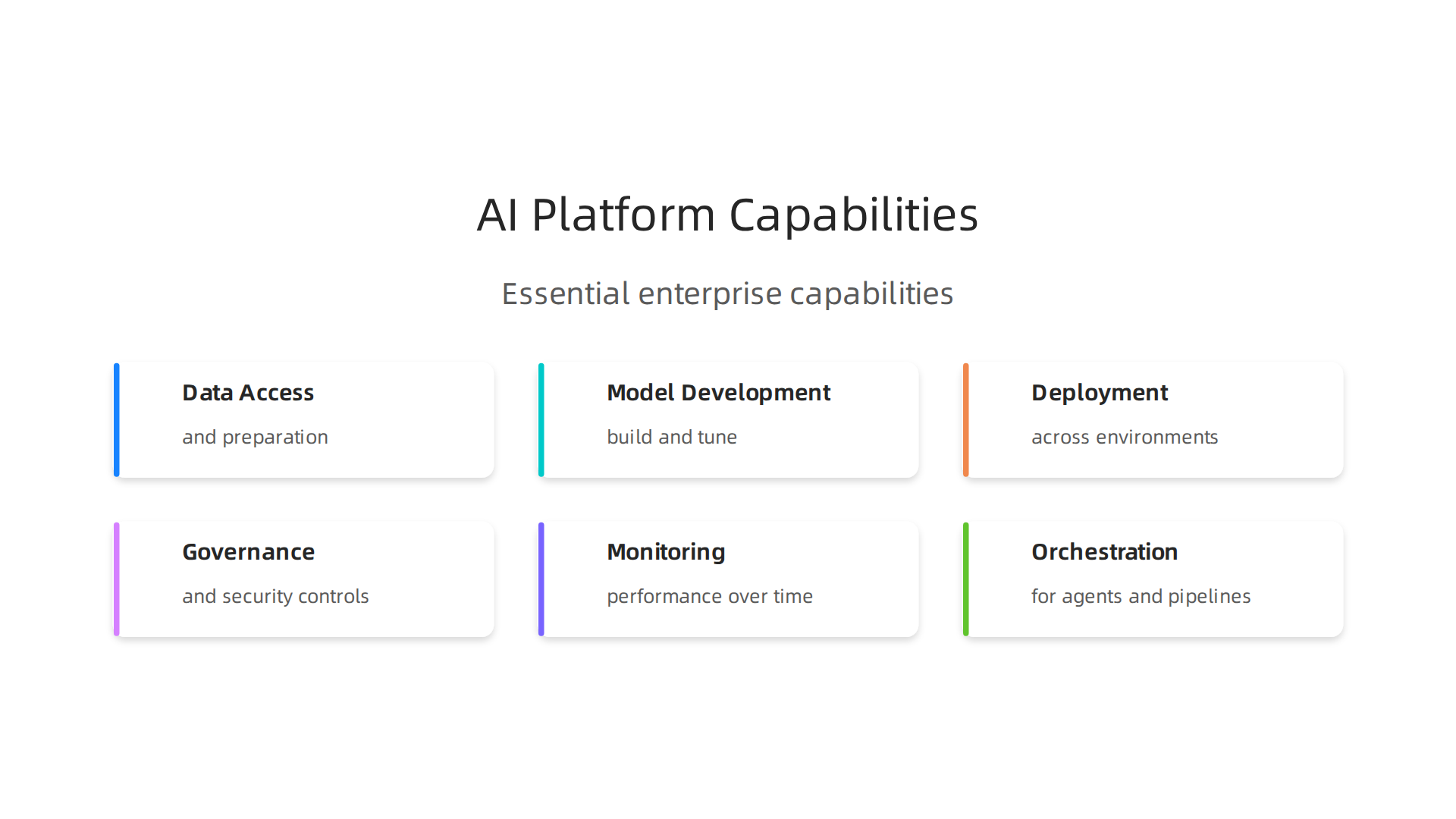
You can see this full breakdown in the top enterprise AI platforms ranking from StackAI.
Think of it like this. Point solutions are like buying a hammer, a saw, and some nails separately. A platform is like getting a fully equipped workshop with storage, safety gear, and instructions. You build more complex projects faster with less headache.
The platform ecosystem in 2026 falls into three main categories. Cloud providers like major tech giants offer platforms that integrate deeply with their existing software ecosystems. Purpose-built vendors focus on solving specific problems in industries like healthcare or finance. And open-source alternatives give you more control and flexibility but require more hands-on work from your team. The enterprise AI platform guide from Sema4.ai breaks down these categories in more detail.
Understanding these differences is step one. Once you know what to look for, you can start evaluating which type fits your organization’s needs, budget, and technical capabilities.
As you explore different platforms, you will run into questions about data quality too. The best platform cannot deliver results without clean, well-organized data. That is why data specialists are more critical than ever in the age of AI.
And if you want to stay current on which platforms are gaining traction and what trends are shaping enterprise AI, Your Daily AI Shortcut delivers simple daily AI insights straight to your inbox.
Key Enterprise Considerations for Choosing an AI Platform
Choosing the right AI platform is one of the most important decisions your organization will make this year. The wrong choice leads to wasted budget, frustrated teams, and projects that never reach production. The right choice accelerates your entire AI strategy. So what should you actually evaluate?
Let’s break down the major factors.
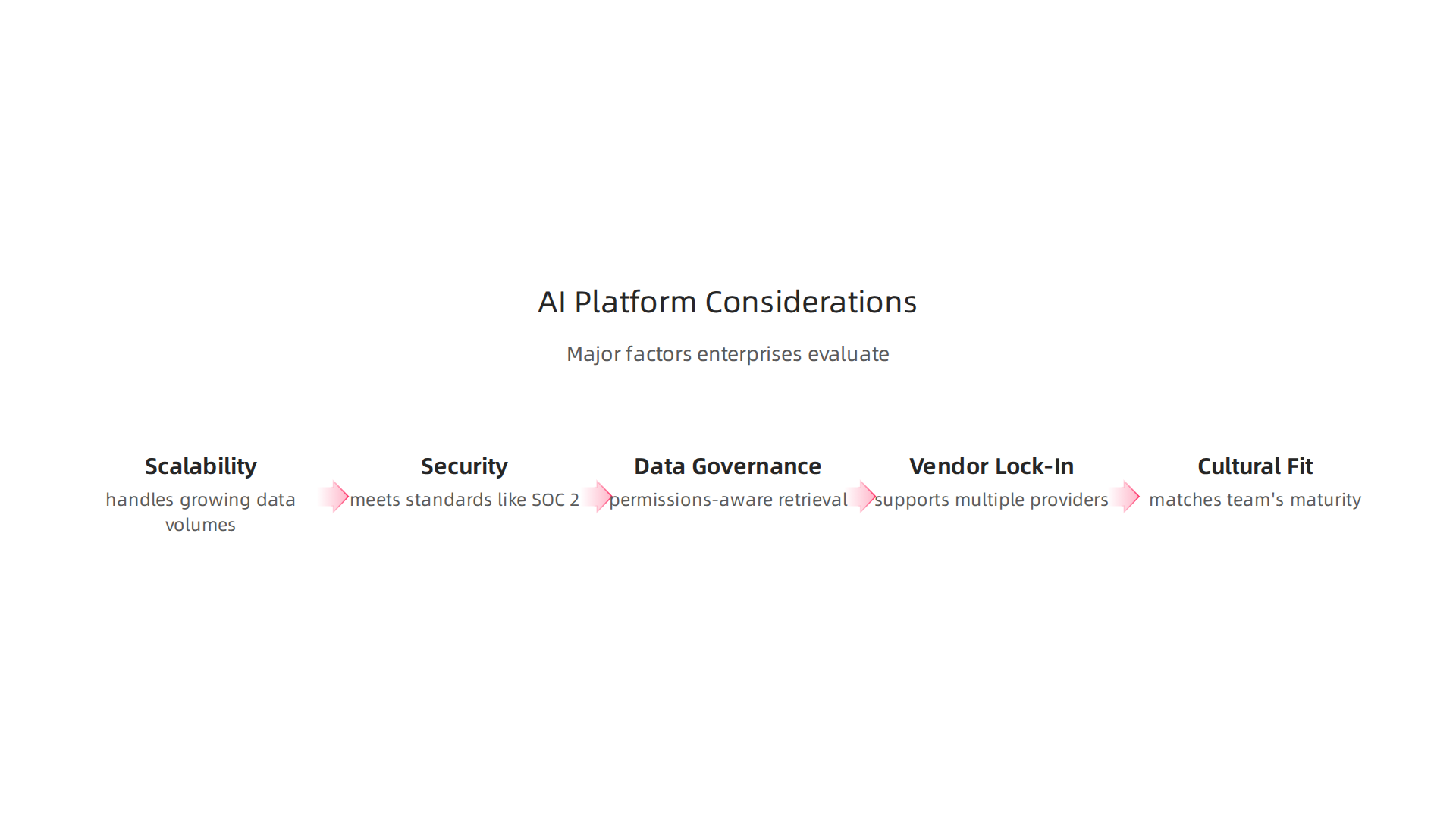
Scalability and Performance
A platform that works for a small pilot may fail under real enterprise load. You need to know how it handles growing data volumes, more users, and multiple concurrent models. Ask about auto-scaling, latency under heavy use, and whether the platform can support both batch processing and real-time inference. The 12 critical criteria for enterprise AI platform evaluation include foundation model flexibility and deployment flexibility. Can the platform run in your cloud environment through a virtual private cloud? Does it support on-premises options for workloads that cannot move to public cloud? These questions matter.
Security and Compliance
This is not optional. Every enterprise AI platform must meet your security standards before it touches your data. Look for SOC 2 Type II compliance, GDPR and CCPA coverage, and industry-specific rules like HIPAA. Role-based access controls (RBAC), audit logging, and data residency options are table stakes. The best enterprise AI platforms for dev teams in 2026 also stress built-in security and governance with SSO and configurable privacy rules. Do not proceed without verifying these.
Data Governance and Access
Your platform needs to know who can see what. Permissions-aware retrieval ensures users cannot access content they should not see. You also need clear traceability from AI responses back to source material. This is critical for regulated industries. Look for features like data boundaries, redaction, retention controls, and metadata handling by department or region. The enterprise AI platform comparison from StackAI emphasizes governance depth as a top priority.
Avoiding Vendor Lock-In
Relying on a single foundation model provider is risky. If that provider raises prices, changes its model, or goes down, your entire operation is affected. The best AI platforms support multiple providers and allow you to bring your own model. They offer open APIs and standard SDKs so you are not trapped in a proprietary ecosystem. Check whether the platform supports model routing based on task, cost, and performance. That flexibility protects your investment.
Cultural Fit and AI Maturity
Your team’s experience level matters a lot. A platform designed for data scientists will frustrate business users. A no-code platform may limit advanced teams. Be honest about your internal AI maturity. If your organization is new to AI, you need a platform with strong templates, guided workflows, and built-in governance guardrails. If your team already knows MLOps, you may prefer more open control. The right platform matches your operating model.
A Structured Evaluation Framework
Do not jump into demos without a plan.

Start by defining your non-negotiables. What must the platform absolutely do? Then select two to three candidates and run parallel pilots using real production data. Measure integration friction, developer experience, latency, and cost. Model total cost of ownership at two times and five times your initial deployment scope. The enterprise AI platform buyer’s guide from Coworker AI recommends focusing on integration depth, security, pricing transparency, organizational memory, and autonomous execution.
After the pilot, make a hard go or no-go decision before signing any long-term agreement. Never commit without a live workload running on the platform.
These considerations reduce risk and get you to value faster. As you narrow down your options, stay current with how the best companies are making these decisions. For simple daily AI insights that keep you ahead of platform trends, join The Deep View Newsletter for simple daily AI insights.
Top AI Platform Capabilities: What Enterprises Need in 2026
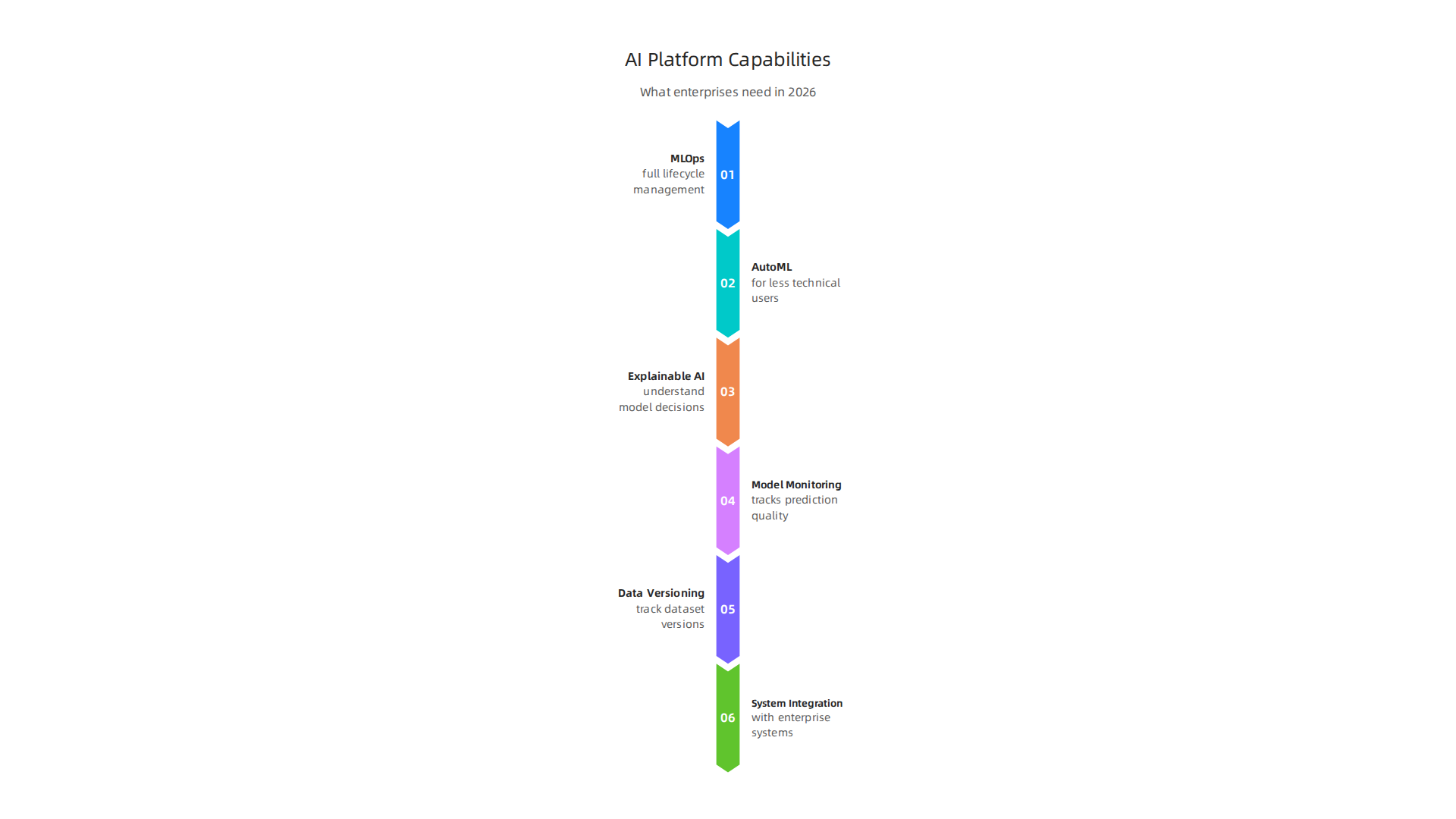
Once you have your evaluation framework in place, it is time to dig into the specific capabilities that separate an average platform from a great one. The enterprise AI platforms that thrive in 2026 all share a core set of features. Here is what to look for.
MLOps and Model Lifecycle Management
You need a platform that treats AI like a product, not a science experiment. That means full MLOps support: experiment tracking, version control for models and data, automated training pipelines, and smooth promotion from dev to staging to production. The best platforms also offer built-in CI/CD for machine learning so your team can iterate fast without breaking things. According to the top enterprise AI platforms 2026 ranking from StackAI, model development, deployment, and monitoring are essential pillars of any serious platform. Without these, your AI projects stall after the proof of concept.
Automated Machine Learning (AutoML)
Not everyone on your team is a data scientist. That is okay. AutoML lets less technical users build and tune high-quality models without writing code. The platform handles algorithm selection, hyperparameter tuning, and feature engineering automatically. This speeds up experimentation and frees your data scientists to focus on hard problems. Platforms like Vertex AI and Azure AI include strong AutoML capabilities, as highlighted in the enterprise AI 2026 trends overview from Windows Forum.
Explainable AI and Model Transparency
When an AI makes a decision, your team and your regulators need to understand why. Explainable AI (XAI) tools show you which features drove a prediction and how confident the model is. This is not a nice-to-have. It is a requirement for compliance in finance, healthcare, and insurance. The LinkedIn article on five defining enterprise AI trends for 2026 points out that neurosymbolic AI, which blends probability with deterministic business rules, is making AI systems more explainable and governable. Look for platforms that offer built-in explainability dashboards and feature importance reports.
Model Monitoring and Observability
Models drift. Data changes. Performance degrades. You cannot fix what you do not see. Strong monitoring tracks prediction quality, latency, cost, and data drift in real time. The best platforms give you end-to-end traces so you can pinpoint exactly where a pipeline broke. They also support A/B testing, canary deployments, and automatic rollbacks. Observability is not just for IT. It builds trust with business stakeholders who need to see that AI is working as expected.
Data Versioning and Lineage
Every model is only as good as the data it was trained on. You need to know exactly which dataset version, preprocessing steps, and training run produced each model. Data versioning tools let you snapshot datasets, track transformations, and reproduce results months later. This is critical for audit trails and debugging. When you pair data versioning with strong MLOps, your team can roll back to a working version quickly if something goes wrong. For a deeper look at why data quality matters, check out this guide on why data annotation tech is critical for AI accuracy.
Integration with Enterprise Systems
This is where many platforms fail. A beautiful AI interface that cannot talk to your ERP, CRM, or data lake is worthless. In 2026, the best enterprise AI platforms offer deep, native connectors for popular business systems like Salesforce, SAP, Oracle, and Snowflake. They also support open standards like Model Context Protocol (MCP) and provide SDKs for custom integrations. The Vellum AI guide to enterprise automation platforms stresses that integration breadth is a top factor, with connectors for CRM, ERP, ITSM, data warehouses, and vector databases.
Without these, your AI agents cannot execute real work.
Unified Platforms vs. Best of Breed
You face a choice: go with one broad platform that does everything, or stitch together specialized tools. Each approach has trade-offs. Unified platforms like Azure AI, Google Vertex AI, and AWS Bedrock offer seamless integration across the AI lifecycle. Everything works together out of the box. Best-of-breed stacks let you pick the best tool for each job, but they require more engineering effort to glue together and maintain. In 2026, the trend leans toward unified platforms for most enterprises because they reduce complexity and lower total cost of ownership. However, if you have a strong engineering team and very specific needs, best-of-breed may still win. Evaluate based on your team size, skills, and risk tolerance.
Focus on these capabilities during your platform pilots. They are the difference between a platform that gathers dust and one that transforms your business.
Evaluating AI Platform Costs and ROI
Pricing is often the trickiest part of evaluating ai platforms.

The sticker price never tells the whole story. You might see a low monthly fee, but by the time you factor in everything else, the real cost can be two or three times higher. Let’s break down what you actually pay and how to measure the return.
Cost Models: Which One Fits Your Budget?
Most enterprise AI platforms use one of three pricing models. The first is subscription, where you pay a flat monthly or annual fee for a set of features. This is predictable and easy to budget for. The second is consumption-based, where you pay per API call, per token, or per hour of compute. This scales with usage, which is great if your volume varies, but it can surprise you with spikes. The third is a perpetual license, a one-time upfront cost plus ongoing maintenance. This model is rare now, but some legacy vendors still offer it.
Your choice depends on your usage pattern. If you are building a steady internal tool, a subscription might be best. If you are launching a customer-facing product that could go viral, consumption-based lets you start small.
Hidden Costs That Sneak Up On You
The real expense of ai platforms often goes beyond the core pricing. According to the guide on best AI platforms for enterprise in 2026 from Noxus AI, you need to look beyond initial software cost and factor in implementation, developer time for maintaining integrations, and the pricing structure itself. Here are the hidden costs to watch for:
- Training and onboarding: Your team needs to learn the platform. That takes time and sometimes paid training sessions.
- Data migration: Moving data from old systems into the new platform costs engineering hours and can cause downtime.
- Integration maintenance: Keeping connectors working with your ERP, CRM, and data lake requires ongoing attention.
- Monitoring and operations: Someone has to watch model drift, handle alerts, and manage the infrastructure. That is a human cost.
- Scaling penalties: Some platforms offer cheap entry-level pricing but get very expensive when you scale. Always model costs at 2x and 5x your initial scope.
How to Calculate ROI the Right Way
ROI is not just about cost savings. It also includes productivity gains, fewer errors, and new revenue streams. Here is a simple framework:
- Estimate productivity gains: How many hours does your team save each week using an ai app builder? Multiply by their hourly rate to get a dollar figure.
- Reduce error rates: AI can cut human errors in data entry, compliance checks, and forecasting. Quantify those avoided mistakes.
- Identify new revenue: Can the platform help you launch a new product or improve customer retention? Even a small percentage lift adds up.
- Subtract total costs: Add up subscription, hidden costs, and operational overhead. Then compare to the total benefits.
If the number is positive and meets your internal threshold, you have a strong business case.
Keep Learning and Stay Informed
ROI analysis is not a one-time exercise. As your usage grows and the market changes, your costs and benefits will shift. Staying up to date on the top ai companies and their pricing changes helps you renegotiate and optimize. For a hands-on look at tools that can boost your team’s productivity right now, check out our guide to the best AI productivity tools for 2026. And if you want simple daily insights to keep you ahead, join The Deep View Newsletter for simple daily AI insights.
Implementation Strategies and Best Practices
Alright, you have crunched the numbers and the ROI looks good. Now comes the real work: actually putting the AI platform into action without causing a mess. The difference between a successful rollout and a costly failure often comes down to three things: starting small, bringing the right people together, and improving as you go.
Start with a Focused Pilot Project
The biggest mistake teams make is trying to do too much too fast. Instead, pick one high-value use case that ties directly to a business KPI. Maybe you want to cut customer support response time by 30 percent. Or reduce manual data entry errors in your finance team. One clear goal keeps everyone focused.
According to the guide on top enterprise AI platforms in 2026 from StackAI, a smart implementation follows a structured timeline. Weeks one and two are for requirements and risk guardrails. You define your success metrics and classify your data. Weeks three through six are for building the first thin slice of your app or AI agent. Start with just one or two data sources. Add human review for risky actions. Run a controlled pilot with real tasks and a small user group.
This approach lets you prove value before you invest heavily. If the pilot does not work, you fail fast and cheap. If it works, you have a clear case to expand.
During this phase, exploring the Flow AI for developers can help you test integrations quickly without wasting time.
Bring Everyone to the Table Early

A common reason AI projects stall is that only the tech team is involved. IT picks the platform. Data science builds the models. Then nobody in the business uses the result. That is a setup for failure.
You need a cross-functional team from day one. That means IT, data science, the business unit that will use the tool, and compliance or legal. Each group brings something essential. IT knows the infrastructure. Data science understands the model limits. The business unit knows the real workflow pain points. Compliance keeps you out of regulatory trouble.
The best practices in developing an enterprise AI roadmap from C3 AI stress that you must write a clear business use case that defines the problem, the value, and the scope. Getting sign-off from all those teams upfront prevents surprises later.
Roll Out in Iterative Cycles
Do not try to launch a perfect system all at once. Plan for multiple cycles. Each cycle should include a build phase, a test phase with real users, and a feedback review. Then you adjust before the next cycle.
This iterative rollout reduces risk. If something breaks, you catch it early. If users hate a feature, you change it before it goes enterprise-wide. Continuous feedback loops also keep your team aligned with actual business needs. According to the AI transformation roadmap for enterprises from LinkedIn, building in governance and monitoring early ensures you can scale without chaos.
The same approach helps you reuse components across teams. After one successful cycle, document the templates and connectors. Let other departments use what you already built.
Keep Building Momentum
Implementation is not a one-and-done event. It is an ongoing process of refinement. The more you learn from each cycle, the smarter your next move becomes. That is why staying connected to the latest thinking matters. For a bite-sized daily update that helps you track what works and what does not, join The Deep View Newsletter for simple daily AI insights.
Future Trends: AI Platforms and the Enterprise Roadmap
The AI platform landscape is shifting fast. What worked in 2024 is already outdated. In 2026, several powerful trends are reshaping how enterprises choose, build, and scale AI.
If you are planning your roadmap today, these are the forces you need to watch.
Agentic AI Moves from Hype to Reality
The biggest shift is agentic AI. Instead of simple chatbots that answer questions, AI agents can now act on your behalf. They book meetings, update CRM records, run complex workflows, and even negotiate with other agents. This changes everything. Platforms are racing to add native agent orchestration, approval workflows, and human oversight.
According to the enterprise AI trends report from Spectro Cloud, four key trends are shaping 2026: sovereign AI, agentic AI, edge AI, and AI factories.
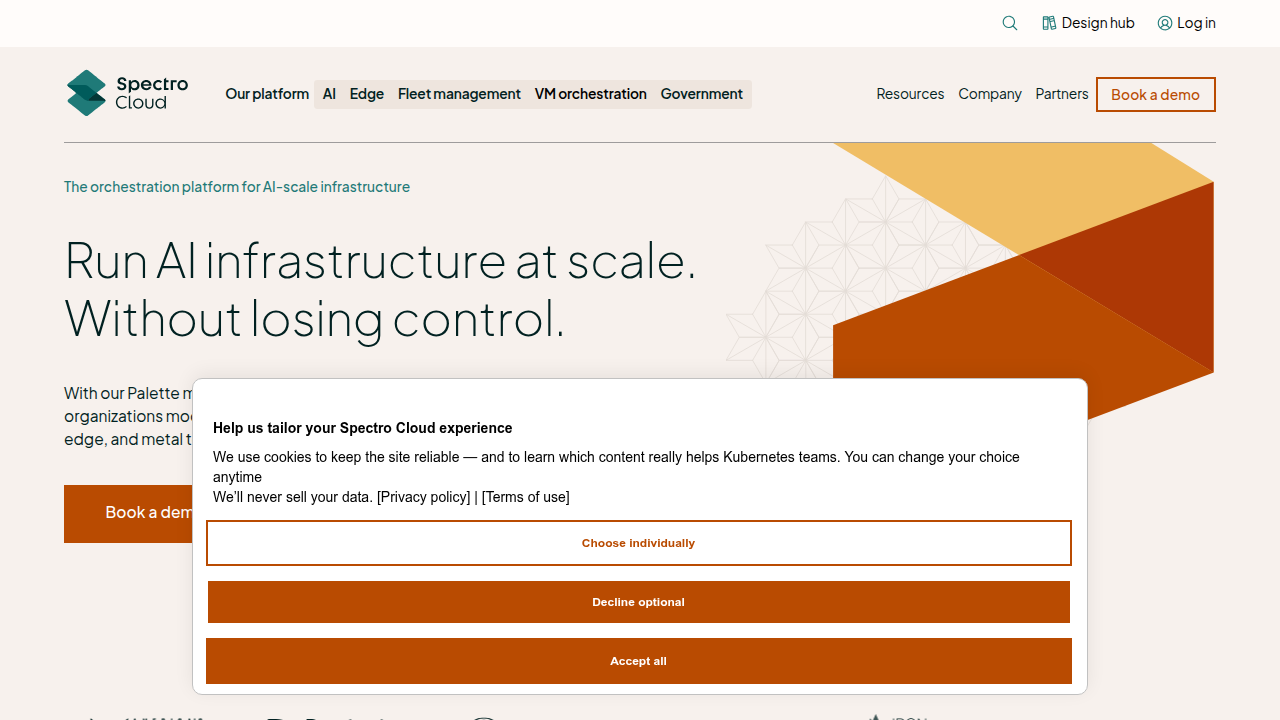
Sovereign AI lets governments and regulated industries keep data and models under their own control. Agentic AI moves beyond generative chatbots into autonomous execution. Edge AI pushes intelligence closer to where data is created, solving latency and privacy issues. And AI factories bring an industrial mindset to running AI at scale.
Multimodal Models and Low-Code Platforms
Another big trend is multimodal AI. Models that handle text, images, video, and audio together are becoming standard. This means your AI platform can analyze a customer support ticket, a screenshot, and a recorded call all at once. The insights are far richer.
At the same time, low-code and no-code AI platforms are booming. Gartner projects that about 70 percent of new enterprise apps will be built with low-code tools by 2025, and that trend has only accelerated in 2026. This means your business analysts can build AI workflows without waiting for the engineering team. It speeds up everything.
Regulatory Pressure Is Rising
Regulations like the EU AI Act are forcing companies to get serious about compliance. Your AI platform must include built-in governance, audit trails, and explainability. You cannot just deploy a model and hope for the best. Platforms that offer strong access controls, data residency options, and policy enforcement will win in regulated industries.
Plan for a Composable Architecture
The smartest enterprises are moving toward composable AI architectures. Instead of locking into one vendor, they build with interchangeable components. An AI orchestrator here, a vector database there, a fine-tuning layer somewhere else. This makes it easier to swap out a model when a better one arrives or adjust to new regulations.
Staying ahead of these trends means staying informed every day. That is why so many leaders keep a pulse on what is happening. For a simple way to catch up on the most important shifts without information overload, check out the tracking your AI competitors guide and then join The Deep View Newsletter for simple daily AI insights.
Summary
This guide explains why enterprise AI platforms are now the operational backbone for organizations and offers a practical, structured approach to choosing and implementing one. It defines what qualifies as an enterprise-ready platform, compares platform types (cloud, purpose-built, open source), and lists the capabilities that matter in 2026—MLOps, AutoML, explainability, observability, data lineage, and deep integrations. The article walks through critical evaluation criteria such as scalability, security, governance, vendor lock-in, and cultural fit, then shows how to run focused pilots, calculate true costs and ROI, and roll out iteratively with cross-functional teams. It also highlights emerging trends—agentic AI, multimodal models, low-code tools, and composable architectures—that should shape your roadmap. After reading, you will know how to set non-negotiables, run parallel pilots, measure outcomes, and select a platform that balances risk, cost, and long-term flexibility.