

The way we work with data has changed fast. If you have been searching for remote data analyst jobs in 2026, you already know the market looks different than it did a few years ago. Companies still need people who can make sense of numbers, but the tools and expectations have shifted.
The demand for skilled data professionals remains strong. According to the 2026 data analyst job outlook, the US Bureau of Labor Statistics predicts a 23% increase in the job market by 2032. Salaries have climbed significantly, too. Entry-level data analysts now earn an average of $90,000, up $20,000 from just a year earlier. That tells you something important. Employers are willing to pay more for the right skills.
But here is the thing. Landing one of those remote roles takes more than just knowing how to build a spreadsheet. AI tools have become part of everyday data work. Companies want analysts who can work alongside these tools, not just run basic reports. As data specialists are more critical than ever in the age of AI, your ability to combine analytical thinking with modern tools will set you apart.
In this guide, I will walk you through exactly what it takes to find and land a remote data analyst job in 2026. We will cover the skills that matter most, the best places to look for openings, and how to stand out in a competitive field. Whether you are just starting out or looking to make a move, this guide is built for you. And if you want to stay sharp on the latest AI trends affecting your career, Your Daily AI Shortcut delivers simple daily AI insights straight to your inbox.
Understanding the Remote Data Analyst Role in 2026
So what does a remote data analyst actually do in 2026? If you picture someone staring at spreadsheets all day, it is time to update that image. The job has changed, and AI is a big reason why.
A few years ago, data analysts spent a huge chunk of their time cleaning up messy data. You know the drill. Removing duplicates, fixing formatting, filling in missing values. It was necessary work, but it was also slow and repetitive. Today, AI tools handle most of that grunt work automatically. Tools like ChatGPT and Power BI Copilot can clean, sort, and even explore data for you. That frees you up to focus on the higher level stuff.
And that is exactly what employers want now. They do not need someone who just runs basic reports. They need someone who can look at the insights AI surfaces and figure out what they actually mean. Then explain those insights to people who are not data experts. The ability to translate numbers into plain, useful recommendations is gold. As companies increasingly look for people who can work alongside AI, understanding how the data job market has changed in 2026 helps you see what skills really matter.
Working from home adds another layer. When you are remote, you do not have a manager peeking over your shoulder. You have to manage your own time, stay focused, and communicate clearly through writing. A lot of your collaboration will happen on Slack, email, or video calls. If you cannot explain your findings in a short message or a quick dashboard, you will struggle. Strong written communication and self discipline are now just as important as knowing SQL or Python.
So the role has shifted from being a number cruncher to being a storyteller who uses AI as a helper.

That is actually good news for job seekers. It means you do not have to be a technical genius. You just need to be curious, clear, and willing to learn new tools. To build a strong foundation, check out this guide to mastering the data science process — it will show you how the pieces fit together.
In short, the remote data analyst jobs of 2026 are not about doing the boring work yourself. They are about guiding the AI, checking its work, and making sure the final story makes sense for your team.
Essential Skills for Remote Data Analyst Success
Let’s talk about what it really takes to land one of those remote data analyst jobs in 2026. The skill set has changed, but not in the way you might think.
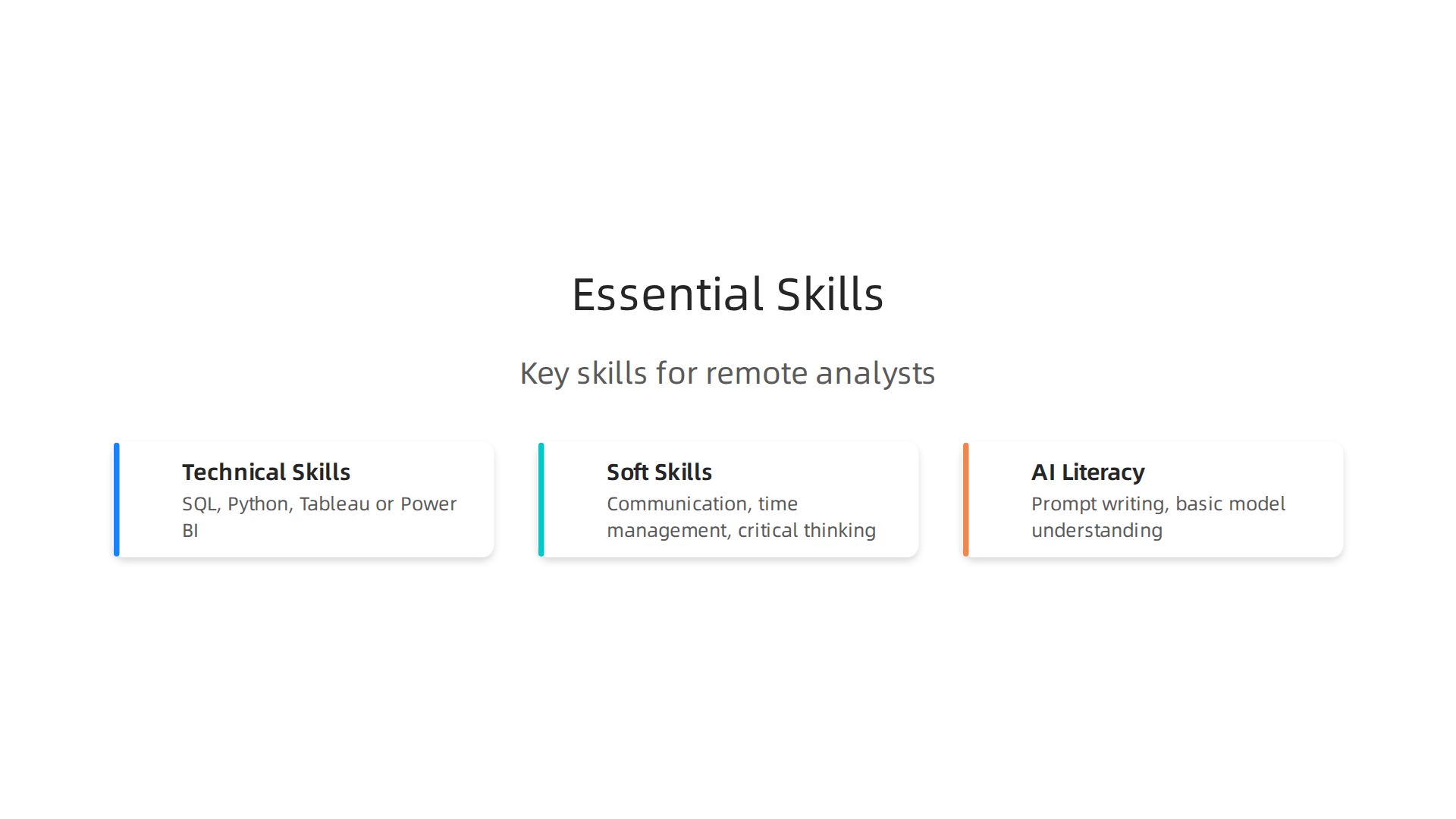
Technical skills are still the foundation. You cannot skip them. SQL is the biggest one. Every hiring manager expects you to write clean queries and work with databases. Python comes next for automation and deeper analysis. And you need at least one data visualization tool like Tableau or Power BI. These are non-negotiable according to current hiring trends. As one career guide notes, the top data analyst skills employers are looking for include SQL, statistical programming, data visualization, and database management. If your resume does not list these, recruiters will move on quickly.
But here is where the game changes. Technical skills alone will not make you stand out anymore. In a remote setting, soft skills matter just as much. Maybe more.
Think about it. When you work from home, you are not sitting next to a manager who can read your body language. You need to communicate clearly through writing. A weekly summary email, a short Slack update, or a recorded Loom video showing your work makes a huge difference. You also need strong time management. Nobody is watching your screen. You have to stay focused and deliver on your own.
Critical thinking is another big one. The AI tools can surface insights, but they cannot decide what actually matters for your business. You need to look at the data, question it, and figure out the real story. That is where human judgment still wins.
And here is a newer area that employers are paying attention to in 2026. AI literacy. You do not need to be a machine learning expert. But understanding how to write good prompts for AI tools and knowing the basics of how models work will set you apart. If you want to build on these skills, checking out the top data analysis certifications for 2026 is a smart next step.
The bottom line is simple. Remote data analyst jobs now reward T-shaped people. Deep technical skill in one area, plus broad communication and AI awareness.
Master that mix, and you become very hard to ignore.
If you want to stay ahead of how AI is reshaping roles like this, a quick daily read can help. Your Daily AI Shortcut delivers simple insights that keep you in the loop. Join The Deep View Newsletter and stay informed in just a few minutes each day.
How to Build a Standout Remote Data Analyst Resume
You have the skills. Now you need to prove it on paper. Your resume is often the first thing a hiring manager sees, and for remote data analyst jobs, it needs to do more than just list your old job duties.
It has to show you can deliver results from anywhere.
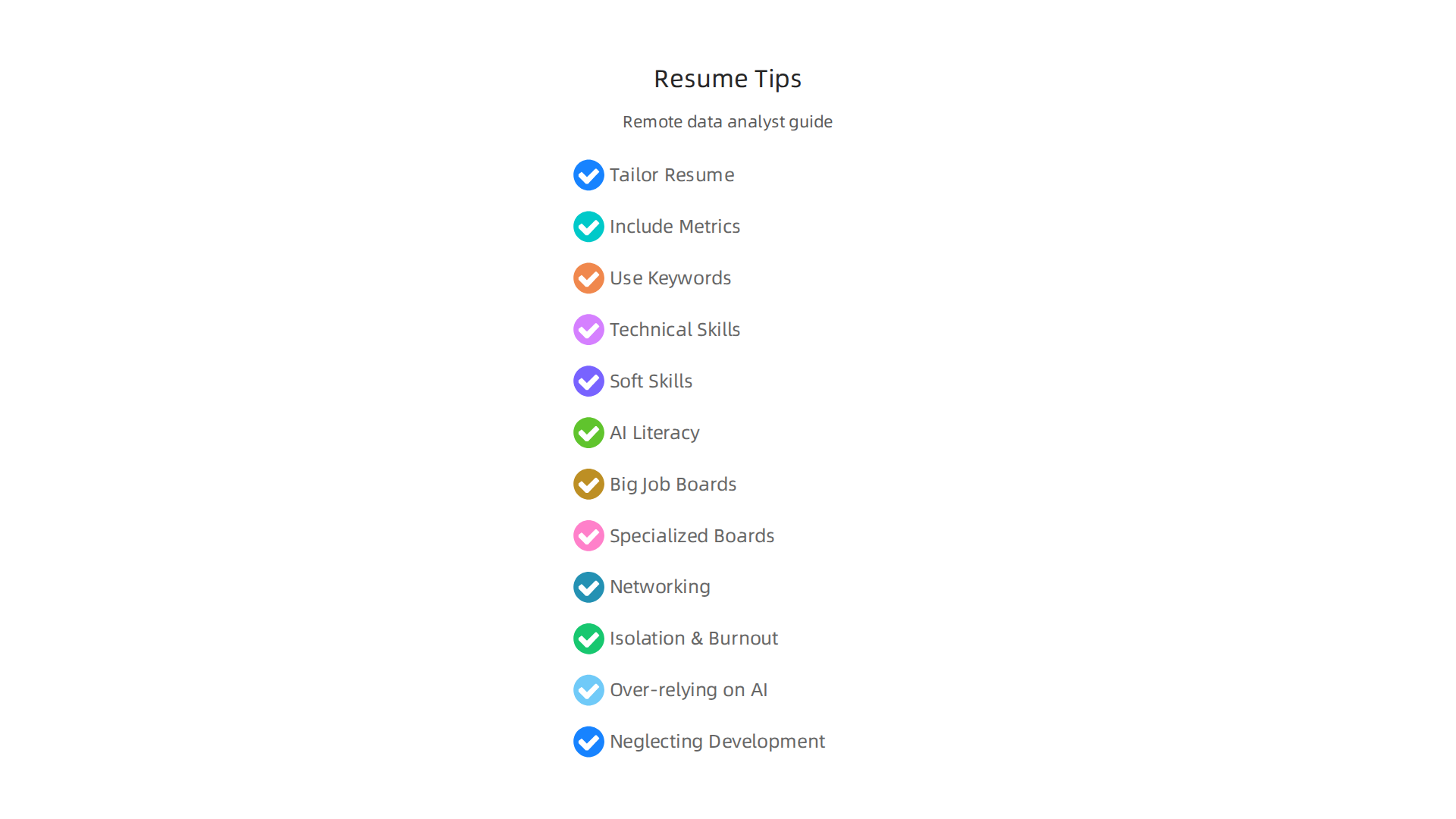
Tailor your resume to highlight remote experience.
If you have worked remotely before, make that clear. Mention the tools you used, like Slack, Zoom, Asana, or Jira. Talk about how you managed your time and communicated with teams across different time zones. Even if you only worked in an office, you can still show you are ready for remote work by mentioning independent projects or self-directed learning. The key is to show you can work without someone looking over your shoulder.
Include metrics and quantifiable achievements.
Hiring managers love numbers. Do not just say you analyzed data. Say you "reduced customer churn by 15% using a predictive model" or "cut monthly reporting time by 10 hours with automated dashboards." This makes your impact real. According to career experts, a strong data analyst resume focuses on achievements, not just duties. Use the STAR method to structure your bullet points. One guide on what to include in a data analyst resume explains that quantifying your achievements adds impact and shows the value you brought.
Also, try the formula "Accomplished X by doing Y as measured by Z." This makes each bullet clear and results focused.
Use keywords from job descriptions to pass Applicant Tracking Systems (ATS).
Most companies use software to screen resumes before a human ever sees them. That software looks for specific keywords. If a job posting asks for SQL, Python, Tableau, and A/B testing, make sure those exact terms appear in your skills section and work experience. A complete overview of data analyst resume examples for 2026 recommends listing tools by category and including statistics skills like "A/B testing" and "regression analysis" as separate items. You can also add relevant certifications like the Google Data Analytics Certificate if you have them.
Do not guess at keywords. Pull them directly from three to five remote data analyst job descriptions you want. Then weave them naturally into your resume.
Final tip: Keep your professional summary tight and specific. Avoid phrases like "detail oriented analyst." Instead, name your years of experience, your top tools, and one big result. For more on building a strong analytical approach, check out this guide to mastering the data science process.
Top Platforms and Strategies for Finding Remote Data Analyst Jobs
With your resume polished and ready, the next step is knowing where to look. Remote data analyst jobs can be found on many platforms, but the best opportunities often come from a mix of smart searching and active networking.
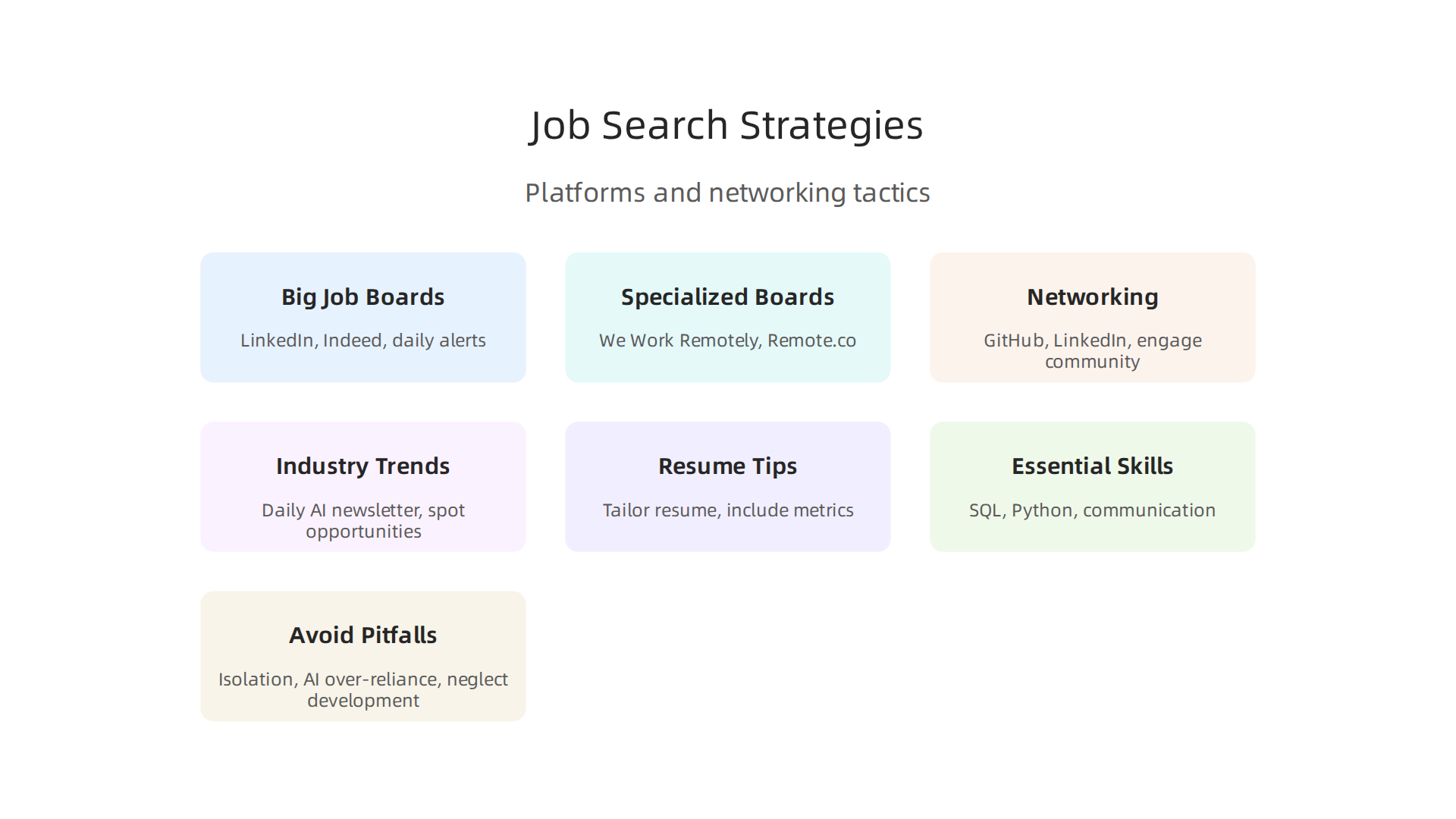
Start with the big job boards. LinkedIn and Indeed are still the top places for data roles. You can filter by "remote" and set up daily alerts so you never miss a new posting. But do not stop there. Specialized remote job boards like We Work Remotely, Remote.co, and even Y Combinator Jobs (for startup roles) often list positions that get less attention on mainstream sites. For a more targeted approach, check out DataAnalyst.com which lists remote data analyst jobs directly.
Networking is just as important, and for remote roles, your online presence matters a lot. Share your data projects on GitHub, write about your analysis process on LinkedIn, and engage with the data community. Companies are more likely to notice someone who shows their skills publicly. The 2026 job market is still strong, with demand for data analysts projected to grow 34% by 2034 according to a LinkedIn analysis of data analyst job growth. To understand why this field is booming, check out why data specialists are more critical than ever in the age of AI.
Another overlooked strategy is staying informed on industry trends. Many remote data analyst jobs are posted first in niche communities or by companies that value continuous learning. Subscribing to a daily AI newsletter can help you spot emerging companies and trends early. For example, the Your Daily AI Shortcut delivers simple daily insights that can reveal hidden job opportunities in AI and tech.
Finally, remember that consistency wins. Set alerts, check new postings daily, and keep building your skills. The effort pays off.
Preparing for the Remote Data Analyst Interview
You have found great remote data analyst jobs to apply for. Now comes the part that makes many people nervous: the interview. But with the right preparation, you can walk in feeling confident.
Most remote data analyst interviews include a technical assessment. Expect to be tested on SQL queries, Python data manipulation, and a data analysis case study. Companies want to see how you think, not just what you already know. Practice writing clean SQL joins and Python pandas code without looking things up. Time pressure is real, so simulate that at home.
Behavioral questions are just as important. Since this is a remote role, hiring managers will ask about your self-discipline, how you handle cross-timezone collaboration, and how you stay motivated without direct supervision. Have a few stories ready that show you can manage your own schedule and communicate clearly in writing.
A great way to structure your answers is the STAR method: Situation, Task, Action, Result. This helps you tell a clear story about a real data project you completed. For example, talk about a time you improved a dashboard or found a trend that saved money. The Dice guide to data analyst resumes explains how to use this technique to highlight your past wins.
Another key part of preparation is knowing what tools the company uses. If they rely on a specific platform like Tableau or Power BI, brush up on it before the interview. If you want a broader view of the skills that matter in 2026, check out this guide to mastering the data science process. It covers the full workflow from raw data to actionable insights.
Finally, practice out loud. Record yourself answering a few questions and listen back. It feels awkward at first, but it helps a lot. When interview day comes, test your internet connection, find a quiet spot, and log in early. Being prepared is half the battle.

Tools and Technologies Every Remote Data Analyst Should Master
You have prepared for the interview. Now let’s talk about the tools you need to know before you even apply. Every hiring manager looks for a certain tech stack. Master these, and your resume will stand out.
The most important tool is SQL. You will write SQL queries every day. It is the language of databases. Next comes Python, especially the pandas and numpy libraries. These help you clean and analyze data fast. Then you need a visualization tool. Power BI and Tableau are the top choices. As noted in this discussion on the data analyst career path in 2026, the order to learn is SQL first, then Python basics, then either Power BI or Tableau depending on your market. That advice still holds.
AI tools are now part of the everyday workflow. ChatGPT and other AI assistants help you write code, debug errors, and explore data faster. Many analysts use them to generate initial SQL queries or Python scripts. This saves time and lets you focus on the bigger picture. Employers value this efficiency.
Cloud platforms are also becoming necessary. AWS, Google Cloud, and Azure host the data you will work with. You do not need to be an expert, but knowing how to query data from cloud databases is a big plus. Version control with Git is another skill that sets you apart. It helps you track changes and collaborate with your team.
If you want to dive deeper into which tools to pick for your specific situation, check out this practical guide on how to choose data analysis tools in 2026. It breaks down the options based on your goals.
To keep up with the fast pace of AI tool updates, many analysts subscribe to a daily newsletter. It is an easy way to learn about new tools without spending hours searching. Join The Deep View Newsletter for simple daily AI insights. It covers the latest AI developments that can make your work easier.
Focus on building strong skills in these core areas. The tools will change over time, but the fundamentals will serve you throughout your career.
Navigating Career Growth as a Remote Data Analyst
You have the tools. You landed one of those remote data analyst jobs. Now what? The best thing about this career is that it does not stop at one role. Many paths open up once you gain experience.

According to this data analyst career paths guide on Coursera, four main directions exist: data scientist, management, specialist roles, and consulting. Senior data analyst roles pay a median of $132,000, while analytics managers earn around $143,000. Director of analytics roles can reach $221,000. So the upside is real.
But you do not get there by sitting still. You need continuous learning. Online courses on platforms like Coursera and DataCamp help you build new skills. Certifications also matter. The Google Data Analytics Certificate is one well-known option. For a deeper look at which credentials carry the most weight, check out this guide to top data analysis certifications in 2026 for AI professionals.
The job market supports this growth too. The US Bureau of Labor Statistics predicts a 23% increase in data jobs through 2032, as noted in the data analyst job outlook for 2026. Salaries are rising alongside demand. The average data analyst now earns around $111,000, up $20,000 from last year.
Now for a key warning about remote work. Remote roles can quietly stall your growth if you stay passive. You have to advocate for yourself. Send weekly summaries of your work. Record Loom videos showing your impact. Volunteer for stretch projects. Build relationships outside your direct team. As one career guide puts it, remote does not mean isolated. It means you have to be intentional about your growth.
Stay current with AI trends too. The field changes fast. Following industry news helps you spot new opportunities early. That awareness can guide your next move, whether you aim for a promotion or a shift into a new domain like marketing analytics or data science.
Common Pitfalls and How to Avoid Them
Even the smartest data analysts run into trouble when working remotely. Let’s talk about three big mistakes and how to steer clear of them.
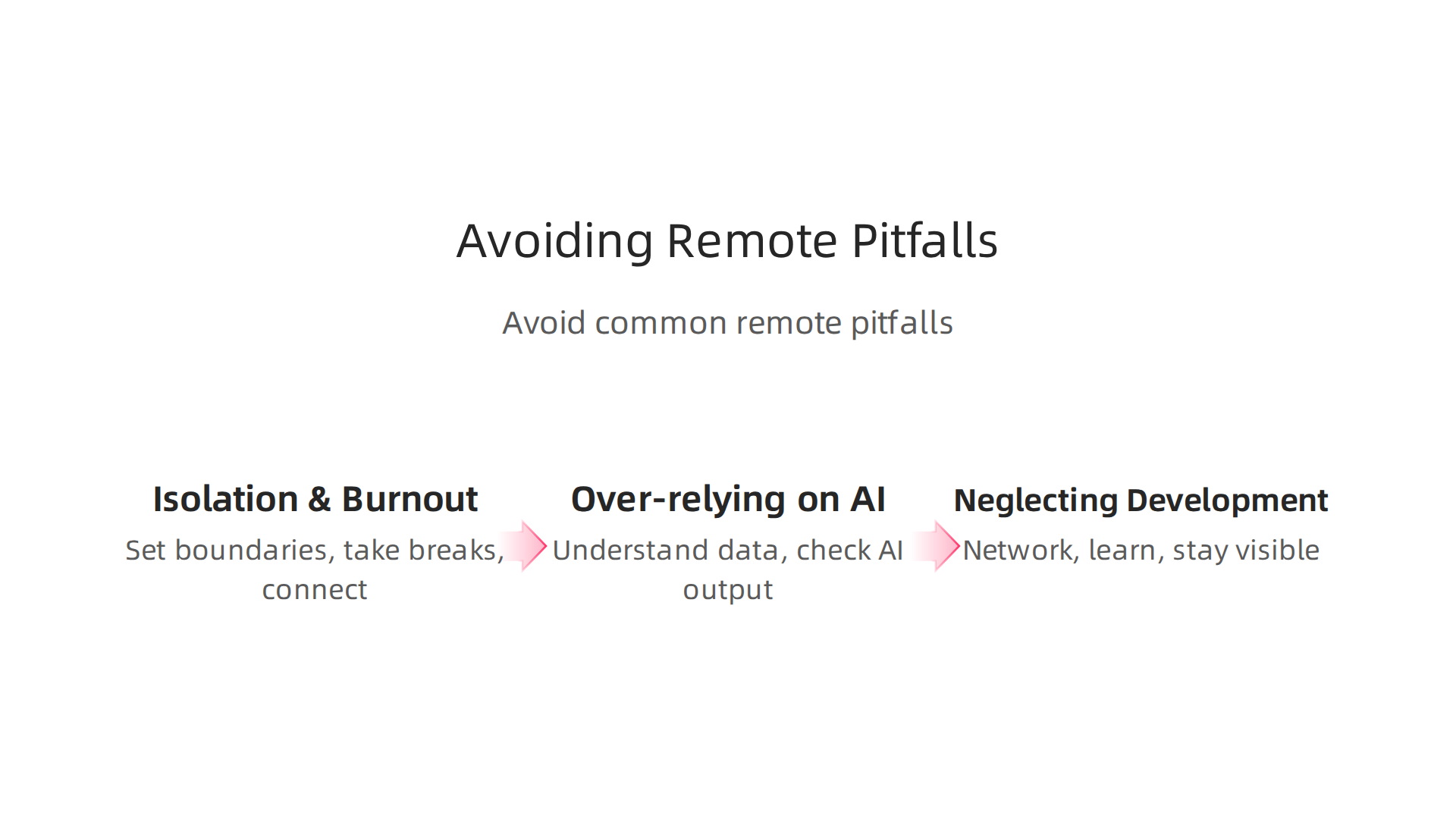
Isolation and burnout are real dangers. When your home is your office, the line between work and rest blurs. You might check emails at midnight or skip lunch to finish a dashboard. Over time, this drains you.

The fix is simple but hard: set firm boundaries. Decide when your workday ends. Take real breaks. Stay connected with teammates through casual chats, not just project updates. If you are wondering whether remote work still pays off, this detailed look at the remote data analytics career in 2026 offers useful perspective.
Over-relying on AI tools without understanding the data is another trap. Many analysts now use AI to generate code, clean datasets, or even build models. That is fine. The problem comes when you trust the output without checking it. AI can make mistakes. If you do not understand the underlying data, you might present flawed insights to decision makers. That hurts your credibility. That is why data specialists are more critical than ever in the age of AI. Your job is to question the data, not just run a tool.
Neglecting networking and professional development is the third pitfall. Remote roles make it easy to focus only on your tasks and forget to build connections. But your career depends on visibility and relationships. You need to learn from others, share your work, and stay updated on industry trends. If you skip this, you limit your growth and miss out on opportunities like promotions or lateral moves into roles like digital marketing jobs or data science. For a complete walkthrough of what it takes to succeed, check out this full guide to becoming a remote data analyst in 2026.
Avoid these three mistakes, and you will stay healthy, accurate, and visible in your remote role.
Summary
This guide explains how to find and land remote data analyst jobs in 2026, where AI has shifted the role from repetitive data cleaning to higher‑level insight and storytelling. It covers what modern employers expect—strong SQL and Python basics, visualization skills, plus AI literacy and clear written communication for remote work. You’ll learn how to craft a results‑focused resume that passes ATS, where to search (job boards and niche communities), and how to prepare for technical and behavioral interviews. The article reviews the core tools (Power BI/Tableau, cloud platforms, Git, AI assistants) and offers concrete strategies for networking, continuous learning, and certification choices. It also outlines career paths and pay ranges, and warns about common remote pitfalls like burnout and overreliance on AI. After reading, you’ll know which skills to prioritize, how to present your impact, and practical next steps to succeed in a remote analyst role.