

Introduction: Navigating Your BI Career in the Age of AI
The world of data is changing fast. If you are a business intelligence analyst or thinking about becoming one, you already know that artificial intelligence is reshaping everything. In 2026, over three-quarters of global enterprises rely on AI-powered business intelligence to make faster, smarter decisions. That changes what companies expect from you.
Here is the thing. The old job description for a business intelligence analyst focused on building dashboards and running SQL queries. That work is not going away. But now, companies want analysts who can do much more. They want people who understand machine learning, who can talk to executives about strategy, and who know how to work alongside AI tools.
According to LinkedIn, the business intelligence analyst role in 2026 is more influential and strategically embedded than ever. AI is not replacing analysts. It is making them more valuable.
By 2026, the business analyst role will be more influential, analytical, and strategically embedded than ever before. The convergence of AI, automation, agile methodologies, and lean thinking is reshaping how value is delivered and sustained.
That shift creates huge opportunities. But it also creates a problem. There is so much information out there that it is easy to feel lost. You might wonder whether you should learn Python or stick with SQL. You might ask yourself if you need a certification to compete. You might think about becoming a junior data scientist or an ai engineer instead.
This article cuts through the noise. I have gathered the latest evidence on skills, certifications, salary trends, and career strategies for 2026. Whether you are just starting out or looking to level up, you will find a clear path forward. If you want to keep up with daily AI developments that affect your career, consider subscribing to the Your Daily AI Shortcut newsletter for simple daily insights.

Let us start with the most important question. What does a business intelligence analyst actually do in 2026?
The Evolving Role of the Business Intelligence Analyst
So what does the job actually look like now? In 2026, the business intelligence analyst title still exists, but the day-to-day work has shifted in a big way.
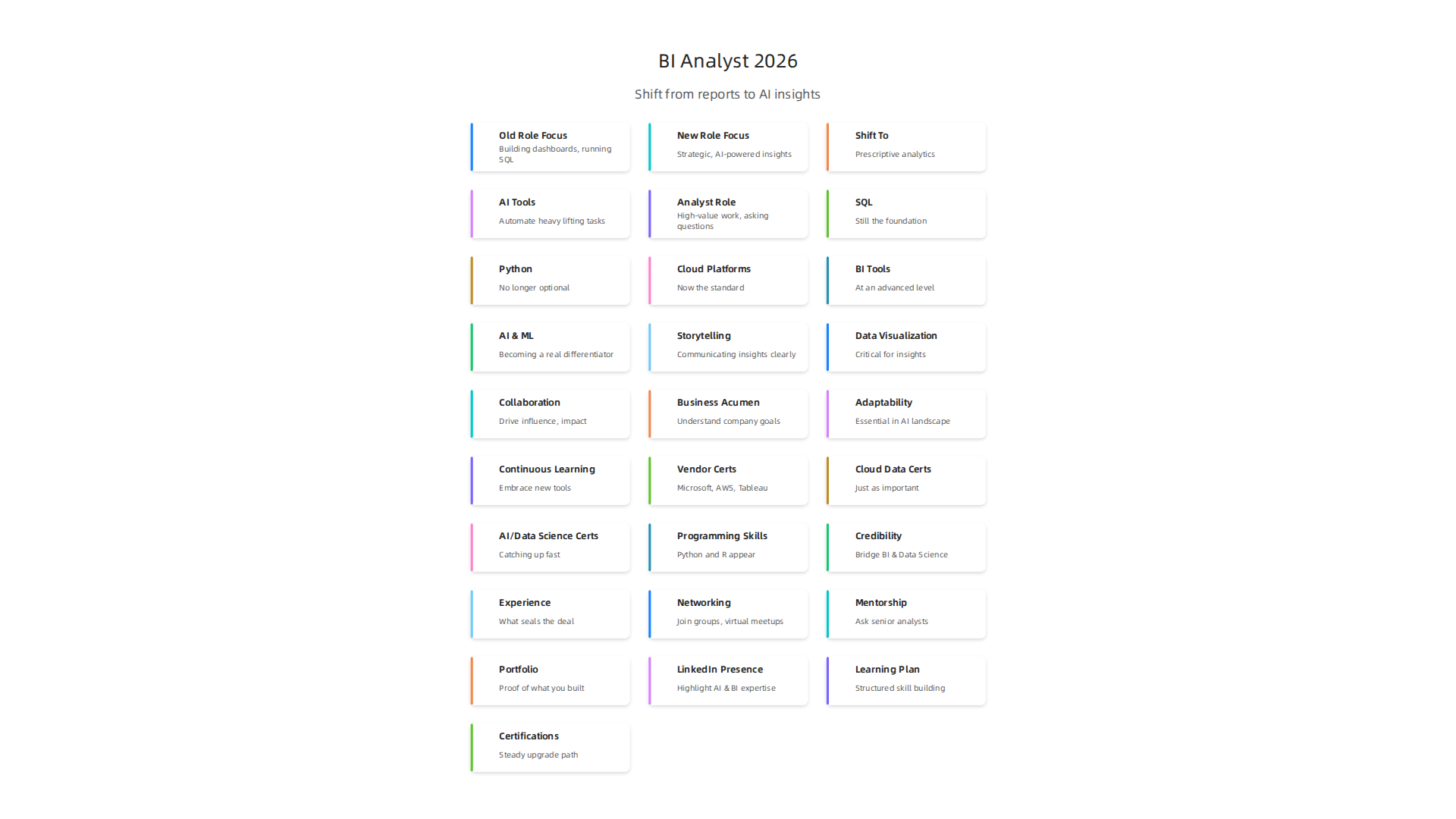
You are no longer just a person who builds dashboards and replies to ad hoc requests. Companies expect you to bring AI and machine learning into your workflow naturally.
Think about it this way. In the past, your job was mostly about describing what happened. Sales went up. Costs went down. That is called descriptive analytics. But now, businesses want more. They want prescriptive analytics: not just what happened, but what should happen next. That is where the demand for new competencies comes from.
According to a detailed look at the evolving business analysis role on LinkedIn, analysts in 2026 are expected to act as strategic partners.

They help organizations sense change early and adapt quickly. That means you need to understand predictive modeling, scenario testing, and how to communicate those insights to leaders who may not be data experts.
Here is the real shift. AI tools now handle a lot of the heavy lifting. Data preparation, trend spotting, and even writing simple reports are automated. That frees you up to focus on higher-value work: asking better questions, validating AI outputs, and designing systems that deliver insights at the point of decision. Machine learning job postings for BI roles have doubled to 14 percent, showing just how much AI integration matters now.
If you want to stay ahead, you have to watch industry trends closely. The move from reactive reporting to proactive intelligence is not slowing down. Understanding where the field is heading helps you pick the right skills to learn next. For more context on why this matters, check out why data specialists are more critical than ever in this new environment.
The bottom line? Your role is not disappearing. It is leveling up. And that is actually great news for your career.
Essential Hard Skills for BI Analysts in 2026
So what specific skills do you need to actually level up? Let me break down the hard skills that employers are looking for right now. The good news is you probably already have some of them.
The challenging news is the bar has moved higher.
SQL is still the foundation. That has not changed. Every company with a database needs someone who can write queries, join tables, and pull the right data. SQL is the one skill that shows up in nearly every job posting. If you do not have it solid, start there. It is the language that connects you to the raw data. Almost every data-driven organization relies on SQL to access and manage information effectively, as noted in a guide to data analytics skills every business professional needs in 2026.
Python is no longer optional. In 2026, Python has become mandatory for most business intelligence analyst roles. You need it for data cleaning, automation, and advanced analysis. Power BI and Excel cannot do everything. Python lets you go beyond what those tools offer. You can build scripts that automate repetitive tasks, run statistical models, and connect to APIs. If you only know SQL and a BI tool, adding Python will open way more doors.
Cloud platforms are now the standard. Think Snowflake, BigQuery, and AWS. Companies have moved their data warehouses to the cloud. That means you need to understand how to query data in these environments, manage permissions, and work with large datasets that live outside your local machine. Cloud skills are one of the fastest ways to stand out in 2026.
BI tools at an advanced level. Tableau, Power BI, and Looker are the big three. But basic dashboard building is not enough anymore. Employers expect you to know advanced features: calculated fields, custom visuals, performance optimization, and embedding analytics into other applications. You should be able to build a dashboard that tells a story, not just displays numbers.
AI and machine learning fundamentals are becoming a real differentiator. You do not need to be an ai engineer. But understanding how machine learning models work, how to interpret their outputs, and when to suggest using them is becoming a core expectation. If a model identifies a pattern, you need to explain it to your business stakeholders in plain language. That is where the value lives. Core business intelligence analyst skills now include familiarity with predictive modeling and scenario testing to guide decision making, as outlined in an overview of essential business intelligence analyst skills.
Here is the honest truth. You do not need to learn everything at once. Pick one gap in your current skill set and focus on it for 90 days. SQL first if you are weak there. Then Python. Then a cloud platform. The demand for these skills is not slowing down. Companies are actively hiring analysts who can bridge the gap between raw data and real business strategy.
If you want practical advice on building these skills and landing a remote role, check out this guide on how to land remote data analyst jobs in 2026. It covers resume tips and interview strategies that match what employers are actually asking for.
Staying current with fast changing skill requirements is tough. That is why getting a daily dose of AI and tech news straight to your inbox can save you hours of research time. Your Daily AI Shortcut delivers simple, actionable insights so you always know what matters for your career.
Soft Skills That Set You Apart
Here is something that surprises a lot of people. Technical skills will get your resume noticed. But soft skills are what get you hired and promoted.
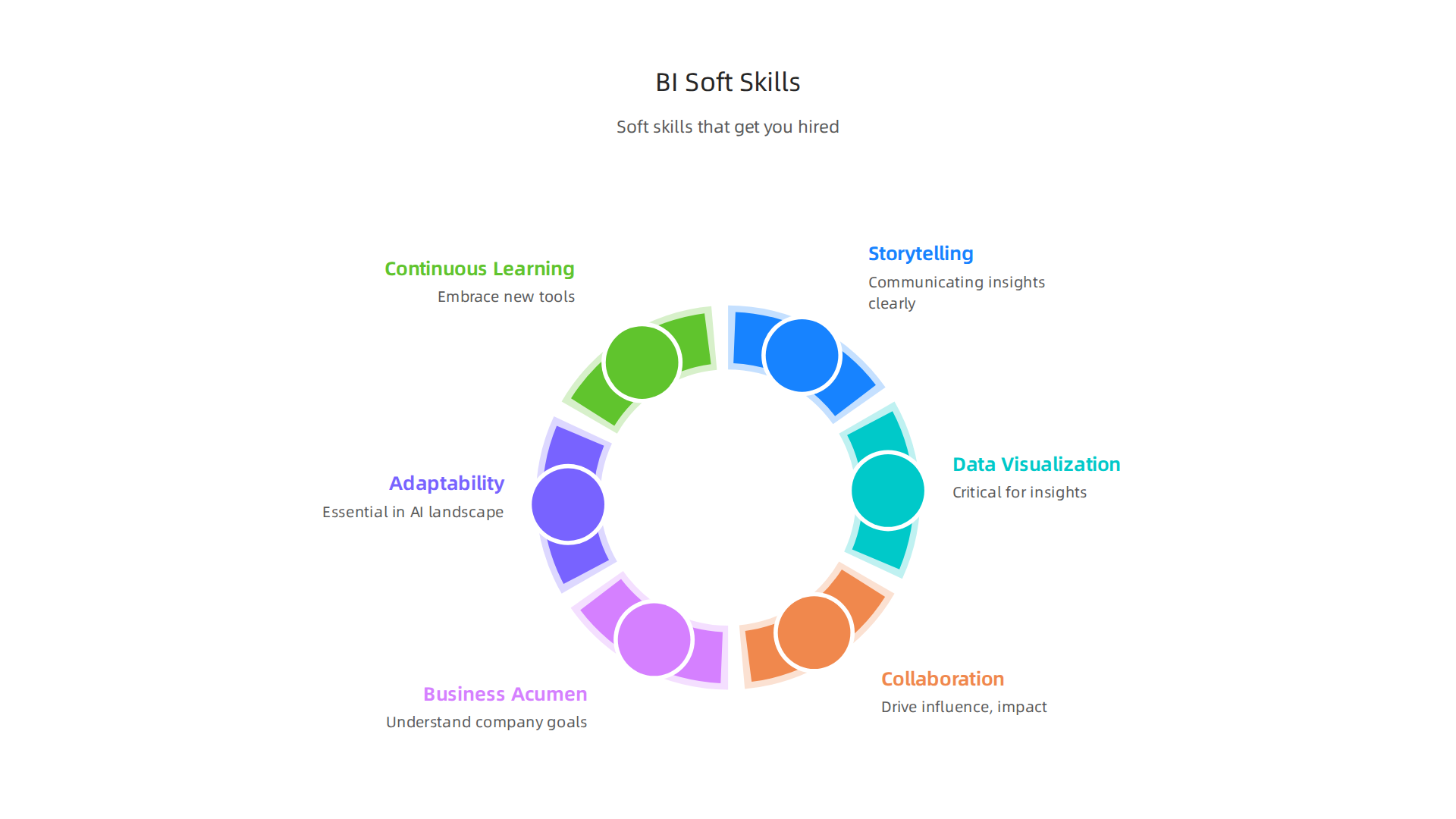
In 2026, employers care just as much about how you communicate, collaborate, and adapt as they do about whether you can write a perfect SQL query. An analysis of 1.3 million job postings on LinkedIn found that communication is the most mentioned competency across all roles, not Python or accounting. The ability to explain ideas clearly, listen actively, and persuade others is what makes a good business intelligence analyst into a great one.
Storytelling and data visualization are critical for communicating insights. You can build the most technically accurate dashboard in the world. But if your stakeholders cannot understand what it means, it does not matter. A great BI analyst knows how to turn numbers into a narrative. You need to highlight the problem, show the data that explains it, and recommend a clear action. That is what people call data storytelling. It is the bridge between raw analysis and real business decisions. Employers in 2026 actively look for candidates who can translate complex data into simple, actionable insights.
Cross-functional collaboration and business acumen drive influence and impact. You will work with marketing, finance, product, and leadership teams. Each group speaks a different language. The BI analyst who can understand their goals, ask good questions, and deliver answers that actually help them win is the one who becomes indispensable.

That takes emotional intelligence, active listening, and a genuine curiosity about how the business works. If you want to stay ahead of the curve, learning how to cut through information overload is just as important as any tool. Check out this guide on how to master data scouting in 2026 to sharpen your ability to find signal in the noise.
Adaptability and continuous learning are essential in a rapidly changing AI landscape. The tools you use today might be different a year from now. New AI models, new platforms, and shifting business priorities will keep coming. The BI analysts who thrive are the ones who embrace change rather than resist it. That means staying curious, experimenting with new tools, and building a habit of learning. Soft skills like adaptability, critical thinking, and emotional intelligence are among the most in-demand workplace competencies for 2026, according to a report on top workplace skills employers will demand in 2026. These skills cannot be automated, and that makes them your most secure career asset.
Here is the bottom line. Technical skills get you in the door. But soft skills are what keep you in the room and move you up the ladder. Start practicing how you explain your findings. Volunteer to present in meetings. Ask your stakeholders what they actually need. Build your business understanding. The best BI analysts are not just data experts. They are trusted partners who help guide decisions with clarity and confidence.
Certifications That Matter in 2026
You have the soft skills. You are learning the tools. But there is one more thing that can make hiring managers take a second look at your resume in 2026. A solid certification.
Not all certs are created equal, though. Picking the right ones can speed up your career. Picking the wrong ones just costs you time and money.
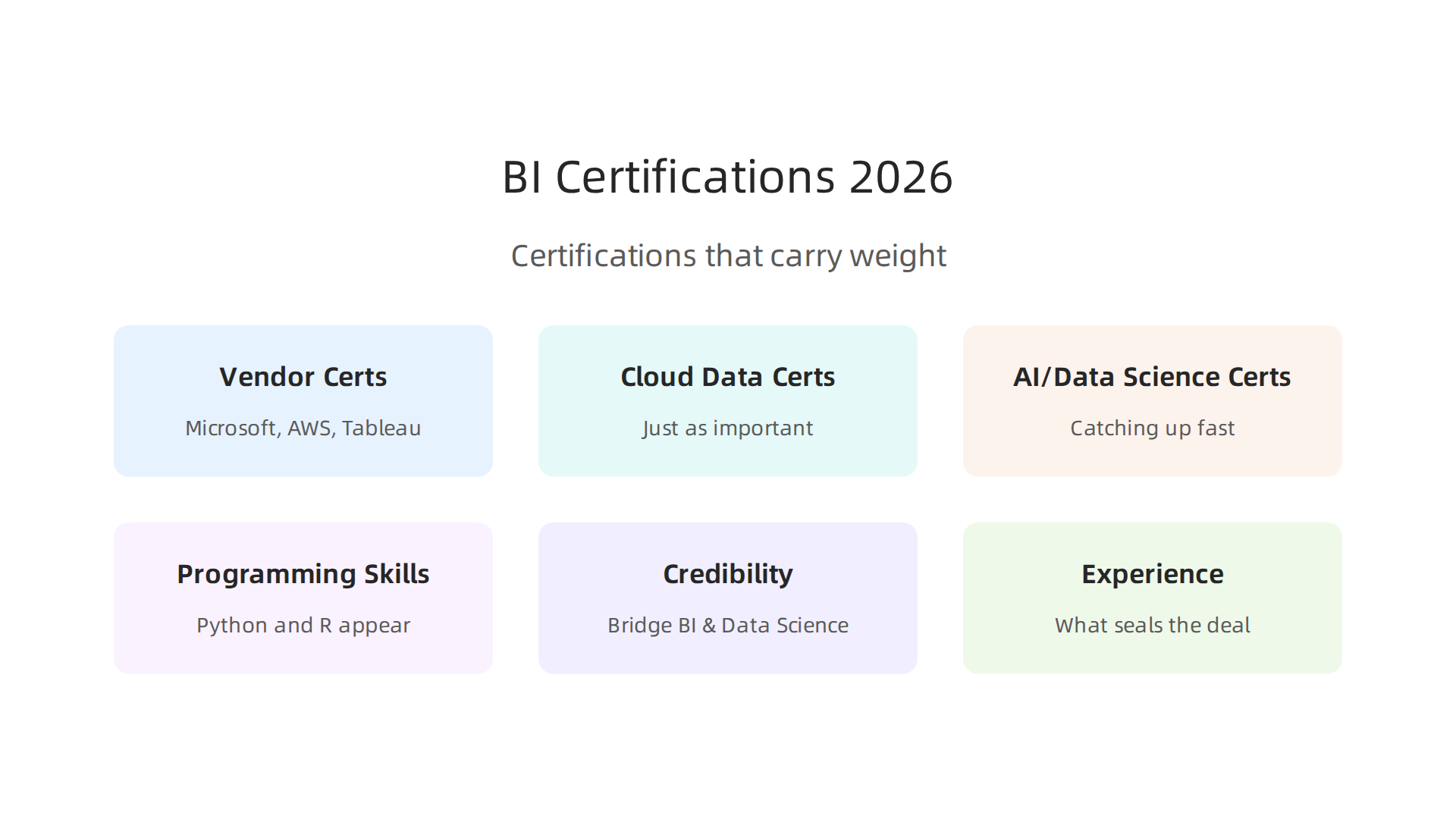
Vendor certifications from Microsoft, AWS, and Tableau still offer real return on investment. These are the platforms most companies rely on every single day. Earning a Microsoft Power BI Data Analyst Associate, an AWS Certified Data Analytics Specialty, or a Tableau Desktop Specialist tells employers you can hit the ground running. It reduces their uncertainty about your hands-on ability. It also shows discipline. You studied, you sat for the exam, and you passed. Companies value that signal. And as cloud platforms like Snowflake and BigQuery become standard, a discussion on what skills to upgrade as a 2026 BI analyst confirms that cloud data certifications are becoming just as important as traditional BI certs.
AI and data science certificates are catching up fast. Here is what is different this year. A pure BI certification alone no longer impresses the way it used to. Employers increasingly want analysts who understand machine learning fundamentals, know Python for data analysis, and can speak the language of AI. A certificate that covers Python, basic statistics, and predictive modeling adds a layer of credibility that a dashboard-only cert cannot match. That is especially true if you are aiming for roles that sit between a traditional business intelligence analyst and an AI engineer. As one report on essential business intelligence analyst skills points out, programming skills like Python and R now appear alongside SQL and data visualization in job postings. The line between BI and data science is blurring. Your certification should reflect that.
Certifications prove your skills are current, but experience is what seals the deal. Hiring managers look at a cert as a starting point. They want to see what you actually built with those skills. The winning combination in 2026 is a strong certification paired with a portfolio of real projects. Show the dashboard you designed. Show the analysis that helped a team make a decision. If you want to explore which credentials carry the most weight right now, take a look at this guide to top data analysis certifications for 2026.
The certification landscape shifts fast. The cert that made you competitive three years ago may not open doors today. Stay focused on the ones that match where the industry is heading, not where it has been. And while you are building those credentials, keeping up with daily changes in AI can feel like a full-time job on its own. Your Daily AI Shortcut delivers simple daily insights straight to your inbox so you never miss what matters.
Salary and Compensation Trends
Once you have the right certifications, the next question is usually the same. What can you actually earn? The good news is that business intelligence analyst salaries have gone up in 2026. And if you bring AI skills to the table, you can expect even more.
Looking at the numbers, the average base salary for a business intelligence analyst in the US sits between $85,000 and $99,000 per year. This data comes from a detailed 2026 Business Intelligence Analyst salary guide. But that range shifts a lot based on your experience. Entry level analysts with less than one year of experience earn around $90,000. Mid level analysts with four to six years of experience make about $112,000. Senior analysts with ten or more years of experience can earn $128,000 or more. The top 10 percent of earners push past $148,000.
Here is where the market has changed in your favor. AI expertise now commands a real premium. Companies are hungry for analysts who can work with machine learning models, build predictive dashboards, and understand how AI tools fit into business decisions. If you have those skills stacked on top of your BI foundation, you can push your salary well past the averages. That is one reason why the path from business intelligence analyst to AI engineer is becoming more common.
Your location also makes a big difference. The highest paying cities for BI analysts include Andrews, MD, Cupertino, CA, and Nome, AK. These areas offer salaries 23 to 27 percent above the national average. If you can work remotely for a company based in one of these high paying regions, that is a smart career move.
Industry matters just as much. Manufacturing companies pay a median total compensation of $106,958 for BI analysts. Human resources and staffing firms pay $105,875. Telecommunications companies pay $105,094. Energy, mining, and utilities also offer strong pay at around $101,003. Picking the right industry can boost your earnings without changing your role.
Do not forget to look at the whole package. Many BI analyst roles come with bonuses, profit sharing, and restricted stock units. These extras can add $10,000 to $20,000 or more to your total compensation. When you get a job offer, ask about the full picture. The base salary is only part of the story.

If you want to dig deeper into compensation expectations and learn how to negotiate your next role, this guide on landing remote data analyst jobs in 2026 covers the skills and strategies that actually work in this market.
Building Your Career Roadmap
Now you know what you can earn. But how do you actually get there? Building a career as a business intelligence analyst in 2026 takes more than collecting certifications. The people who move up fastest combine three things: a strong network, a portfolio that proves their skills, and a structured plan to keep learning.
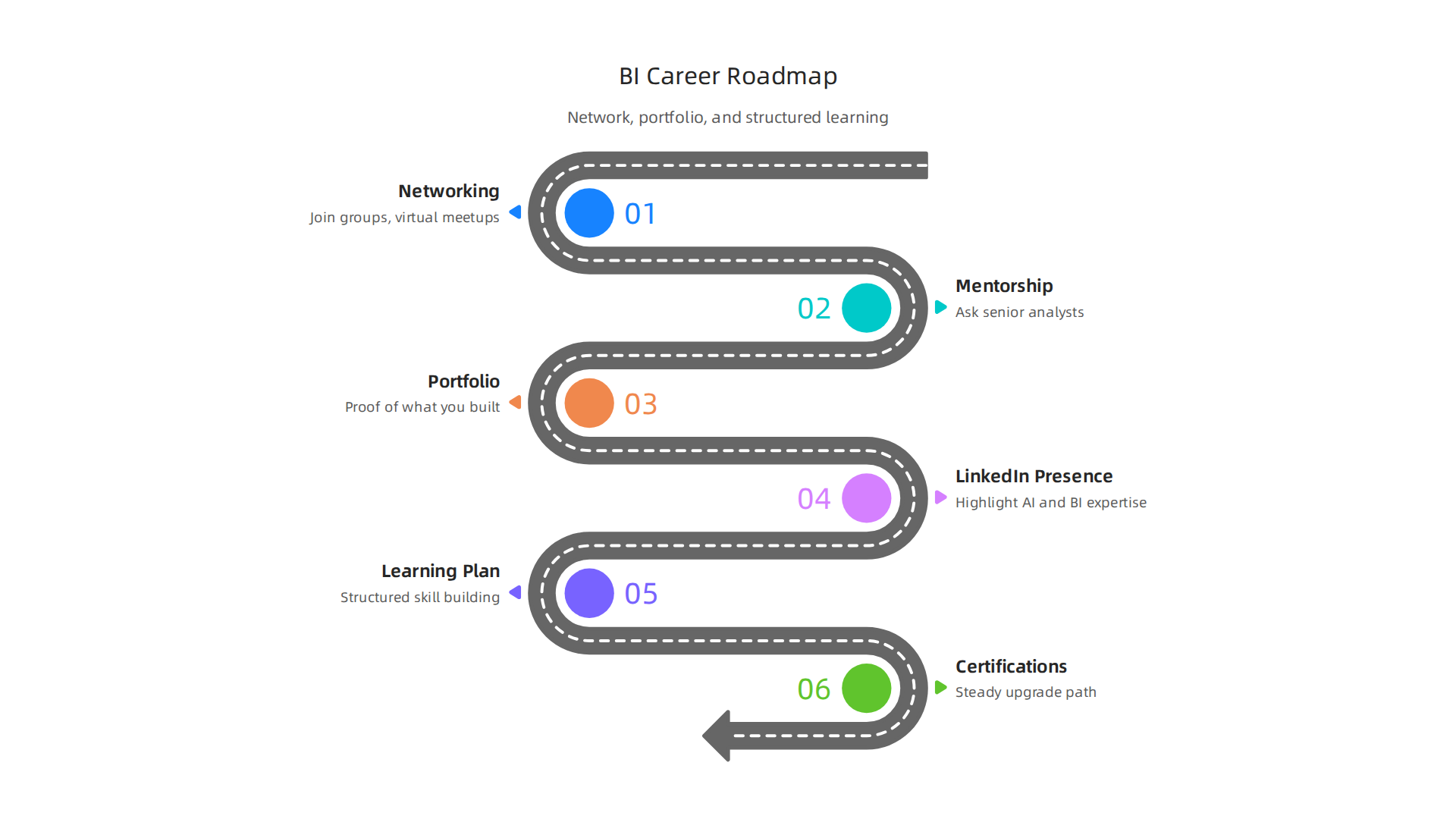
Let’s start with networking and mentorship. This is where many analysts drop the ball. They focus only on technical skills and forget that the best opportunities come through people. Join LinkedIn groups focused on business intelligence. Attend virtual meetups. Reach out to senior analysts and ask for 15 minutes of their time. Most people are happy to help if you show genuine curiosity. A good mentor can show you what certifications actually move the needle, which skills to learn next, and how to position yourself for that next promotion. These connections open doors that applications alone never will.
Next up is your portfolio and LinkedIn presence. In 2026, employers want proof of what you can actually do. Not a list of courses you finished. Build projects that solve real business problems. Create dashboards that track revenue, customer churn, or operational efficiency. Host them on GitHub or a personal website. Tailor your LinkedIn profile to highlight your AI and BI expertise. Use the headline to describe what you do. Write about your projects in the experience section. A well crafted profile gets noticed by recruiters who search for specific skills like SQL, Power BI, and Python. One strong project speaks louder than ten half finished courses.
Finally, create a structured learning plan. This is not about jumping from one random course to another. It is about building skills in a logical order. Start with SQL and Excel. Move into visualization tools like Power BI or Tableau. Then add Python for deeper analysis. Once you have those, learn cloud platforms like Snowflake or BigQuery. The complete BI analyst roadmap for 2026 walks through each step with the exact progression you need to stay competitive.
Keep your certifications on a steady upgrade path. The Microsoft Power BI Data Analyst Associate is a strong choice. So is the Certified Business Intelligence Professional (CBIP). Plan to earn one certification every 12 to 18 months. That keeps your resume fresh and your skills current. For a full breakdown of which credentials carry weight right now, check out this guide on top data analysis certifications 2026 for AI professionals.
Staying current is half the battle in this field. The tools and techniques change fast. You need a reliable source of daily updates to keep your edge. Your Daily AI Shortcut delivers simple daily insights so you never miss what matters in the AI and analytics world.
Summary
This article explains how the business intelligence analyst role has evolved in 2026 as AI shifts the job from descriptive reporting to proactive, prescriptive intelligence. It outlines which hard skills matter now — SQL as the foundation, Python as mandatory, cloud data platforms, advanced BI tooling, and basic ML literacy — and why soft skills like storytelling, cross‑functional collaboration, and adaptability are equally important. You’ll learn which certifications still carry weight and how to pair them with real projects, how AI skills raise compensation, and which industries and locations pay most. The piece also gives a practical career roadmap: prioritize gaps, build a portfolio, network for mentorship, and follow a structured learning sequence. Readers finish with clear next steps to stay relevant, negotiate better offers, and position themselves as strategic, AI‑savvy analysts.