

Why the next wave of personal AI assistants matters for businesses and builders
Think about how you use computers today. You open different apps for different jobs. Maybe one app helps you write, another helps with pictures, and another keeps your schedule. But what if one smart helper could do many of these things for you, even before you ask? That’s what a personal AI assistant is all about, and it’s changing fast in 2026.
We are moving past simple tools that just do one thing when you tell them. Now, we are seeing a new kind of AI. These are not just tools; they are like smart partners that learn about you. They can understand what you need, even guess what you might want next, and help you get things done. This big shift is called "agentic autonomy," where AI helpers become proactive and can plan out tasks on their own, instead of waiting for your every command Personal AI Assistant Market Size 2026-2030.
This new wave of personal AI assistants is more than just a cool idea. It’s a huge business. In 2026, the market for these personal AI assistants is already worth $4.84 billion. Experts believe it will keep growing very quickly, reaching nearly $20 billion by 2030 11 Best Personal AI Assistants in 2026 – Vellum.
This kind of growth shows that these future tools ai are here to stay and will change how we all work and live.
For business leaders, product builders, and developers, understanding this change is very important.

Executives need to know how these ai engine improvements will affect their company’s future. Product leaders need to figure out what new products to create. And developers need to learn how to build these smart assistants. Everyone needs a simple way to understand what is happening and how to use it best. A clear plan can help them evaluate the real impact and opportunities.
To stay on top of these rapid changes and understand what business leaders must know in 2026, it’s wise to keep learning.
Get clear daily AI updates from The Deep View Newsletter
How Personal AI Assistants Work: Architectures, Models, and Data Flows
So, how do these smart helpers actually work their magic? Even though a personal AI assistant can feel like a super smart friend, it’s built from different parts working together.

Understanding these parts helps us see how these future tools ai can do so much.
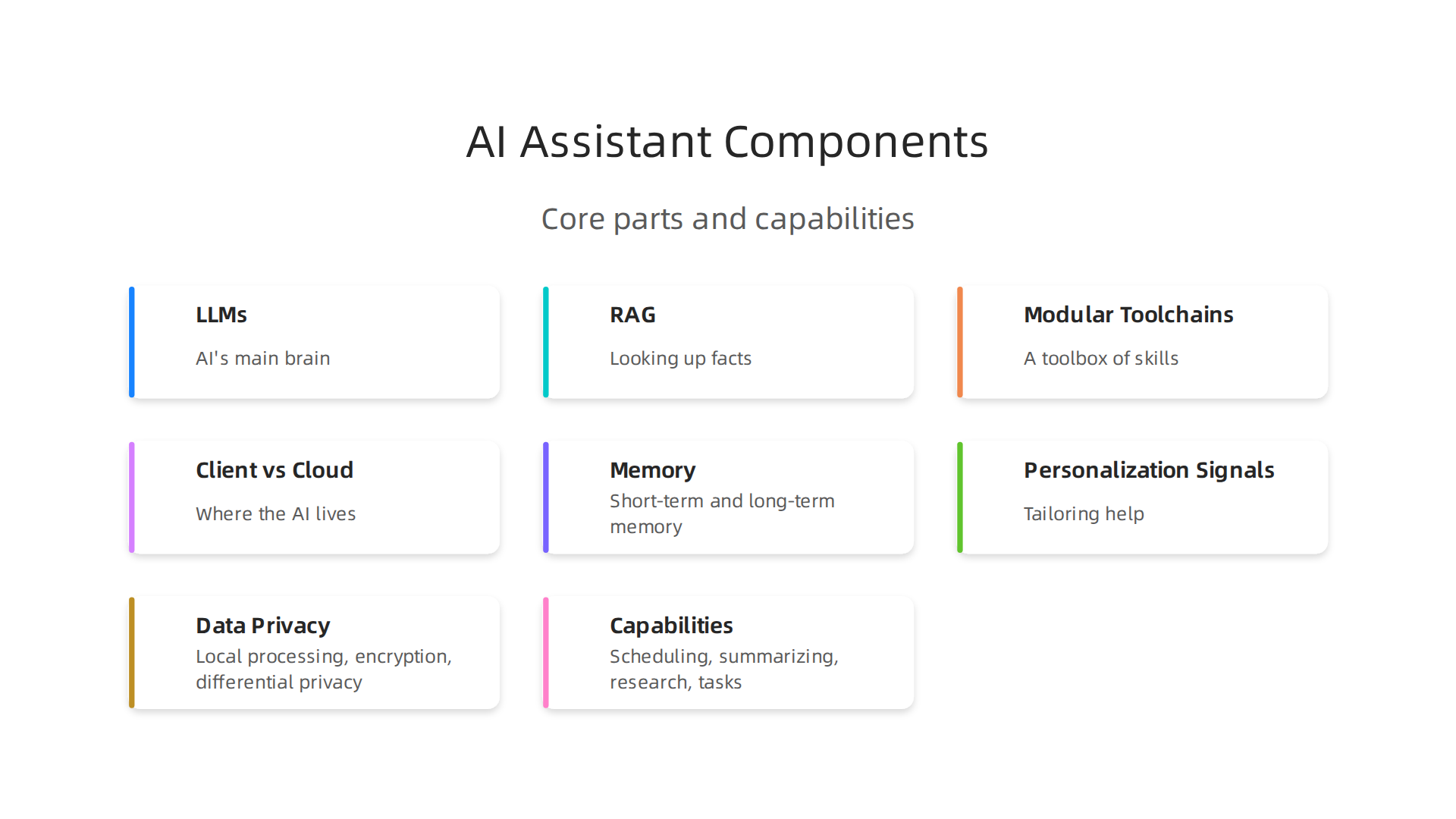
At its heart, a personal AI assistant uses a few main ideas:
The Brains and Tools of an AI Assistant
- Large Language Models (LLMs) as the Brain: Think of LLMs as the AI’s main brain. These are huge computer programs that have read tons of text and can understand and create human-like language. They are good at answering questions, writing stories, and even coding. They form the core
ai enginethat processes your requests and figures out what to do. Top providers like OpenAI, Anthropic, and Google offer strong LLMs for building these assistants in 2026 How to Build Your Personal Artificial Intelligence Assistant in 2026.

-
Retrieval Augmented Generation (RAG): Looking Up Facts: LLMs are smart, but they don’t know everything that’s new or specific to your life. This is where "retrieval" comes in. The AI can look up extra facts from its own stored information or even search the internet to get the most up-to-date or specific answer. It’s like having a super-fast librarian ready to grab the right book. This helps the AI be more helpful and accurate.
-
Modular Toolchains: A Toolbox of Skills: A modern personal AI assistant isn’t just one big program. It’s often made of many smaller parts, or "modules," each with a special job. One module might be a calculator, another a calendar, and another a web search tool. The AI brain decides which tool to use for your task. This allows for complex actions, much like how developers build advanced AI solutions using different parts Flow AI How Developers Build Advanced AI Solutions.
-
Client-Side vs. Cloud Components: Where the AI Lives: Some parts of your AI assistant might run right on your phone or computer. This is called "client-side." It’s faster and better for your privacy because your information doesn’t leave your device. Other, more powerful parts might live in big data centers on the internet, called "cloud components." These cloud parts can do very complex tasks that need a lot of computing power. Knowing the difference is important when you choose an AI platform for your business How To Choose The Best Enterprise AI Platform For Your Organization.
How AI Assistants Remember and Learn
To be truly helpful, a personal AI assistant needs to remember things. This involves clever ways of handling information, called "data flows."
-
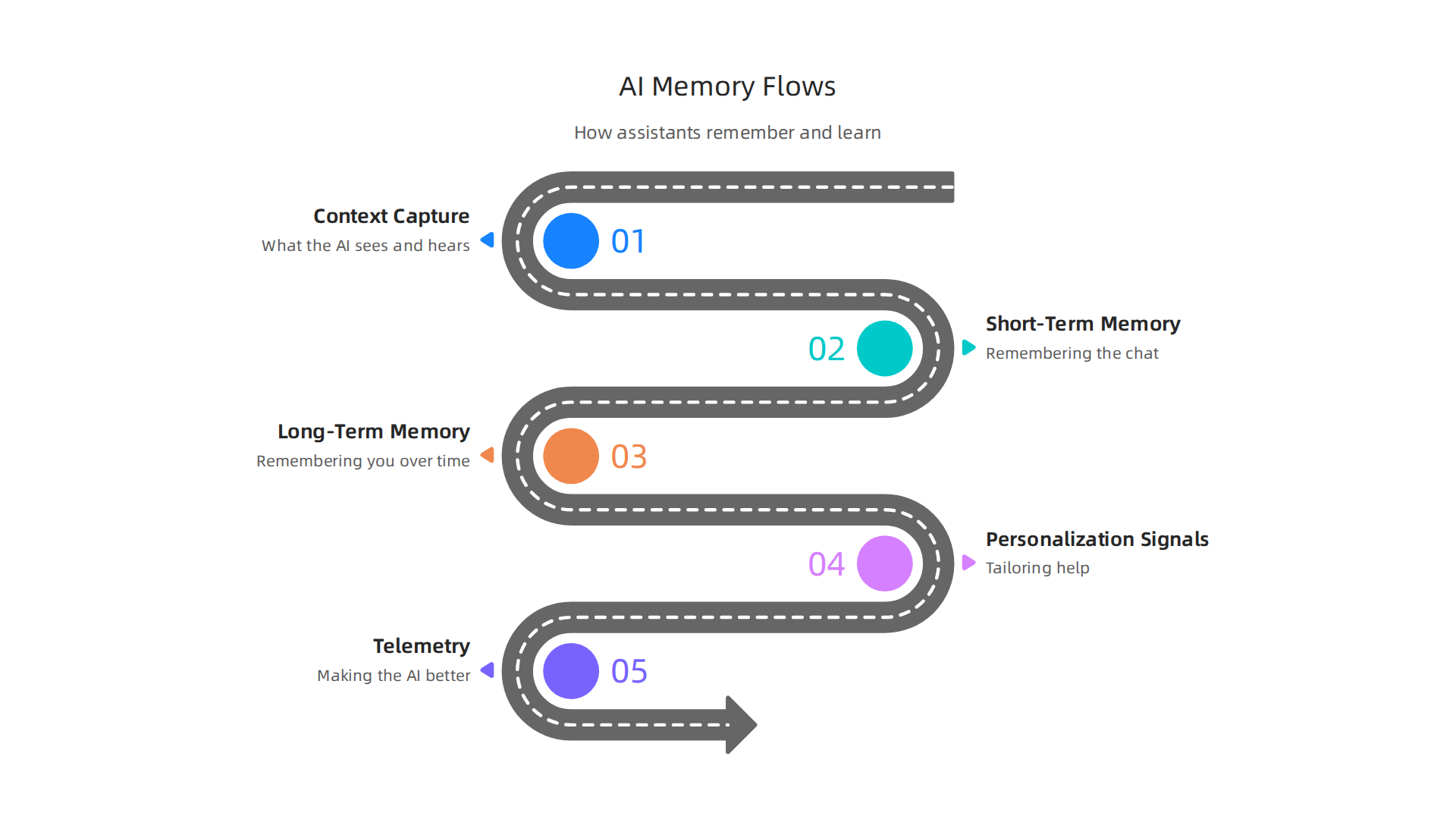
Context Capture: What the AI Sees and Hears: The AI needs to understand what you’re doing right now. This means it collects "context" from your voice commands, what you type, or even the apps you’re using. This helps it understand your immediate needs.
-
Short-Term Memory: Remembering the Chat: Imagine a normal conversation. You remember what was just said a few moments ago. AI assistants do this too, storing the recent parts of your chat. This "short-term memory" helps it keep track of the current topic. Researchers are always finding ways to make this context usage more efficient Agentic Memory: Learning Unified Long-Term and Short-Term Context Utilization for Autonomous Agents.
-
Long-Term Memory: Remembering You Over Time: This is where the magic of "personal" really comes in. A good personal AI assistant stores things like your preferences, past tasks, and important details you’ve shared. This "long-term memory" allows it to offer truly personalized help. For instance, systems like MemX are being built to offer stable, searchable long-term memory for AI assistants, often running locally for better privacy A Local-First Long-Term Memory System for AI Assistants. Making this memory work well for personalized agents is a big area of research in 2026 Benchmarking Long-Term Memory for Personalized Agents.
-
Personalization Signals: Tailoring Help: With its long-term memory, the AI learns what you like and how you work. These "personalization signals" help it give you suggestions or complete tasks in a way that fits you best. For example, a personalized LLM assistant uses evolving memory to align with your preferences and learn from real-world conversations AlpsBench: An LLM Personalization Benchmark for Real-Dialogue Memorization and Preference Alignment. This means the AI can guess what you might want next, even before you ask.
-
Telemetry for Improvements: Making the AI Better: To make the AI smarter, developers collect information about how people use it. This "telemetry" helps them find bugs, improve how the AI understands requests, and make it generally more helpful for everyone. This process is similar to why data annotation is critical for AI accuracy Why Data Annotation Tech Is Critical For AI Accuracy. They always make sure to keep your private information safe while doing this.
When a personal AI assistant learns and remembers, it collects a lot of information. This brings up very important questions about privacy.

Who owns the data you share? How can you be sure your information is safe? As future tools ai become smarter, having clear rules about privacy and data is a must in 2026.
Understanding Data Ownership and Consent
When you use a personal AI assistant, you often share personal details. This can include your calendar, emails, or even health info. It’s crucial to know that any personal information you put into an AI system, and even the new information the AI creates about you, comes with privacy duties attached Guidance on privacy and the use of commercially available ….
Think of data ownership like owning your house. You decide who comes in and what they do. With your AI assistant, you should have a say in:
- What data is collected: What kinds of information does the AI take in?
- How it’s used: Will it only help you, or will it be used to train the
ai enginefor other purposes? - Who sees it: Does anyone else get access to your data?
For this to work, you need "explicit consent." This means you clearly agree to how your data will be used. It’s especially important for private information or when the AI makes big decisions based on your data. In 2026, many places have new laws requiring clear consent for AI use [AI-Governance-Frameworks-Updated-March-2026 … – Ramparts]. These rules, like GDPR in Europe, apply to any AI system that collects or uses personal data from residents GDPR Rules for Companies To Implement AI in 2026.

You should always be given easy-to-understand information about how your data is handled.
Smart Ways to Keep Your Data Private
Good personal AI assistants use special methods to keep your information safe.
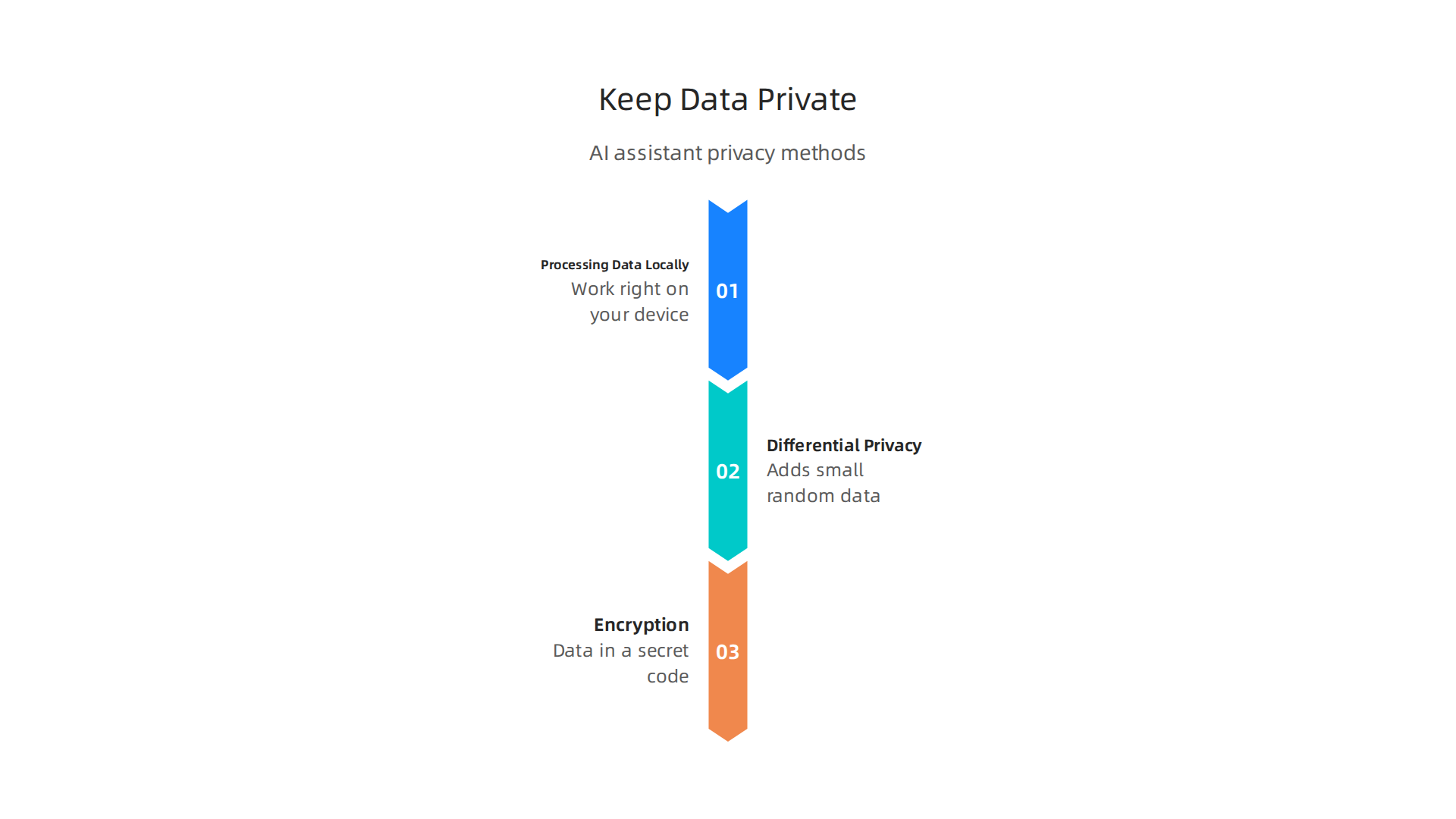
- Processing Data Locally (Localization): Some AI tools can do a lot of their work right on your device, like your phone or computer. This is called "client-side" processing. When your data stays on your device, it doesn’t travel over the internet, which makes it much harder for others to see or steal. It’s a great way to boost your privacy.
- Differential Privacy: This is a clever math trick. It adds a small amount of "noise" or random data to your information before it’s used to train the AI. This noise is too small to change your personal experience, but it’s enough to hide your individual details when the AI looks at patterns from many users. So, the AI can still learn from everyone without knowing exactly what you did.
- Encryption: This is like putting your data in a secret code.
- Encryption-in-transit: When your data has to move from your device to the cloud (like when the AI needs more computing power), it’s put into a secret code. If anyone tries to intercept it, they’ll just see gibberish.
- Encryption-at-rest: When your data is stored on a server, it’s also kept in that secret code. So, even if someone broke into the server, they couldn’t read your information. This is a standard practice for many online services today.
Practical Policies for You to Adopt
As you explore personal AI assistant options, keep these ideas in mind:
- Read Privacy Policies: Yes, they can be long, but try to understand them. Look for simple language that explains how your data is owned and used.
- Check for Consent Controls: Does the AI tool let you easily give or take back consent for different types of data use? You should have control.
- Ask About Data Storage: Does the AI emphasize local processing or offer strong encryption for data in the cloud?
- Be Aware of Regulations: In 2026, data privacy laws are becoming stronger globally, including in places like Europe and the US Governing AI in 2026: A Global Regulatory Guide White …. Companies must follow these rules.
- Understand the Risks: It’s also wise to understand the general dangers of AI, including potential privacy issues, as these tools evolve The Real Dangers of AI in 2026 Bias Privacy Job Loss and Existential Risk.
Making smart choices about privacy will help you get the most out of your personal AI assistant while keeping your digital life secure.
Want to stay on top of all the latest AI developments, including new privacy regulations and tools?
Get clear daily AI updates from The Deep View Newsletter.
Now that we’ve talked about keeping your information safe, let’s look at what these clever personal AI assistants can actually do for you today in 2026. Forget the big sci-fi ideas for a moment. We’re going to focus on the helpful things a personal AI assistant can do every day.
What assistants can do today: capabilities and realistic expectations
In 2026, personal AI assistants are not just smart; they are practical helpers. These future tools AI are getting better at understanding your needs and helping you with daily tasks. It’s good to know what they are truly good at so you can pick the right one.
Here are some real things a personal AI assistant can do:
- Scheduling and organizing: Imagine your AI assistant checking your calendar and setting up meetings for you. It can send invites and remind everyone. This saves you a lot of time.
- Summarizing information: Do you get a lot of long emails or need to read a big report? An AI assistant can quickly give you the main points. This helps you understand things faster without reading every single word.
- Helping with research: If you need to find facts or learn about a new topic, your personal AI assistant can search for you. It can gather important information and answer your questions.
- Doing small tasks again and again: Many jobs have small, repeated steps. An AI can learn these steps and do them for you. This is called task automation. It frees you up for more important work. For example, some AI tools are great for making quick video ads or other content. If you want to see what’s out there, you can find the best AI tools 2026 for your specific needs.
- Helping you make choices: An AI assistant can look at lots of information and give you clear choices or ideas. This doesn’t mean the AI makes the choice for you, but it gives you good facts to think about, helping you make better decisions.
It’s important to know the difference between what AI can do and what people hope it can do. In 2026, a personal AI assistant works best when it has clear goals and good information. These smartlead AI tools are built on powerful AI engines that are constantly being tested to make sure they perform well in real situations, especially when they need to remember things over time Benchmarking Long-Term Memory for Personalized Agents. So, while they’re not mind-readers, they are reliable helpers for many everyday needs.
To truly understand what new AI models and tools are doing now and in the future, you need a good source.
Get clear daily AI updates from The AI Newsletter Worth Reading.
Now that we’ve talked about keeping your information safe, let’s look at what these clever personal AI assistants can actually do for you today in 2026. Forget the big sci-fi ideas for a moment. We’re going to focus on the helpful things a personal AI assistant can do every day.
Regulation, safety, and ethical standards shaping assistants
As personal AI assistants become more common, it’s super important to have rules for how they work. In 2026, many places around the world are putting new laws in place to make sure these future tools AI are safe and fair. These rules help protect your privacy and make sure the AI acts in a good way.
One big focus is how personal information is handled. Laws like GDPR in Europe and CCPA in California make sure that if a smartlead AI system collects or uses your personal data, it has to be done carefully. This means the AI must ask for your permission to use your information. Also, any information the AI creates about you counts as personal data and needs to be protected, too Guidance on privacy and the use of commercially available AI products. Many countries now have binding AI laws to guide these systems Governing AI in 2026: A Global Regulatory Guide White Paper.
Making sure an AI assistant is safe also involves special engineering steps. Think of it like building a car: you add seatbelts and airbags for safety. For AI, these are called "guardrails." Guardrails are rules built into the AI engine that stop it from doing harmful things or giving bad advice.
Here are some ways companies make personal AI assistants safe:
- Red-teaming: This is like having a team of experts try to "break" the AI to find its weaknesses before it’s used by everyone. They try to make the AI say or do bad things so that the creators can fix those problems.
- Human-in-the-loop: This means a human is often involved in the AI’s important decisions. For example, if a personal AI assistant suggests something very important, a human might need to approve it first. This is especially true for tasks that could have a big impact AI View: May 2026.
- Monitoring: After an AI assistant is working, it’s watched closely to make sure it’s still acting safely and correctly. If something goes wrong, the makers can fix it quickly.
- Consent: If an AI assistant is used in a meeting, everyone in the meeting should know and agree to it being there Guidelines for AI Chatbots and Assistants. This helps make sure everyone feels comfortable.
Companies are also setting up clear rules for how they handle data, like having a Data Protection Officer. They make sure you give clear permission for how your data is used, especially for sensitive information AI Governance Frameworks Updated March 2026.
These safety steps and rules are very important. They help us trust that our personal AI assistants are not just smart but also good and reliable helpers. Understanding these aspects helps you see the bigger picture of AI and its impact. To learn more about the risks involved, check out The Real Dangers of AI in 2026: Bias, Privacy, Job Loss, and Existential Risk.
For people to really use and benefit from these trusted personal AI assistants, the companies that make them need good ways to earn money.

They also need to make sure more people and businesses want to use these future tools AI.
Business models, monetization, and adoption barriers
The market for personal AI assistants is growing fast. In 2026, it’s expected to be worth $4.84 billion. This shows that many people are interested in these smart helpers AI Personal Assistant Market Hits $4.84 Billion in 2026.
But how do these companies make money?
Most personal AI assistant companies use different ways to charge for their services:
- Subscriptions: This is a common way. You pay a set amount regularly, like every month, to use the AI assistant. Many AI companion apps use a free version first, then ask you to subscribe for more features The AI Companion Market in 2026: Business Opportunity, ….
- Hybrid Models: Some smartlead AI apps combine subscriptions with other ways to pay. For example, you might pay a monthly fee, but then buy "credits" for special tasks you only do sometimes AI Apps in 2026: Market Trends, ASO Strategies, Monetization …. This helps different types of users access the AI. Experts say that more and more software companies are using these mixed payment plans in 2026 How to Monetize AI Agents in 2026: The Complete Playbook.
- Embedded Services: Businesses also use personal AI assistants. These AI tools can be built right into other software that companies already use for work. This is called "embedded SaaS" or "enterprise services" and helps workers be more productive. The entire market for AI-powered personal assistants relies on these different payment plans to keep growing AI-Powered Personal Assistants Market Size & Industry …. If you’re looking for AI tools, it helps to understand these options to find the best AI tools 2026 for your specific needs.
Even with these ways to make money, some things stop more people from using personal AI assistants. These are called adoption barriers:
- Trust: People need to feel safe and sure that an AI assistant will do what it’s supposed to. They worry about their information and if the AI will make mistakes. Building trust is very important for AI, and good design helps people trust these smart tools 9 UX Patterns to Build Trustworthy AI Assistants.
- Costs: While prices for AI technology have come down, getting and setting up an AI engine or a smartlead AI system can still cost money.
- Learning New Ways: Sometimes, companies and people find it hard to change how they do things. Learning a new AI system and fitting it into daily tasks can take time and effort.
- Showing Value: It can be tricky for businesses to see exactly how much money or time an AI assistant saves them. They need to measure if the AI is truly worth the investment. For businesses, choosing the right AI platform is key to seeing a return on investment. You can learn more about how to choose the best enterprise AI platform for your organization.
Overcoming these barriers means making AI trustworthy, easy to use, and clearly showing its benefits.
To stay on top of all the latest AI trends and developments, get clear daily AI updates from The AI Newsletter Worth Reading.
Integration and developer tooling: APIs, SDKs, and edge deployment
To truly make a personal AI assistant work well and be easy for everyone to use, we need to think about how these smart helpers are built and connected to other things. This is where developers and special tools come in.
How personal AI assistants connect
Imagine your personal AI assistant as a brain that needs to talk to many different parts of your digital life. Companies use special methods to make this happen:
- APIs (Application Programming Interfaces): Think of an API as a waiter in a restaurant. You tell the waiter what you want (like ordering food), and the waiter goes to the kitchen (the AI brain) and brings back what you asked for. Many advanced personal AI assistants offer strong APIs that let other software easily connect to them. This way, the AI can take action across many tools you already use 10 Best Personal AI Assistants for Developers in 2026. Big names in AI like OpenAI, Anthropic, and Google give developers these powerful APIs to build their own AI assistants How to Build Your Personal Artificial Intelligence Assistant in 2026.
- SDKs (Software Development Kits): An SDK is like a toolbox given to developers. It has all the parts and instructions needed to build an AI feature directly into an app or program. For example, the GitHub Copilot SDK Lets Developers Integrate a powerful AI engine into their own apps. This helps create future tools AI that work seamlessly inside different programs. Developers can also use things like the Spring AI guide for Java developers building AI applications.
- Connectors for Business Systems: For big companies, personal AI assistants need to connect to their existing work software, like customer management tools or sales platforms. Special connectors are made for these enterprise systems, allowing the smartlead AI to flow information and help employees without needing to rebuild everything from scratch.
Tools for AI builders
Building a personal AI assistant is complex, so developers need good tools to help them. In 2026, there are many new and important tools for AI creators:
- Observability: This means having ways to watch how the AI is working in real-time. Developers need to see if the AI is making mistakes, running slowly, or using too many resources. This helps them fix problems quickly.
- Simulators: These are like safe playgrounds where developers can test their AI. They can see how the AI reacts in different situations without causing any real-world issues. This is key for making sure AI is safe and reliable.
- Safe-by-Design SDKs: Some SDKs are made to help developers build AI that is safe from the very beginning. They include features that prevent common AI problems like bias or giving wrong answers.
- CI for Models: CI stands for Continuous Integration. It means regularly testing and updating the AI models as they learn and improve. This makes sure the AI engine stays sharp and effective. Many new infrastructure tools are coming out to help with these advanced AI agent development steps GitHub Trending June 2026: AI Agents and Developer Tools. If you want to dive deeper into how developers build these advanced AI solutions, check out our article on Flow AI how developers build advanced AI solutions.
Running AI at the "edge"
Another important area is called "edge deployment." This means running the personal AI assistant’s brain closer to where it’s actually used. Instead of all the thinking happening far away in a large data center, some AI work can happen right on your phone, computer, or other device. This makes the AI faster and can help keep your private information more secure, as data doesn’t have to travel as far. This trend for Edge AI 2026 brings real time intelligence to devices everywhere.
Understanding these technical parts helps us see how personal AI assistants are becoming more common and powerful in 2026. For more daily insights into the world of AI, you should definitely subscribe to The AI Newsletter Worth Reading.
Summary
This article explains why the next wave of personal AI assistants matters for businesses, product builders, and developers in 2026. It describes how these assistants work—based on large language models, retrieval-augmented generation, modular toolchains, and a mix of client-side and cloud components—and how they use short- and long-term memory to deliver personalized help. The piece covers practical capabilities like scheduling, summarization, research and automation, and it lays out key privacy concerns around data ownership, consent, and telemetry. It also reviews technical and policy protections—local processing, differential privacy, and encryption—plus safety practices such as red-teaming and human-in-the-loop reviews. Finally, the article walks through business models, adoption barriers, and the developer tooling and edge deployment patterns you need to build, integrate, and scale trusted personal AI assistants.