

Why AI-augmented business analytics matters now
In 2026, the world of business is changing faster than ever. A big reason for this change is the rapid growth of Artificial Intelligence, or AI. AI is not just a buzzword anymore. It’s truly changing how businesses look at their data and make important choices every day. This shift means that how we do business analytics is also changing a lot, very quickly.
Think about it: just a few years ago, digging through tons of company data took many hours. Now, with AI, this process is becoming much quicker and smarter. AI-powered tools can help companies find hidden patterns and make predictions that human eyes might miss. This new way of working is often called "AI-augmented business analytics" or "AI and data analytics" because AI helps make the regular analytics process even better 1. It helps analyze data automatically, find patterns, and predict what might happen next, leading to faster and more confident decisions 2.
This fast change means that business leaders like you need to understand how AI works with your company’s information.

It’s not just about collecting data anymore, which we sometimes call "electronic data gathering analysis and retrieval." It’s about using smart tools to get the most out of that data. AI agents, for example, can now do things like build and keep data pipelines running without constant human help. This frees up people to focus on bigger ideas 3.
This article is here to help you. We will talk about what leaders need to know to truly understand, bring in, and manage AI in their business analytics. We’ll cover how AI is transforming different parts of business and how you can make sure your company is ready for the future.
To keep up with these fast-moving changes in AI every day, you might find The AI Newsletter Worth Reading helpful. It gives clear daily updates on AI. You can also learn more about how AI models are changing industries by reading our article on how AI models in 2026 are transforming every major industry.
Core AI capabilities that amplify business analytics
As we saw, AI makes business analytics much quicker and smarter. But how does it do this? It’s all about special AI "brains" that can handle different kinds of information and tasks. Let’s look at the main ways AI helps your business understand its data better and make smarter moves.
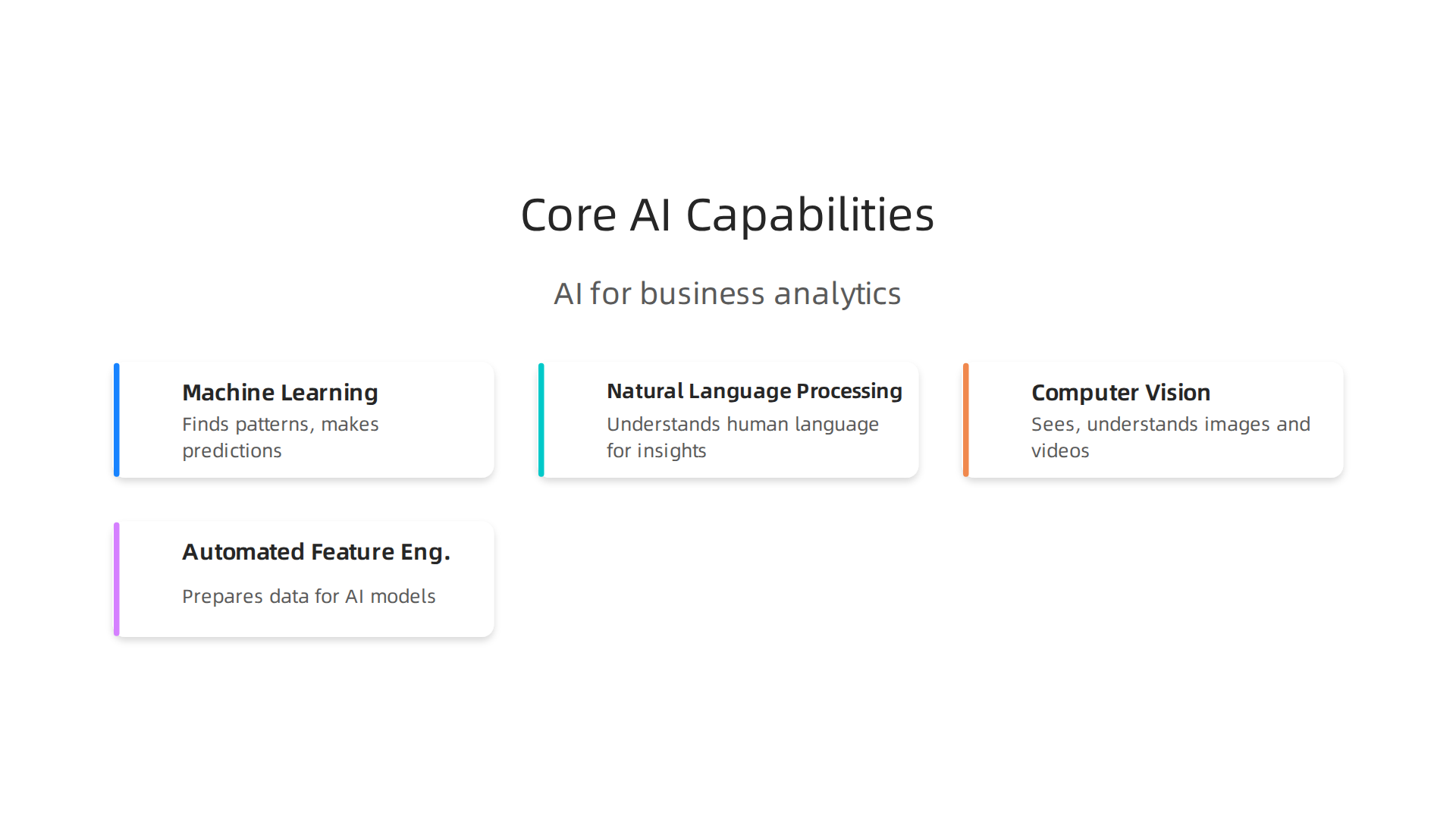
Machine Learning (ML) Modeling
One of the most important parts of AI for business analytics is called Machine Learning, or ML. Think of ML as teaching a computer to learn from past information without being told every single step. Instead, you give it lots of examples, and it finds patterns on its own.
In business, ML helps in many ways:
- Forecasting: ML models can look at old sales numbers, weather patterns, or website visits to guess what might happen in the future. This helps businesses plan better for things like how much product to make or how many staff they need. For example, ML models can predict customer behavior and market trends more accurately than older methods [1].

- Anomaly Detection: ML is great at finding unusual things that don’t fit the normal pattern. This could be a strange dip in sales, a fraud attempt, or a problem with equipment. Catching these "anomalies" quickly can save a lot of money and trouble.
Natural Language Processing (NLP) for Text Analytics
Another powerful AI tool is Natural Language Processing, or NLP. This is how AI understands and works with human language. Every day, businesses deal with lots of text: customer reviews, emails, social media comments, and reports. NLP helps make sense of all this "unstructured data."
With NLP, your business can:
- Understand Customer Feelings: NLP can read thousands of customer comments and tell you if people are happy, sad, or angry about your products or services. This helps you improve what you offer.
- Find Key Topics: It can quickly pull out the most important ideas or problems being talked about in a huge pile of documents.
- Segment Customers: By understanding how different groups of customers talk about your brand, you can learn more about them and make better marketing plans. AI-powered business intelligence uses natural language processing to explain insights and support faster decisions [2].
Computer Vision
Computer vision is like giving computers the ability to "see" and understand images and videos. This AI capability is becoming very useful in business analytics, especially for companies that deal with physical products or customer experiences in stores.
Here’s how it can help:
- Quality Control: AI cameras can check products on a factory line to make sure they meet quality standards, catching defects faster than human eyes.
- Store Layout and Traffic: In retail, computer vision can help understand how people move through a store, which areas they visit most, and how long they stay. This helps with store design and product placement.
- Safety Monitoring: It can also be used to monitor safety in workplaces, looking for potential hazards or unauthorized access.
Automated Feature Engineering
This one sounds a bit technical, but it’s really about making data ready for AI to use. Often, the raw information a business has isn’t in the best shape for an AI model to learn from. Automated feature engineering means AI can create new, useful pieces of information from existing data all by itself.
For example, if you have sales data with dates, automated feature engineering might create new "features" like "day of the week" or "month of the year" which could be very important for predicting sales. This helps improve the quality of your business intelligence without needing a lot of manual work [3]. It makes sure the AI models have the best possible information to work with, leading to more accurate predictions and insights. Understanding these tools helps leaders make better choices about their company’s data. If you want to dive deeper into selecting the right analytical tools, explore our guide on how to choose data analysis tools in 2026 for AI professionals.
The rise of these AI capabilities means that businesses can get much deeper insights from their data than ever before. They help automate many tasks in electronic data gathering analysis and retrieval, making the entire business analytics process more efficient and powerful.
References
- Business Intelligence Using AI: The Definitive Guide 2026
- AI in Business Intelligence: 2026 Data Roadmap Guide
- AI Data Analytics: Transforming Business Insights in 2026
Now that we know what AI can do, how do businesses actually put these smart tools to work? They build something called an AI analytics pipeline. Think of this pipeline as a clear path or a step-by-step process that takes raw business data and turns it into useful insights and smart actions. It’s how companies make sure their advanced business analytics are always running smoothly and giving them the best information.

Stages of an AI Analytics Pipeline
Building an AI analytics pipeline involves several important steps:
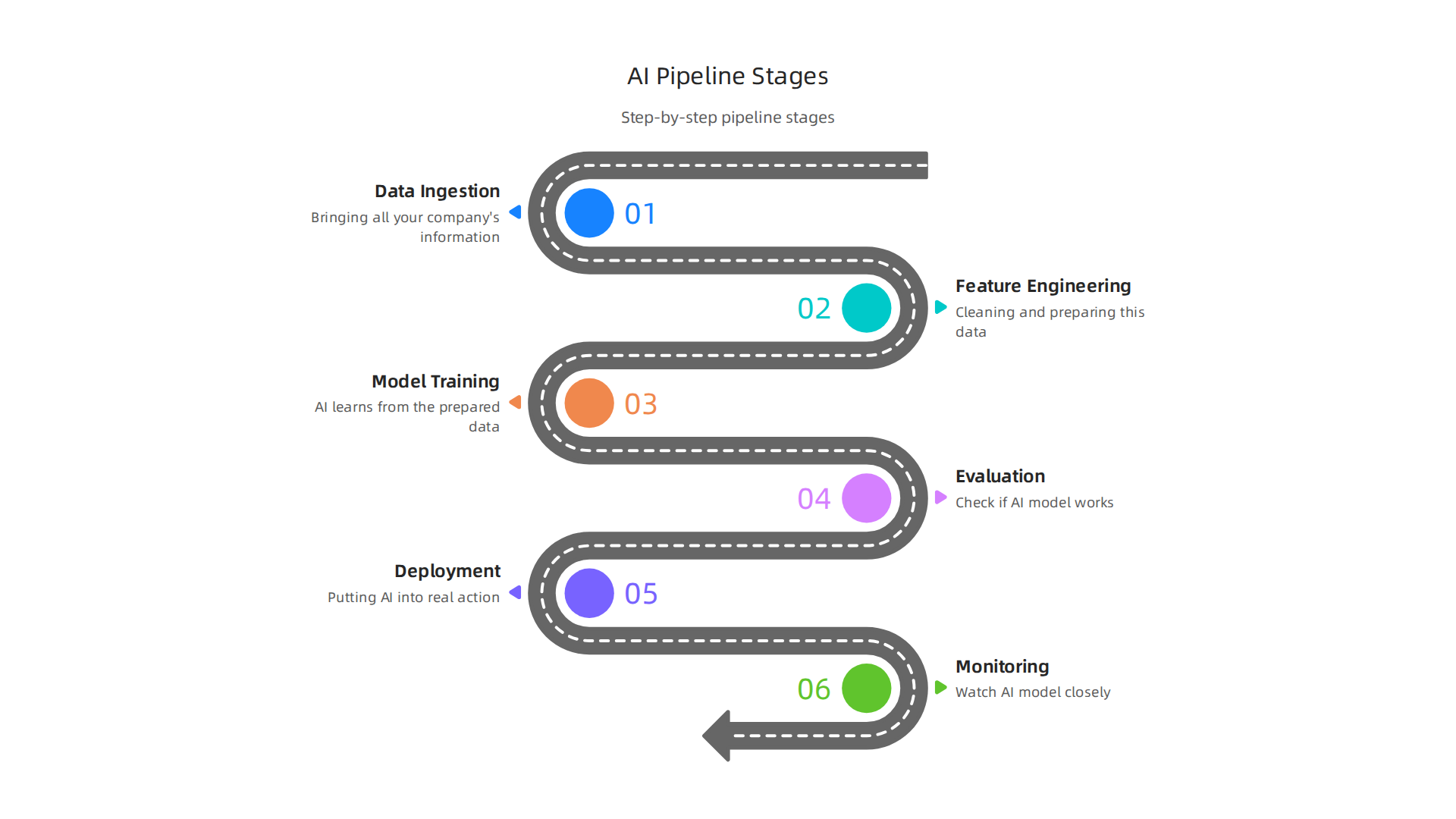
- Getting Data Ready (Data Ingestion and Feature Engineering)
The first big step is Data Ingestion. This means bringing all your company’s information, like sales numbers, customer comments, or website visits, into one central place. This data can come from many different places. Next comes Feature Engineering, which we talked about before. It’s all about cleaning and preparing this data so AI can understand it. Actually, AI tools can help a lot here by automating tasks like data cleaning and making sure different types of data work well together [5]. - Teaching the AI (Model Training and Evaluation)
Once the data is clean and ready, it’s time for Model Training. This is where the AI learns from the prepared data, finding important patterns and rules. After the AI learns, Evaluation happens. We check if the AI model is doing a good job, for example, by seeing how well it predicts future sales or spots unusual activity. It’s like giving the AI a test to make sure it learned correctly. - Putting AI to Work (Deployment)
When the AI model passes its tests and is ready, it’s moved to Deployment. This means putting it into real action so it can start helping your business make decisions. - Keeping Watch (Monitoring)
But the work does not stop once the AI is deployed. Monitoring is super important. We need to watch the AI model closely to make sure it keeps working well over time and gives correct, useful results [6].
Making it Run Smoothly: Operational Needs
Building these pipelines is one thing, but running them effectively needs special care.
- MLOps (AI Operations)
This is where MLOps comes in. MLOps is like the operations team for your AI. It makes sure all your AI models are built, run, and kept up-to-date in an organized way. This helps keep your business analytics flowing without problems. - Data Governance and Lineage
Good data governance is also key. This means having clear rules for how data is collected, stored, and used. Knowing the data lineage helps here too. It’s like tracing the journey of your data from where it started to where it ends up, making sure it is trustworthy and accurate [7]. - Reproducibility and Observability
Reproducibility means that if you run the same AI process again, you should get the same results. This helps build trust in your AI insights. And observability is about having clear visibility into every part of your pipeline, so you can quickly see if something goes wrong [8]. All these steps are crucial for effective electronic data gathering analysis and retrieval. If you’re keen on understanding the broader picture of how data is transformed into insights, consider your guide to mastering the data science process.
Putting all these pieces together creates a strong foundation for advanced business analytics. It allows companies to not only understand their past but also to predict their future with greater confidence. Staying on top of these trends is vital for anyone in business intelligence in 2026. Want to keep up with the latest in AI and how it is changing business? The AI Newsletter Worth Reading delivers clear daily AI updates right to your inbox.
Building strong AI analytics pipelines is a big step. But with so many possibilities, how do businesses decide which AI projects to tackle first? It is like having a list of great ideas and needing to pick the best one to start with. This is where prioritizing analytics projects comes in. You want to focus on projects that will bring the most value without being too hard to do.
Prioritizing Analytics Projects: ROI, Feasibility, and Data Readiness
To pick the right projects, companies use a simple framework that looks at three main things:
1. Potential Impact (ROI)
This is about how much good a project will do for your business. Will it make more money? Will it save money? Will it make customers happier? This is called Return on Investment, or ROI. It is important to know that AI automation can offer strong financial returns. Some companies have seen an average ROI of 171% from their AI projects AI Automation ROI Benchmark Report 2026.
Different AI uses can have very different ROIs, ranging from 80% to over 340%, with many showing payback in just a few months. This shows that the right project can make a big difference very quickly AI ROI by Use Case: Returns Across 12 Applications.
To check the value of a project, start small. Pick one clear task where AI could produce a clear before-and-after picture. Measure how things work before you add AI. Then, run a short test, maybe for 30 days, with a small team. This can show quick wins and help you track things like time saved, fewer errors, or higher sales. These early results help prove the project’s worth and get more support for it AI ROI 2026 Case Studies: How Pragmatic Enterprise AI Delivers Real Returns.
2. Feasibility (Technical Complexity)
Next, think about how hard the project will be to build. Do you have the right people with the right skills? Do you have the right computer tools and systems? Some AI projects need very special knowledge or a lot of computing power. A project that is too complex might take too long or cost too much. It is wise to choose projects that match your team’s current abilities or those you can quickly learn.
3. Data Readiness
Finally, look at your data. To make an AI project work, you need good, clean data. Remember our talk about data governance? It is key here. Data governance means having clear rules for how data is collected, stored, and used. If your data is messy, incomplete, or hard to get, the AI project will struggle. The steps of electronic data gathering analysis and retrieval must be solid. Making sure your data is ready is like preparing the ingredients before you start cooking. Without good ingredients, the meal will not be great.
By looking at these three areas together, businesses can pick the best projects for their advanced business analytics. This helps them get the most out of their AI investments and improve their overall business intelligence. Knowing how to choose wisely is a crucial skill in 2026 for anyone working with data. If you are interested in growing your career in this area, learning more about the role of a business intelligence analyst could be a great next step. For more details, explore the business intelligence analyst 2026 skills salary and career roadmap.
Picking the right AI projects is only one part of the puzzle. Once you know what you want to do, you need to decide where to build and run these projects. This means choosing the right tools and systems for your AI business analytics. It is a big choice because the platform you pick can change how well your projects work and how much they cost.
Vendor Selection and Platform Trade-Offs for AI Analytics
When looking at platforms for your AI analytics, businesses usually consider three main options. Each has its own good points and bad points.
1. Managed Cloud Platforms
These are services like Amazon Web Services (AWS), Google Cloud, or Microsoft Azure.
- Good points: They are easy to start with and can grow very big or shrink very small depending on your needs. This is called scalability. You do not have to buy and maintain your own computer servers. They also often include tools for things like model governance, which helps you manage your AI models properly.
- Bad points: Costs can add up, especially as you use more services. You might also become very dependent on one vendor, which is known as vendor lock-in. This can make it hard to switch later.
2. In-House Stacks
This means building and running your AI analytics systems on your own computers and servers, managed by your own team.
- Good points: You have full control over everything. You can customize tools exactly how you need them. For sensitive data, keeping everything in-house might feel safer.
- Bad points: This option is complex. You need a skilled team to set it up and keep it running. It also costs a lot to buy and maintain hardware. This can be a huge drain on resources.
3. Specialized Analytics Vendors
These are companies that offer specific tools or platforms for particular types of business analytics or AI tasks.
- Good points: They often have very strong tools for certain jobs, like predicting sales or understanding customer behavior. Their solutions can be very effective for niche problems.
- Bad points: These tools might not easily work with all your other systems, causing integration challenges. You might also end up with many different tools that do not talk to each other well, which can make your overall business intelligence harder to manage.
How to Choose the Right Platform
To pick the best option, you need to look at several key things. By 2026, over 65% of organizations are already using or actively exploring AI technologies for data and analytics, making this decision even more important for staying competitive Top AI Statistics and Trends for Analytics (2026).
Here are the main things to evaluate:
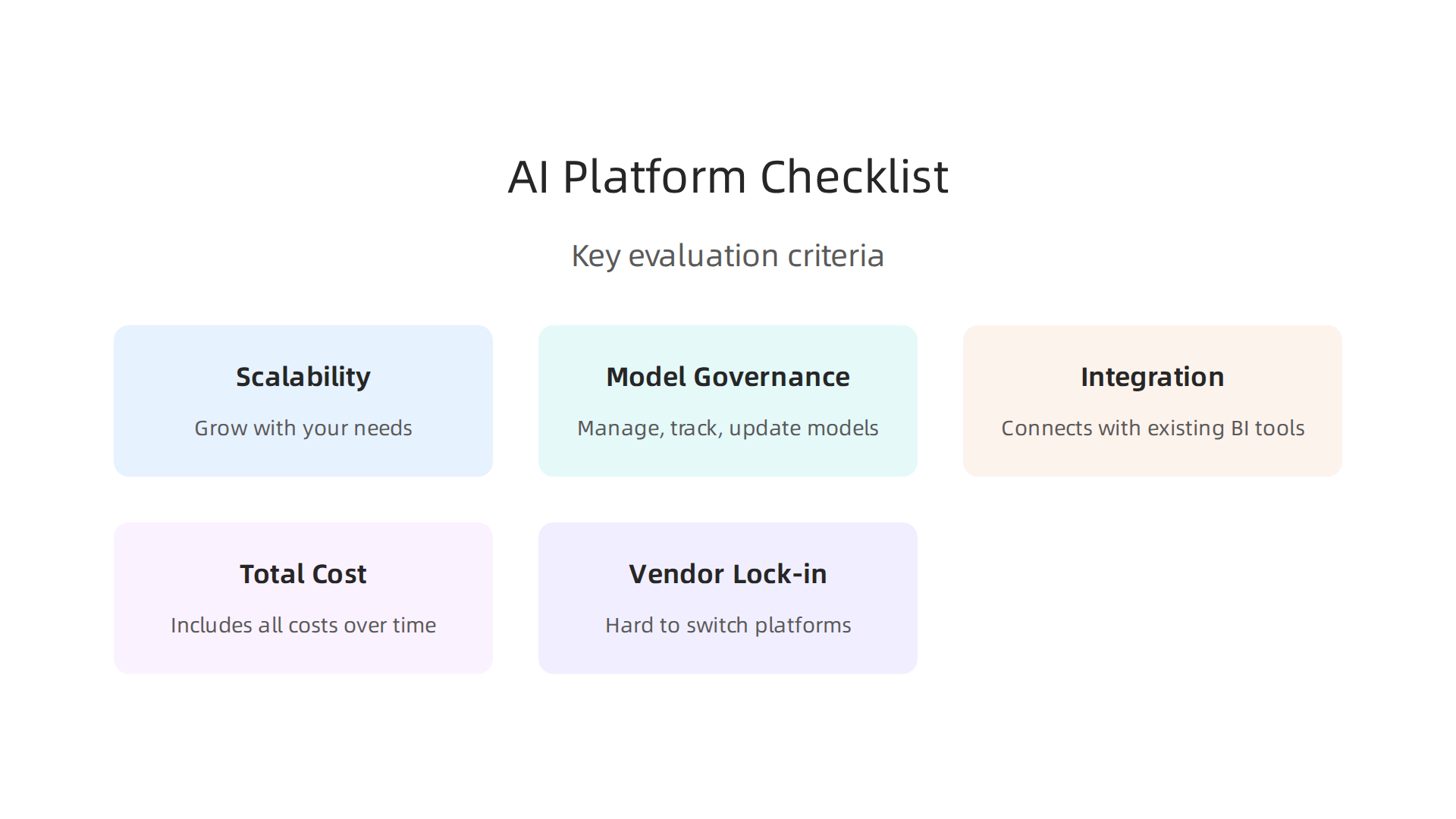
- Scalability: Can the platform grow with your needs? Will it handle more data and more users as your business grows?
- Model Governance: How easy is it to manage, track, and update your AI models? Good model governance helps ensure your AI is fair and works correctly.
- Integration with BI Tools: How well does the platform connect with your existing business intelligence tools? You want your AI insights to be easy to see and use alongside your other data.
- Total Cost of Ownership (TCO): This is not just the price tag. It includes all costs over time: setup, maintenance, training, and potential future upgrades. It is important to think about the long-term budget.
- Vendor Lock-in Risk: How hard would it be to switch to a different platform if you needed to? High vendor lock-in can limit your choices in the future.
Choosing the right platform is crucial for building strong AI analytics pipelines and making the most of your data. To learn more about selecting the right tools, explore how to choose the best enterprise AI platform for your organization. Keeping up with all the latest in AI and how it affects business analytics can be tough.
If you want to stay ahead of the curve, it is vital to have reliable information. Get clear daily AI updates from The AI Newsletter Worth Reading.
Choosing the right tools for your AI projects is a big step, but it is just the beginning. Once you have your platforms, you also need to make sure your AI systems are used in a fair, safe, and lawful way. This is where rules about governance, ethics, and compliance come in.
Governance, ethics, and compliance in analytics with AI
Using AI for business analytics means you must have clear rules. These rules help make sure your AI is working correctly and not causing any harm.

It is about being responsible with your powerful new tools.
What are governance controls for AI?
Governance controls are like safety checks and guideposts for your AI systems. They help you manage your AI from start to finish.
- Model Documentation: It is super important to write down everything about your AI models. This includes how they were built, what data they learned from, and how they make their decisions. Good model documentation acts like a user manual and history book for your AI, which is important for checking how AI systems reach decisions and for audits later on. This also includes keeping records about the data used for training AI models and publishing how the AI will be used for business purposes What is AI Governance? The Ultimate Guide.
- Bias Testing: AI learns from data, and if that data has unfair patterns, the AI can become unfair too. This is called bias. Testing for bias helps make sure your AI treats everyone equally and does not make bad decisions based on things like race or gender. Companies should have policies on AI ethics and fairness, and train staff on bias awareness How Do You Audit AI Bias?.
- Access Controls: Not everyone should have access to change or even see how your AI models work. Access controls make sure only the right people can get to these systems. This is a key part of good data governance, keeping your business intelligence secure.
- Audit Trails: Imagine keeping a detailed log of every change, every decision, and every person who interacts with your AI. That is an audit trail. These trails are important for reviewing what happened if something goes wrong or if you need to prove your AI is working properly AI Governance: A Guide for the Enterprise.
Meeting compliance rules
Compliance means following the law and industry rules. With AI, this can get tricky because rules are still being written.
- Data Privacy: AI often uses lots of personal data. You must follow privacy laws like GDPR or CCPA, which protect people’s information. This means handling data carefully and making sure AI does not misuse it.
- Sector-Specific Rules: Some industries have special rules. For example, AI used in healthcare must protect patient data very strictly. Financial AI needs to be fair and transparent to avoid discrimination in lending or insurance.
- Explainability Requirements: Sometimes, an AI decision can feel like a "black box" where you do not know how it reached an answer. But for important decisions, you might need to explain how the AI got there. This is called explainability. For example, if an AI decides a loan application, the company might need to explain why it was denied. This is important for trust and for complying with rules that require understanding AI models to avoid the "black box" problem AI Governance Guide: Risks, ROI & Enterprise Strategy.
By paying close attention to governance, ethics, and compliance, businesses can use AI for business analytics in a way that is both powerful and responsible. It helps build trust and makes sure AI tools are used for good. Not following these rules can lead to big problems, including legal issues and a loss of trust from your customers. The challenges of AI, like bias and privacy risks, are real, and understanding them is crucial for all businesses today. To dive deeper into these challenges, read about the real dangers of AI in 2026: bias, privacy, job loss, and existential risk.
Beyond just avoiding problems and following rules, businesses also need to know if their AI tools are actually helping them succeed. This is where measuring impact comes in. It helps you see if your AI for business analytics is making a real difference.
Measuring impact: KPIs and continuous learning loops
To truly understand if your AI projects are working, you need to measure their performance. You do this with special numbers called Key Performance Indicators, or KPIs. These are like scorecards for your AI and business goals.
What are KPIs for AI analytics?
KPIs help you track if your AI is hitting its targets. For business analytics, you need to look at both business goals and how well the AI tech itself is working.
- Business Goals and KPIs: These KPIs tell you if your AI is helping the company make more money, save costs, or make customers happier. For example, if you use AI to improve marketing, you might track how many new customers you get or how much money you earn from new sales. In 2026, many companies focus on important numbers like return on ad spend (ROAS) and customer lifetime value (CLTV) to link marketing efforts directly to money earned Marketing Analytics: 3 KPIs for 2026 Growth. These help show the real value of your AI-powered business intelligence.
- Technical Goals and KPIs: These KPIs focus on how well your AI models are actually doing their job. For example, if your AI is predicting something, how accurate are its predictions? Is it making many mistakes? You might look at things like how often the AI gives wrong answers or how fast it can process information. This helps ensure the AI itself is performing well. When looking at advanced AI, companies measure things like how true the AI’s answers are or how fast it responds GenAI Performance Metrics and KPIs – Agility at Scale.
You need to set up ways to check these numbers regularly. This might involve setting up special dashboards that show you the KPIs clearly.
Learning and improving with feedback loops
Using AI is not a one-time thing. It is an ongoing process of learning and getting better. This is where "continuous learning loops" come in.
- Gathering Feedback: Think of feedback loops as a way for your AI to keep learning. After you deploy an AI, you collect new information about how it is working and what real people think of its results. This includes all the electronic data gathering, analysis, and retrieval that happens when your AI interacts with the world. You collect data on everything, like if customer service agents like the AI’s suggestions or if the AI’s predictions were correct in the real world.
- Improving Models: This new feedback and data are used to make your AI models smarter. You can use this information to train the AI again. This helps the AI learn from its past actions and fix its mistakes. It is like teaching a student and then testing them again after they have studied more. This continuous cycle means your AI gets better and more useful over time. If you want to learn more about how data helps AI, check out our guide on Your Guide to Mastering the Data Science Process.
- Updating Analytics: As your AI models get better, your business analytics products need to be updated too. This means your reports, dashboards, and insights should always show the most accurate and up-to-date information that your improved AI provides.
By setting up clear KPIs and having strong feedback loops, businesses can make sure their AI investments keep delivering good results and get better with each passing day in 2026. This keeps your business intelligence sharp and always improving.
To keep up with all the exciting changes and improvements in AI daily, you need a reliable source. The AI Newsletter Worth Reading delivers clear daily AI updates right to your inbox.
Summary
This article explains why AI-augmented business analytics matters in 2026 and how leaders can put it to work. It walks through core AI capabilities—machine learning, natural language processing, computer vision, and automated feature engineering—and shows how these tools unlock faster, deeper insights from company data. You’ll learn the stages of an AI analytics pipeline (data ingestion, feature engineering, model training, deployment, and monitoring) and the operational practices like MLOps, data governance, reproducibility, and observability needed to run it reliably. The piece gives a practical framework for prioritizing projects based on ROI, feasibility, and data readiness, and compares platform trade-offs between managed cloud, in‑house stacks, and specialized vendors. It also covers governance, bias testing, privacy and compliance, and how to measure success with business and technical KPIs plus continuous learning loops. After reading, you’ll be able to prioritize AI analytics work, choose platforms more confidently, and set up the controls and metrics to keep models effective and trustworthy.