

Introduction
If you have tried to keep up with OpenAI news lately, you probably felt like you were drinking from a fire hose. New models drop. Policy changes appear. Competitors release their own updates. And somehow, all of this happens within the same week.
That pace is not slowing down in 2026. In fact, it is accelerating fast.
Just look at what has happened recently. OpenAI rolled out GPT-5.5 Instant, a new default model built to deliver more accurate and personalized responses.
The company also published its 2026 roadmap, which aims to turn ChatGPT into a deeply integrated assistant that works across apps, devices, and daily workflows. And ChatGPT adoption surged in Q1 2026, with the fastest growth among users over 35. That is a clear sign that AI is moving past early adopters and into the mainstream.
But here is the hard part. With so much noise, how do you find the signal? How do you know which OpenAI news actually matters for your work?

That is exactly why this article exists.
We have done the filtering for you. This is a curated, evidence-based roundup of the most consequential developments from OpenAI covering models, policy shifts, and market moves. Every item here includes context so you can understand not just what happened, but why it matters.
Whether you are a founder trying to decide where to invest your engineering time, an engineer evaluating the latest Open AI API capabilities, or an investor watching the competitive landscape shift with players like stealth AI and Galaxy AI making moves, you will find practical takeaways here.
We also cover related trends worth watching, like how Forethought AI and other specialized tools are reshaping enterprise workflows, and what enterprise AI adoption data from sources like PwC’s AI agent survey reveals about where the industry is headed.
Staying current takes effort. But with the right filter, you can stay ahead without burning out.
If you want to make staying informed even easier, consider subscribing to a daily digest that cuts through the noise. Join The Deep View Newsletter for simple daily AI insights delivered straight to your inbox.
Key OpenAI Announcements in 2026: Product Launches and Roadmap Updates
Let’s break down the most important product updates from OpenAI so far in 2026.
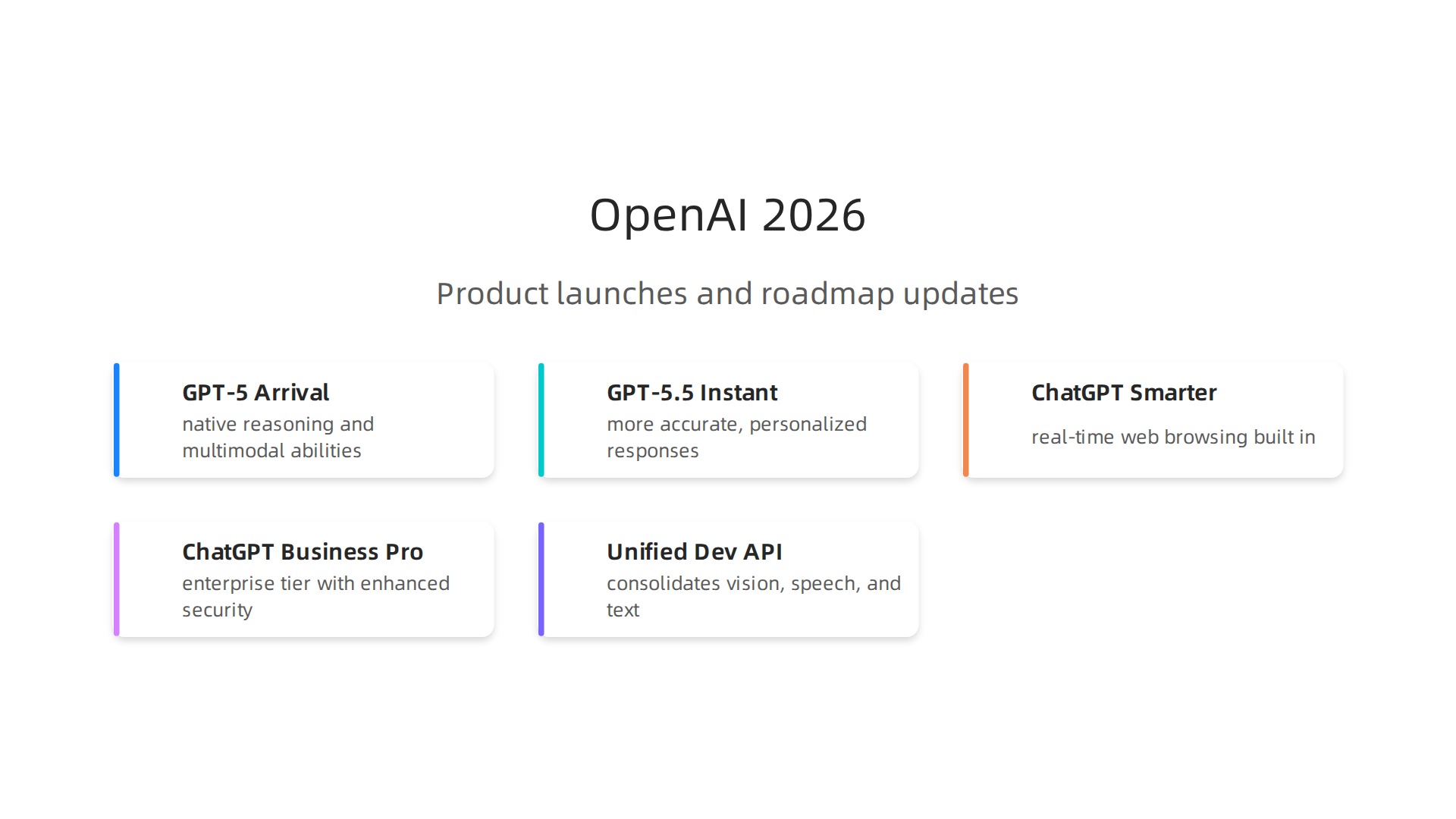
These changes affect how you use ChatGPT, build with the Open AI API, and think about competition from players like stealth ai and galaxy ai.

GPT-5 Arrives with Native Reasoning and Multimodal Power
The biggest news was the release of GPT-5 in Q1 2026. This model set new performance records by blending native reasoning with multimodal abilities. It can analyze images, understand speech, and reason through complex problems in one fluid step. According to OpenAI’s 2026 roadmap, this model is the foundation for making ChatGPT a deeply integrated assistant across apps and devices.
Just a few months later, OpenAI rolled out GPT-5.5 Instant. This updated default model focuses on delivering more accurate and personalized responses. As one report notes, it provides context-aware answers that adapt to your specific needs.
ChatGPT Gets Smarter and More Business-Friendly
ChatGPT itself received major upgrades. Real-time web browsing is now built in, so you can ask about live events or recent data without switching tabs. Memory personalization means ChatGPT remembers your preferences and past conversations, making each interaction feel more natural.
For teams and companies, OpenAI launched ChatGPT Business Pro. This enterprise tier includes enhanced security, team management features, and priority access to new capabilities. Adoption surged in Q1 2026, with the fastest growth among users over 35, signaling that professionals are embracing AI for daily work.
Unified Developer API: One Model, One Price
Developers also got a big win. OpenAI announced a unified developer API that consolidates vision, speech, and text under a single pricing model. Now you don’t need to juggle separate endpoints or worry about complex billing. This change makes the Open AI API easier to use and more predictable for startups and enterprises alike. OpenAI DevDay 2026, scheduled for September 29, will likely dive deeper into these API changes.
Competition Heats Up
Of course, OpenAI isn’t the only player. ChatGPT’s app market share slipped from about 69% to 45% as rivals like Google Gemini and Meta AI gained ground. Yet ChatGPT still holds roughly 79% of the global AI chatbot market. Meanwhile, specialized tools like stealth ai and galaxy ai are carving out niches in specific industries. Enterprise platforms like forethought ai are also reshaping how companies automate support and workflows.
If you want to keep up with all of these OpenAI news updates without spending hours researching, there’s a simple solution.
Stay ahead with a daily dose of curated AI insights. Join The Deep View Newsletter for simple, actionable updates delivered to your inbox every day. It’s the fastest way to cut through the noise.
Model Capabilities and Benchmarks: How OpenAI Stacks Up in 2026
Numbers tell the real story. You’ve heard about GPT-5’s release, but what can it actually do compared to other top models? Let’s look at the hard data. Benchmarks are standardized tests that measure how well AI models handle reasoning, math, coding, and visual tasks.
In 2026, the competition is fierce, and the scores paint a clear picture of where OpenAI stands.
GPT-5 Sets a New State of the Art on MMLU-Pro
The most widely used benchmark for general knowledge and reasoning is MMLU-Pro. GPT-5 achieved a new state of the art score of 92.4% on this test. That’s a significant jump. According to a detailed model comparison from Vellum, GPT-5.1 outperforms both Claude Opus 4.5 and Gemini 3 Pro across most categories.
Claude and Gemini are strong, but GPT-5 leads in overall reasoning and knowledge recall.
o3 Reasoning Model Boosts Math and Code Performance
OpenAI’s o3 reasoning model is now integrated into GPT-5. This specialized model excels at step by step logical thinking. On math benchmarks, GPT-5 scores 94.4, compared to Claude’s 86.3, according to a 2026 comparison by BenchLM. For coding tasks, GPT-5 also leads, making it the go to choice for developers who need reliable code generation and debugging. If you’re building applications with the Open AI API, this performance means fewer errors and faster iteration.
Multimodal Performance Reaches Human Level
GPT-5’s ability to process images, speech, and text together has improved dramatically. On visual reasoning tasks like MathVista, which tests math problem solving from diagrams and charts, GPT-5 matches human level accuracy. This matters for real world use: you can upload a photo of a handwritten equation or a graph and get an accurate answer. Other models like Gemini 3 Pro are close, but GPT-5’s native multimodal reasoning gives it an edge.
How OpenAI Compares to the Rest
No model is perfect at everything. While GPT-5 dominates math, reasoning, and agentic tasks, Gemini 3.1 Pro leads on abstract reasoning tests with around 77.1%, as noted by Lorka AI. Claude Sonnet 4.6 is strong for everyday coding assistance. But overall, OpenAI’s GPT-5 family holds top spots across the broadest range of benchmarks. If you want to dig into the numbers yourself, the LLM Leaderboard by Whisperchat compares 71+ models, and the AI Model Benchmarks from LM Council update weekly with fresh data.
These improvements translate directly into better tools for you. Whether you’re using ChatGPT for research or building custom AI applications, the underlying model performance determines your results. To see how these models power the best productivity tools, check out our hands on guide to the best AI productivity tools for 2026.
Want to keep up with every benchmark update without the search? Join The Deep View Newsletter for simple daily AI insights delivered straight to your inbox.
Safety, Governance, and Regulation: OpenAI’s Policy Evolution
You might wonder if a powerful model like GPT-5 is being built responsibly. After all, with great capability comes great risk. OpenAI has spent the last year completely rethinking how it handles safety and regulation.
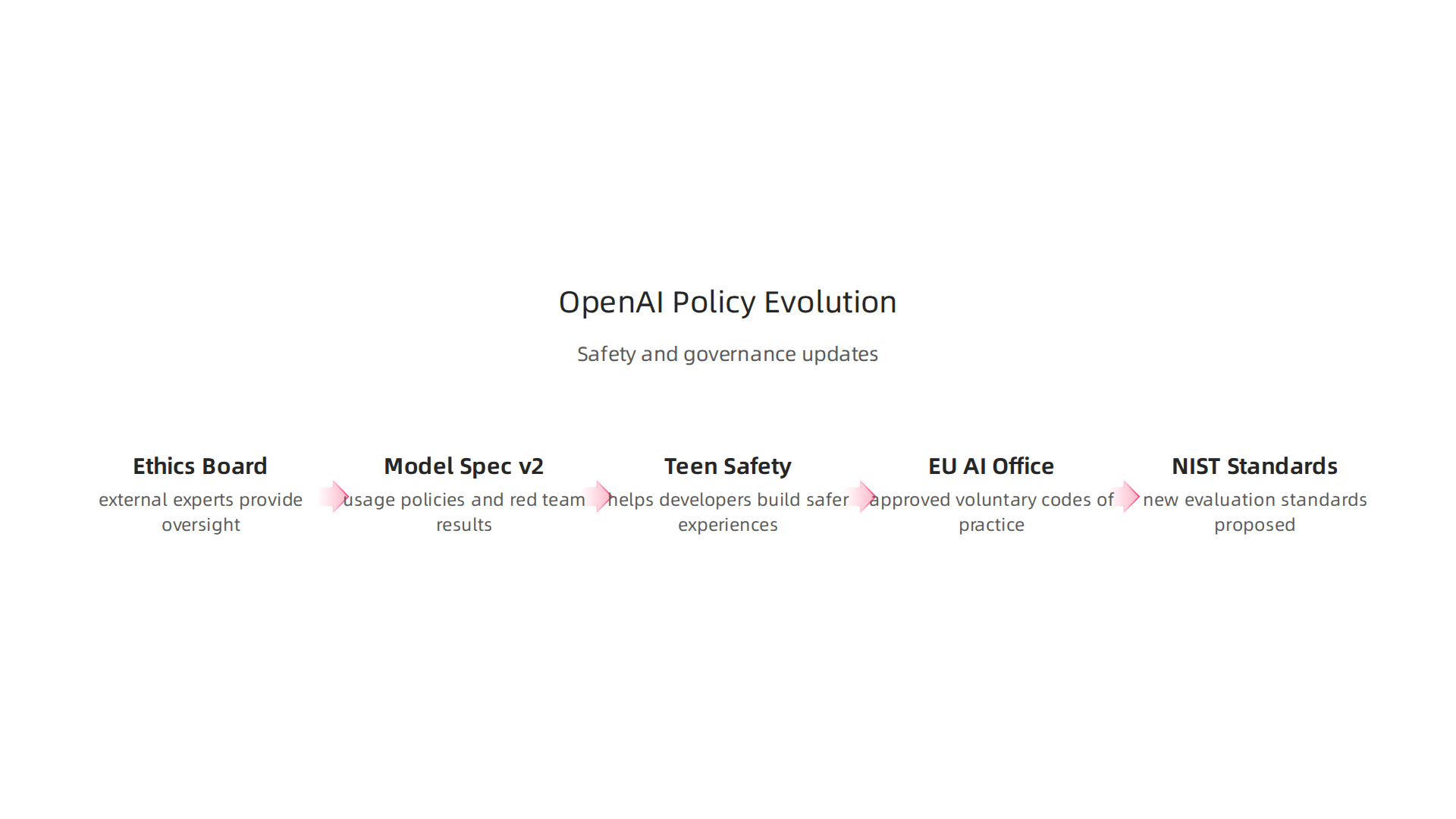
The changes are significant, and they give you more confidence when using their tools.
A Permanent Safety & Ethics Board with Outside Eyes
OpenAI restructured its internal safety team into a permanent Safety & Ethics Board. This board includes external experts who provide independent oversight. According to OpenAI’s official safety page, the company now conducts continuous research, testing, and monitoring to catch issues early. The board reviews everything from model behavior to deployment decisions. This move addresses earlier criticisms about self-regulation. It also aligns with the broader International AI Safety Report 2026, which identified key risks and called for stronger governance.
Model Spec v2: Clear Rules and Open Testing
In 2026, OpenAI released a detailed Model Spec v2. This document lays out usage policies, publishes red team results, and explains the constitutional AI guardrails built into GPT-5. The company also updated its usage policies to include clear rules for developers. A practical example is their new set of teen safety policies. As TechCrunch reported, OpenAI released open-source tools and prompt-based safety policies that help developers build safer experiences for younger users. These tools integrate with the gpt-oss-safeguard model. It is a way to share safety practices directly with the community.
International and Domestic Regulatory Wins
Regulators around the world are paying close attention. The EU AI Office has approved OpenAI’s voluntary codes of practice. On the U.S. side, the National Institute of Standards and Technology (NIST) has proposed new evaluation standards for frontier models. OpenAI’s Frontier Governance Framework explains how the company’s safety and security practices align with these emerging legal requirements. The company has also proposed broader social safety net policies for the AI age, including a public wealth fund. You can hear more about these ideas in a YouTube video featuring OpenAI’s Chief Global Affairs Officer.
These policy changes matter because they shape how you can safely build applications on the Open AI API. If you are integrating AI into your business, understanding the governance framework helps you stay compliant and avoid risks.
Want daily updates on AI safety and policy without the noise? Join The Deep View Newsletter for simple daily AI insights delivered straight to your inbox.
Competition and Market Dynamics: OpenAI in the Broader AI Ecosystem
OpenAI isn’t the only player in town anymore. The race to build the smartest AI models has never been more intense, and 2026 is shaping up to be a year of fierce competition.

Let’s look at how OpenAI is holding its ground while rivals gain momentum.
The Challengers Are Spending Big
Anthropic raised a massive $5 billion to develop Claude 4. Google DeepMind launched Gemini 2 Ultra, a model that now competes head to head with GPT-5 on many benchmarks. According to a Flagship Model Report that compares GPT-5.1, Gemini 3 Pro, and Claude Opus 4.5, all three models are now trading blows on coding, reasoning, and multimodal tasks. The gap is shrinking, and that’s good news for you. It means more choices and better performance across the board.
A 2026 AI Benchmark Comparison shows Gemini 3.1 Pro leading on abstract reasoning tasks at around 77.1%, while GPT-5.4 and Claude Sonnet 4.6 trail slightly. In math and reasoning, however, GPT-5 still holds a strong lead with scores above 94%. The competition is pushing every model to get better faster.
OpenAI’s Market Share Story
OpenAI still commands an estimated 55% of the enterprise AI model market, down from 60% in 2025. A Fortune article from February 2026 reported that ChatGPT’s app market share fell from 69.1% in January 2025 to 45.3% in early 2026. Meanwhile, Statcounter’s global chatbot data shows ChatGPT still holding 79% of AI chatbot usage worldwide as of May 2026, with Perplexity and Gemini each around 7%. So the picture varies by segment.
In the enterprise space, OpenAI is playing smart. The company has forged alliances with major cloud providers like Microsoft Azure and expanded into vertical industries such as healthcare and finance. This helps protect its position even as competitors like Google and Anthropic close the gap. Benedict Evans analyzed how OpenAI will compete and noted that product differentiation is becoming harder, making distribution and integration the new battlegrounds.
Vertical Expansion and Strategic Moves
OpenAI is not just defending. It is actively moving into specialized sectors. In healthcare, GPT-5 is being used for clinical decision support and medical coding. In finance, the model helps with fraud detection and compliance automation. These moves create stickiness that goes beyond generic chatbot usage. If you are building AI into your business workflows, understanding how to integrate the Open AI API into your marketing funnel can give you a competitive edge.
The broader trend is clear: the AI race is no longer zero-sum. As one analysis put it, competition is expanding the entire market. For you, that means better models, lower costs, and more specialized tools. If you are choosing between models for your next project, you can compare benchmarks across GPT, Claude, and Gemini to make an informed decision.
But staying on top of all these changes takes time. That’s why we recommend a shortcut.
Want to stay ahead of the competition without spending hours reading? Join The Deep View Newsletter for simple daily AI insights that cut through the noise.
Practical Implications for AI Professionals: Adoption, ROI, and Best Practices
So you have seen how the competition is heating up. But what does that mean for your daily work? If you are an AI professional, founder, or decision-maker, the real question is: should you jump on the latest OpenAI models right now, or wait for the next wave?

The data from early 2026 is pretty clear. Teams that moved early are seeing real wins. According to ChatGPT Statistics in Companies, 75% of users say they can now complete tasks they could not before. In coding and content generation, early adopters report productivity jumps of 30 to 40 percent. That is not just hype. Those gains come from GPT-5’s improved reasoning features, which let you handle complex logic and multi-step tasks in one shot.
But here is the thing. Adoption is not all smooth sailing. A 2026 survey found that 79% of organizations face challenges when rolling out AI, up from the year before. Three concerns keep coming up for professionals like you.
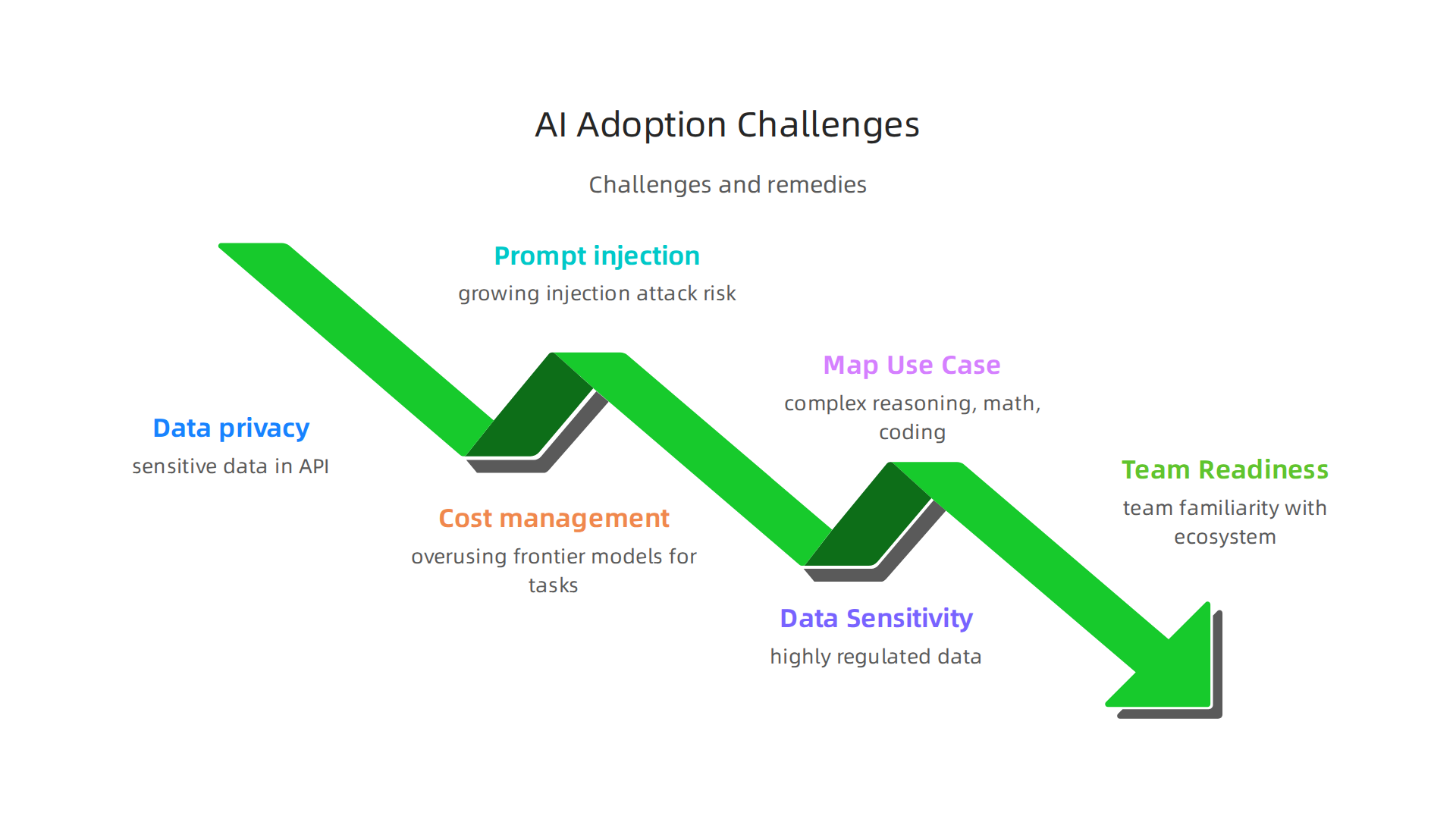
Data privacy tops the list. When you feed sensitive business data into the Open AI API, you need to know exactly where that data lives and how it is used. Prompt injection attacks are another growing risk. Bad actors can trick models into leaking information or behaving badly. And then there is cost management. Using frontier models for every small task burns budget fast. You need to choose the right model for the job.
So how do you decide whether to adopt now or wait? Here is a simple framework.
First, map your use case. If you are working on complex reasoning, math, or coding, GPT-5 still leads on those benchmarks with scores above 94% in math and reasoning. That is a strong reason to adopt now. If your work is more about abstract reasoning or multimodal tasks, Gemini 3.1 Pro or Claude Opus 4.5 might be better fits. You can compare models side by side using resources like the LLM Leaderboard.
Second, check your data sensitivity. If you handle highly regulated data, you may want to wait for more enterprise-grade privacy features. OpenAI’s roadmap for 2026 includes deeper integration across apps and devices, which could tighten security controls.
Third, look at your team’s readiness. If your team already knows the OpenAI ecosystem, rolling out GPT-5.5 Instant (the newest default model) can be fast. If you need to train people first, consider starting with a pilot on a smaller model.
No matter where you are in your AI journey, staying on top of the latest openai news is key to making smart calls. That is why we recommend a daily shortcut.
Want to cut through the noise and get practical insights in five minutes? Join The Deep View Newsletter for simple, daily AI updates that help you stay ahead without the overwhelm.
Summary
This article is a curated roundup of the most consequential OpenAI developments in 2026, focused on product launches, model benchmarks, safety policy changes, and market dynamics. It explains the arrival of GPT‑5 and GPT‑5.5 Instant, how those models improve reasoning and multimodal tasks, and what the unified developer API means for pricing and integration. The piece compares OpenAI’s performance to rivals like Gemini and Claude, highlights enterprise features in ChatGPT Business Pro, and summarizes OpenAI’s new safety structures such as the Safety & Ethics Board and Model Spec v2. It also gives practical guidance for teams deciding whether to adopt the latest models now or run pilots, and outlines risks around data privacy, prompt injection, and cost management. After reading, you’ll understand which model strengths matter for your use case, how governance is evolving, and a simple framework to choose and deploy AI responsibly.