

Why tracing AI’s origin matters today
Many people today, especially those working with new tools, often ask a simple question: "When did AI start?" It seems like a straightforward question, but the answers you get can be very different. Some might tell you AI began in the 1950s with early computers, while others might point to ideas from ancient times. This wide range of answers can make it confusing to get a clear picture of artificial intelligence.
It’s not just a fun fact to know. For leaders and thinkers, truly understanding the full ai overview is key.

Knowing the true history helps us see how far we’ve come and where we might be headed next in the frontiers in artificial intelligence. If we don’t know the real story, it’s easy to believe myths or misunderstand how today’s smart systems actually work.
Knowing when did AI start helps us understand the difference between machines that just follow rules and those that show more complex behavior, like learning.
It also helps us separate what’s truly new from what’s been built upon years of hard work. For instance, recent developments in AI, like those covered in OpenAI News 2026 Key Developments That Matter for AI Users, are built on decades of research.
Actually, the idea of AI can be traced back thousands of years. Early thinkers wondered if non-living things could have something like natural intelligence. More modern efforts to make machines think really kicked off in the mid-20th century. Experts agree that the deep roots of AI go back a long way, with some saying its history can be traced as far back as 380 BC How Long Has AI Been Around: The History of AI from 1920 to 2026.
Understanding this journey helps us make better choices in 2026. It helps us understand the big picture of global ai and how it impacts our world. This article will give you a clear, evidence-focused timeline. We will help you sort out the important moments from the common stories, giving you the real context you need.
To keep up with the fast pace of AI developments every day, consider joining Your Daily AI Shortcut for simple daily AI insights.
To truly understand the journey of AI, we first need to agree on what "start" really means. The question "when did AI start" has many answers because people think about it in different ways. This can make it hard to get a clear picture of the full AI overview.
Here are the main ways people define AI’s beginning:
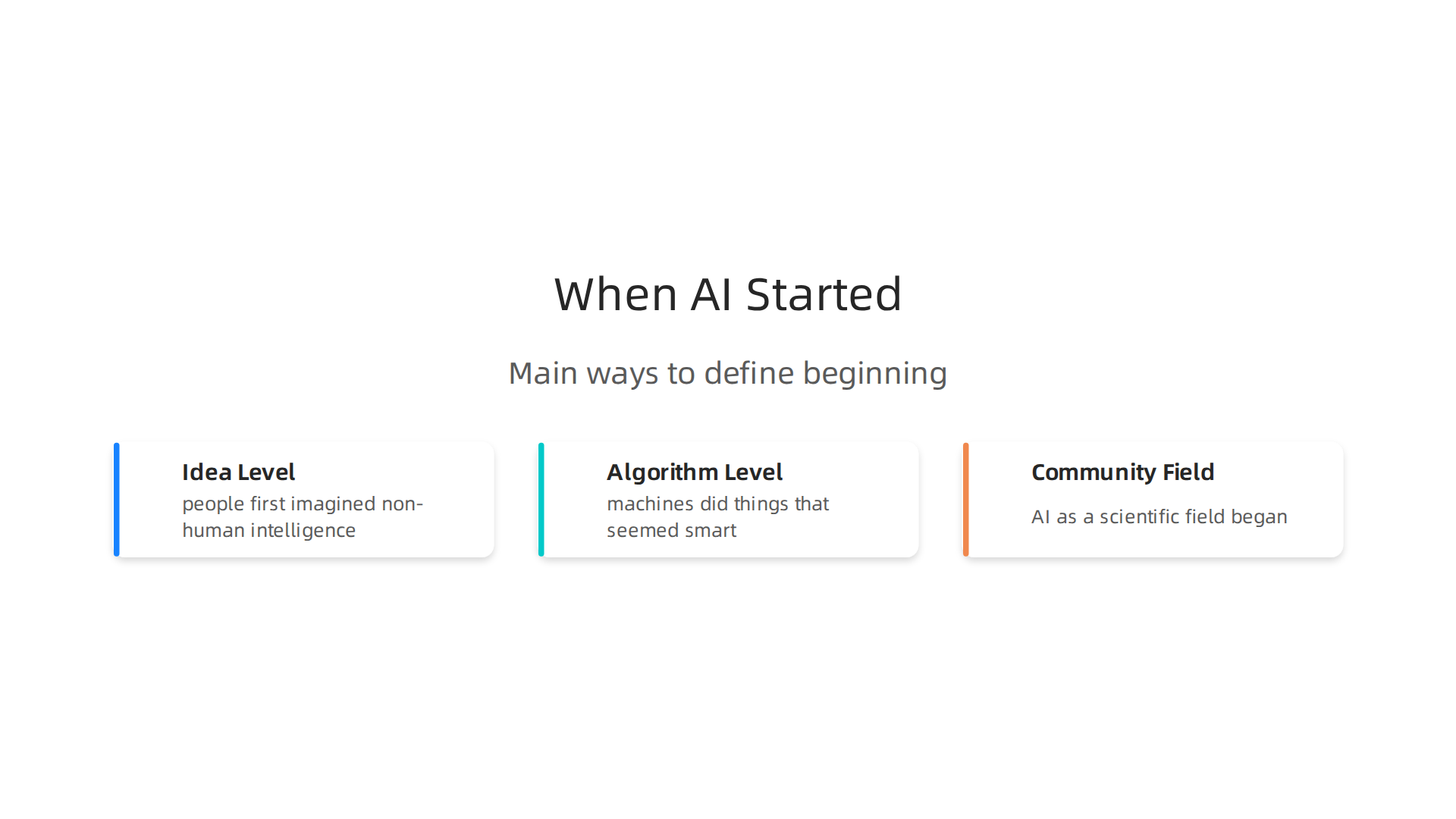
- The Idea Level: This looks at when people first imagined non-human intelligence. Some say this goes back to ancient stories about thinking statues or automatons. These early ideas explored what we now call natural intelligence and wondered if machines could ever have it.
- The Algorithm Level: This refers to the first times machines did things that seemed smart. For example, early computer programs in the 1950s could play simple games like checkers Timeline of artificial intelligence – Wikipedia. This was a big step in making machines follow complex rules.
- The Community/Field Formation Level: Many experts agree that AI as a scientific field officially began at a workshop in Dartmouth in 1956 Appendix I: A Short History of AI. This is when the term "artificial intelligence" was first used, and researchers came together to focus on this new area of study.
However, understanding when did AI start can also be tricky because of some common mistakes. One pitfall is retroactive labeling, which means looking back and calling old inventions "AI" even though people at the time didn’t see them that way. It’s like calling a horse and buggy an "early car."
Another issue is tech hype cycles. New technologies often get a lot of buzz, and sometimes the media makes them seem more advanced or new than they truly are. This can lead to exaggerated origin stories. We also see media-driven origin stories, where movies and TV shows create ideas about AI that aren’t quite real AI: Facts and Myths – Bipartisan Policy Center. These stories can shape what people believe about AI, even if they’re not accurate.
Being aware of these different approaches and pitfalls helps us better understand the true history of AI. It gives us a clearer picture of how far we’ve come and helps us look forward to the frontiers in artificial intelligence with a more informed view. Knowing this history helps us avoid misunderstandings as global AI continues to grow and change our world in 2026.
Early Milestones: 1940s–1950s (Concepts, First Programs, and Foundations)
Building on our understanding of how to define AI’s beginnings, let’s look at the actual groundwork laid in the 1940s and 1950s. This period truly shows us when did AI start from a practical point of view, moving from old ideas to real steps. It was a time when big ideas met new machines.
Seeds of Thought: Early Concepts
Even before computers could do much, smart people were thinking about how machines could "think."

In the 1940s, scientists like Alan Turing asked big questions. He wondered if machines could ever be so smart that we couldn’t tell them apart from a human talking to us. This idea led to what’s now called the Turing Test.
Around the same time, two other thinkers, Warren McCulloch and Walter Pitts, came up with a simple idea for how a "thinking machine" might work. They looked at how real brains have tiny parts called neurons that send signals to each other. They then imagined artificial neurons that could also work together to make decisions Origins of AI: From neurons to neural networks. This was a key step in understanding natural intelligence and trying to make it artificial.
First Sparks: Programs and Experiments
As the 1950s began, electronic computers started to become real. These giant machines, though slow by today’s standards, could follow complex rules. This was the first time that the ideas about AI could actually be tested.
One of the earliest and most famous examples of AI in action was a program that could play checkers. Written by Arthur Samuel in the mid-1950s, this program could learn from its mistakes and get better at the game. It showed that machines could do more than just follow exact orders; they could adapt and improve. These early efforts gave us a glimpse into the future of global AI, even if they were very simple compared to today’s powerful systems How Long Has AI Been Around: The History of AI from 1920 to 2026.
These early programs and the important meeting at Dartmouth in 1956, where the term "artificial intelligence" was first used, set the stage. They showed that AI wasn’t just a dream, but something that could be built. This foundational work formed the basis for the entire AI overview that would unfold over the next decades.
These initial steps were crucial. They showed us that machines could do more than just simple sums. They set the stage for all the amazing frontiers in artificial intelligence we see in 2026. As global AI continues to evolve at a fast pace, keeping up can be tough, even for experts who understand that Data Specialists Are More Critical Than Ever In The Age Of AI.
Want to stay informed about the latest in AI without getting overwhelmed? Your Daily AI Shortcut by joining The Deep View Newsletter for simple daily AI insights.
The early programs were like tiny baby steps for machines that could "think." But for AI to truly start as a field of study, it needed a special moment. That moment happened in the summer of 1956 at Dartmouth College in New Hampshire.
The Big Meeting at Dartmouth
Imagine a small group of smart people coming together for a few weeks to talk about a brand-new idea. This was the famous Dartmouth Summer Research Project on Artificial Intelligence. It was here that a bright scientist named John McCarthy first used the words "artificial intelligence." This simple name stuck, giving a clear label to all the big ideas people had about making machines smart.
This workshop is often called the true start of AI because it brought together many key thinkers. They weren’t just guessing anymore; they were trying to build a new science. It helped answer the question of when did AI start by giving it a name and a shared goal. Before Dartmouth, people worked on similar ideas but didn’t have a common banner. Afterward, they did.
Building a Community and a Field
After the Dartmouth meeting, AI stopped being just a collection of cool ideas. It started to become a real field of study. Here’s how:
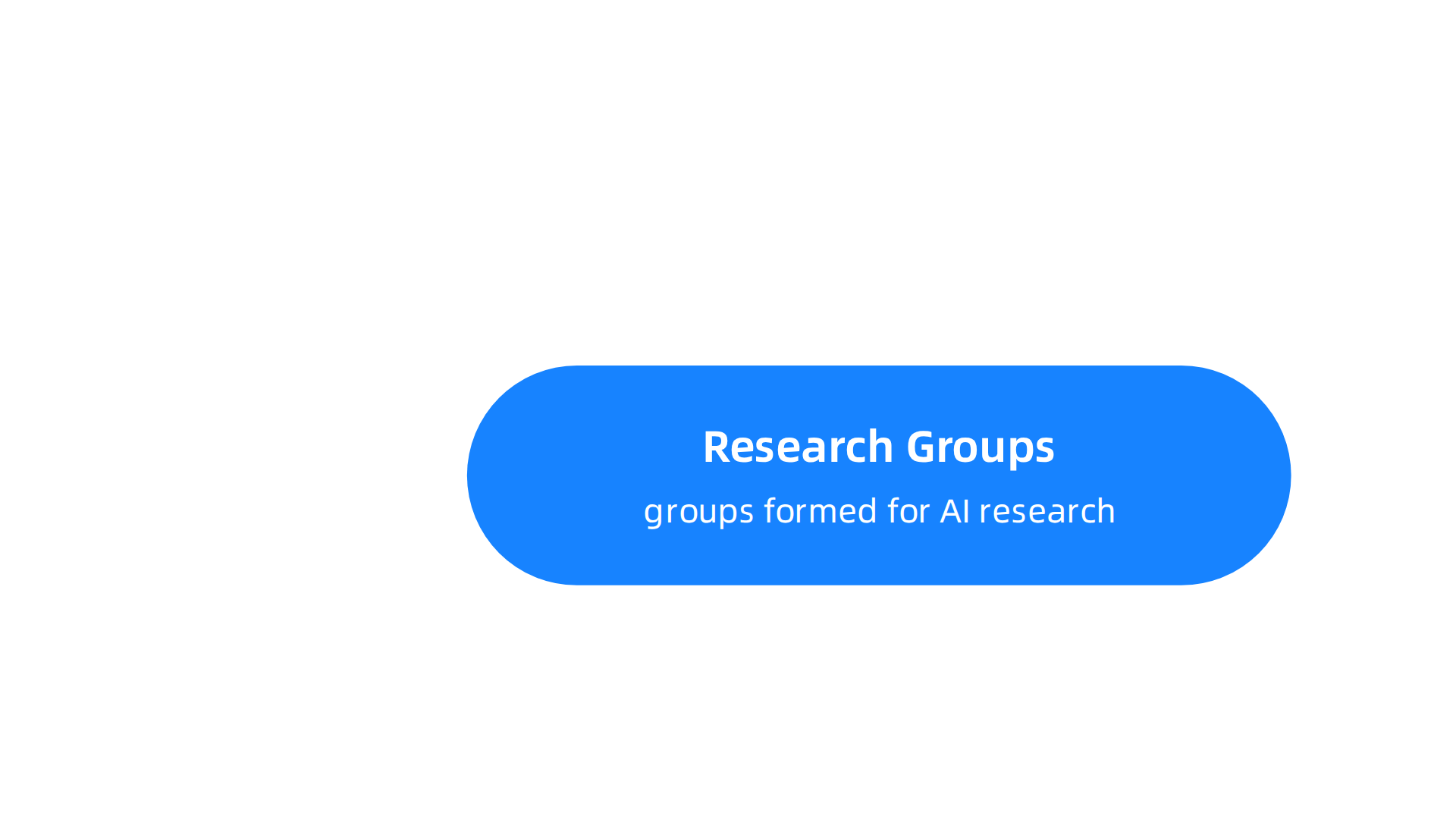
- Research Groups: The people who met at Dartmouth went back to their schools and labs, excited to work more on AI. They started forming groups dedicated to this new science.
- Funding: Governments and big companies saw the promise of AI. They began to give money to researchers. This helped scientists get computers and hire more people to work on complex problems.
- Curriculum: Slowly, colleges and universities started to teach about artificial intelligence. Students could learn the building blocks of natural intelligence and how to make machines mimic it.
This period, from the Dartmouth workshop through the 1960s, was all about building the foundations. It was like laying the first bricks of a huge building. People were still working on programs that could play games or solve simple math problems. These might seem small now, but they were huge steps back then.
The creation of a community and dedicated resources meant that AI was no longer just a dream. It was a serious area of science, setting the stage for all the amazing frontiers in artificial intelligence we see today in 2026. Looking back at those early days helps us understand how far global AI has come, with modern systems like those discussed in OpenAI News 2026 Key Developments showing incredible advancements compared to the early programs. The world of AI has grown so much that a 2026 Artificial Intelligence Index Report highlights how generative AI has been adopted by nearly 53% of the population in just three years. This shows the incredible speed and impact of the field that began at Dartmouth.
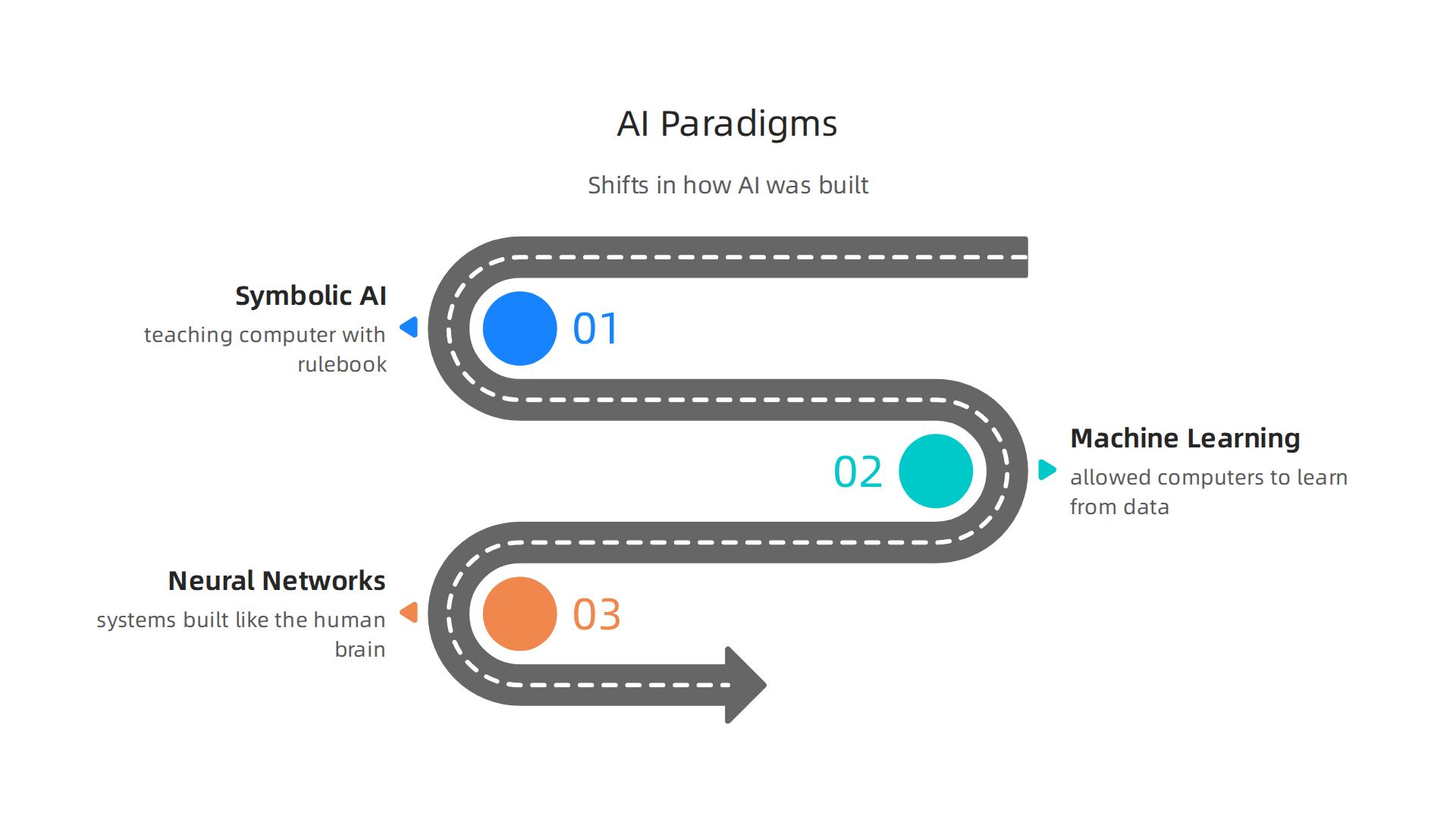
The early years of AI, following the Dartmouth meeting, were like building the first floor of a house. But for AI to really grow, it needed new ways of thinking and new tools. This led to different "paradigms," or main ways that people tried to make machines smart. These shifts in how AI was built helped us understand what AI could really do.
Algorithms and Paradigms: Symbolic AI, Machine Learning, and Neural Networks
For a long time, right after the Dartmouth workshop, most AI work was about "symbolic AI." Think of this like teaching a computer with a rulebook. Scientists gave computers very clear instructions and facts. For example, they might tell a computer, "If X is a bird, then X can fly." This type of AI was good for problems that had clear rules and logic, like playing chess or solving math problems. It focused on making computers reason like humans using symbols and rules, which was a big step for early AI algorithms and helped answer when did AI start in a practical sense by showing its first successes. This approach treated "intelligence as rules," forming a key part of AI’s technical history.
But as AI tried to solve harder problems, like understanding speech or recognizing faces, symbolic AI started to show its limits. There were simply too many rules to write down for everything in the real world. This is where "machine learning" started to change things. Instead of giving computers all the rules, machine learning allowed them to learn from data. You’d show a machine many pictures of cats and dogs, and it would figure out the difference itself.

This was a big jump from just following preset rules, marking a new phase in the evolution of AI algorithms.
A special kind of machine learning, called "neural networks," really changed the game. These are computer systems built loosely like the human brain, with many layers of connections. At first, they were simple, but over time, they grew much more complex. The idea for neural networks has been around for a while, even having "origins from neurons" as a starting point. By the 2000s and especially into the 2010s, something called "deep learning" emerged. This is when neural networks grew very, very large and learned from huge amounts of data. This led to amazing breakthroughs in things like recognizing speech, translating languages, and creating images. This evolution, from symbolic AI to machine learning and then to deep learning, is a great example of how AI has changed its dominant approaches over time. You can learn more about how different types of AI tools work today in 2026 by checking out some of the Best AI Productivity Tools for 2026.
These changes in how AI works mark important technical milestones. Each shift redefined what people thought "AI" could be. Today in 2026, we see a blend of these ideas, with some systems even combining logical symbolic AI with the learning power of neural networks for smarter results. This constant evolution is why the frontiers in artificial intelligence keep pushing forward, with new advancements happening all the time.
To keep up with all the exciting new developments in global AI, there’s a simple way to get daily insights.
Your Daily AI Shortcut
Scaling, Benchmarks, and the Modern Era: 2000s–2020s
The push to explore the frontiers in artificial intelligence really took off in the 2000s and into the 2010s. This was thanks to a few big changes that allowed AI to do much more than before. The main reasons for this boom were better computers, more data, and clear ways to measure how good AI was getting.
First, computers became much more powerful. Think of it like going from a small car to a big truck. This extra power meant AI programs could handle more complex tasks and learn from bigger sets of information. It let deep learning, which uses those brain-like neural networks, really grow. Without this jump in computing power, many of today’s smart AI systems simply wouldn’t be possible.
Second, there was an explosion of data. Every time we use the internet, take a picture, or record a video, we create data. This huge amount of information became the food for AI. Machines learned by sifting through tons of examples, finding patterns we might miss. This is especially true for tasks like understanding speech or recognizing images, where symbolic AI struggled because there were too many rules to write. Actually, data specialists are more important than ever to handle all this information, as you can read about in Data Specialists Are More Critical Than Ever in the Age of AI.
Third, and very important, came "benchmarks." These are like special tests or competitions that show how well an AI system performs certain tasks. For example, there are benchmarks for understanding language, solving math problems, or even writing computer code. By seeing how AI models improved their scores on these tests year after year, researchers could clearly track progress. The Technical Performance – Stanford HAI report, for instance, highlights how rapidly AI models improved in 2025 across many areas. These benchmarks help us understand the real capabilities of global AI and how much closer it gets to natural intelligence.
These advancements completely changed what people thought AI could do. Before, AI was mostly in labs. But by 2026, we see AI everywhere, from helping us choose what to watch online to driving cars. This makes the question of "when did AI start" more complicated. If you’re asking when the idea of smart machines began, it’s decades ago. But if you mean when AI really started working on everyday tasks and making a big impact, the 2000s and 2010s mark that modern era. It’s when AI crossed important capability lines, moving from simple logic to powerful learning systems that continue to push the frontiers in artificial intelligence.
Public narratives, myths, and frequent misconceptions
Even though we see AI everywhere in 2026, many people still have wrong ideas about how it all started. When we ask "when did AI start," we often look for one single moment or one "inventor." But that’s a big myth. AI wasn’t a sudden lightbulb moment for one person. Instead, it grew bit by bit, like a tree adding rings each year, from many different ideas and smart people over a long time.
One common myth is that AI was created all at once, in a single lab or by a single genius. This makes for a good story, but it’s not true. The journey to modern AI is a complex path. It moved from early ideas about thinking machines, to systems that used rules and symbols, and then to the learning systems we see today, like neural networks. You can see this journey laid out in papers discussing the Evolution of AI from Symbolic to Modern AI. This long, winding road shows there was no single "birth date" for AI.
Another misunderstanding comes from how the media sometimes talks about AI. News stories often simplify things, focusing on big breakthroughs or scary predictions. They might highlight one exciting new AI tool and make it seem like that’s the whole story. This can mislead even smart professionals. It makes them think that AI is either magical or evil, instead of seeing it as a set of powerful tools built on decades of work.
These simple stories stick around because complex history is harder to remember. It’s much easier to grasp a quick tale than to learn about all the different scientists, breakthroughs, and setbacks that shaped the frontiers in artificial intelligence. This means that many people, including those who work with global AI, might not fully understand its foundations. They might confuse what AI is with how it’s presented in movies or books, instead of seeing its true connection to human, or natural intelligence, and how it really works.
Understanding the true story of AI helps us use it better and make smarter choices about its future. It teaches us that progress often happens in small steps, not just giant leaps.
To cut through the noise and get clear, daily AI insights, consider this helpful resource.
Join Your Daily AI Shortcut for simple daily AI insights.
How the historical view should inform today’s decisions (product, policy, investment)
Knowing the true story of how artificial intelligence came to be is more than just a history lesson. For leaders in 2026, it’s a vital tool for making smart choices about products, policies, and investments.

When we understand that the answer to "when did AI start" isn’t a single event but a long journey, we gain a clearer AI overview. This deeper understanding helps us see past the hype and make decisions based on facts.
Anticipating Tech Cycles and Assessing Risk
The belief that AI just suddenly appeared can lead to bad choices. If you think AI is magic, you might expect instant results or be too scared of new changes. But seeing AI’s growth as steady steps helps leaders anticipate future technology cycles. It lets them assess risks better, understanding that current frontiers in artificial intelligence build on past efforts. For example, knowing that AI has faced "winters" or slowdowns in the past can prepare companies for similar cycles, preventing over-investment during a boom or panic during a lull. This historical context helps us grasp what AI really is and what it isn’t, clarifying common misunderstandings about its capabilities and limits, as explored in "AI: Facts and Myths" by the Bipartisan Policy Center.
Informing Product Strategy and Policy Making
For product developers, a proper understanding of AI’s origins shows that useful AI often comes from combining different ideas over time. It’s not about one huge invention but many small improvements that lead to big changes. This encourages building products with long-term vision, focusing on steady improvements rather than trying to make a "magical" solution overnight.
When it comes to policy, knowing the history helps governments and groups create rules that truly fit the technology. They can make better decisions about data privacy, ethical use, and how global AI impacts jobs. Instead of reacting to exaggerated fears or hopes, policies can be based on how AI actually develops and interacts with human, or natural intelligence. This helps create balanced policies that support innovation while protecting people.
For those looking to invest, a historical perspective is key. Understanding the timeline and the various stages of AI development allows for more informed investment strategies. It helps separate true innovation from temporary trends. For example, understanding the long-term potential can guide choices, like knowing how to pick promising companies when screening AI stocks with Zacks Investment Research in 2026.
A Checklist for Leaders
To avoid being misled by simple stories about AI’s past, leaders should ask themselves:
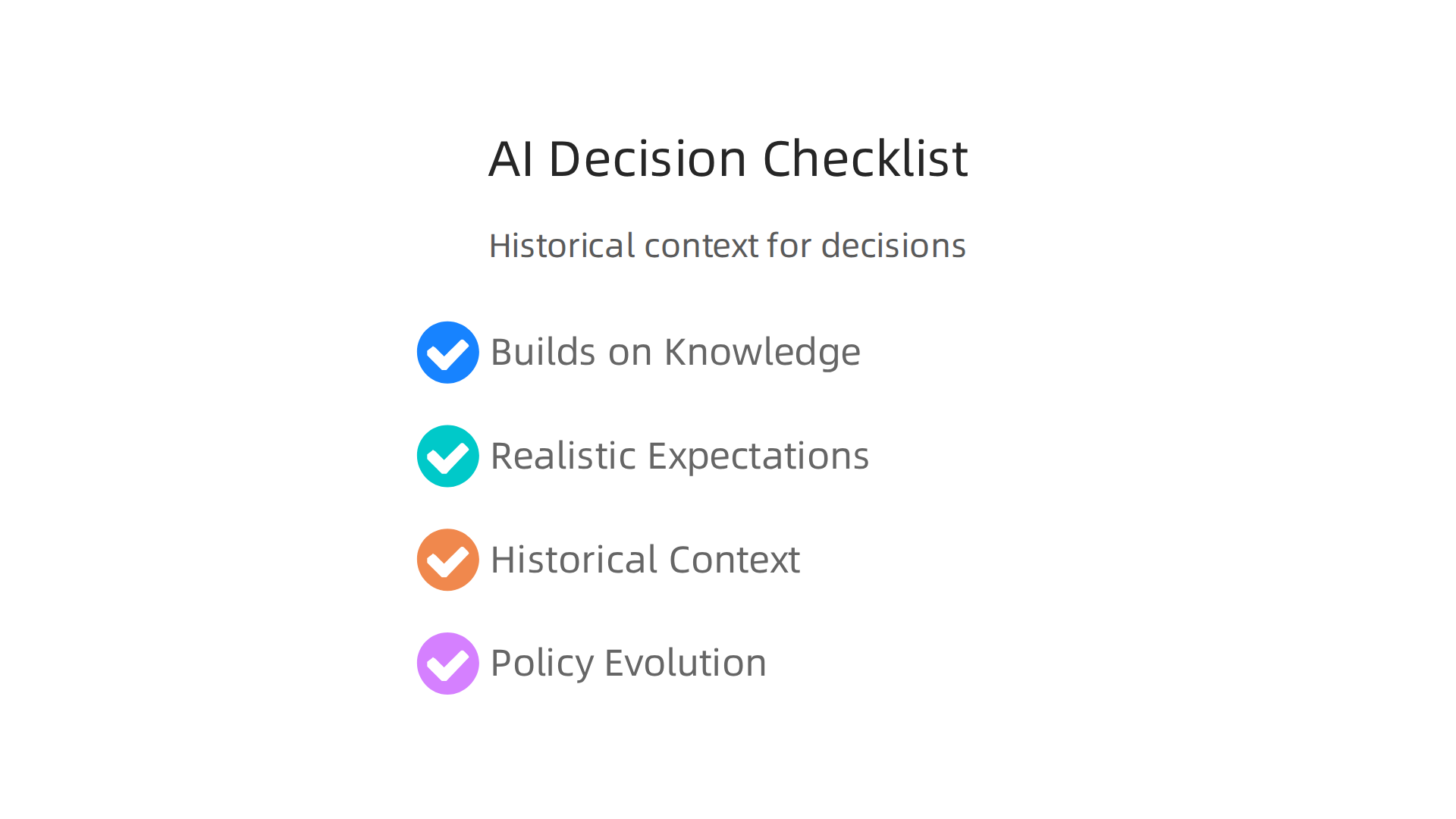
- Does this AI solution truly build on existing knowledge, or does it claim to be a completely new, sudden breakthrough?
- Are our expectations for this AI realistic, or are they based on myths from movies or popular media?
- How does the long history of AI’s development inform our risk assessment for this new product or investment?
- Are our policies for AI based on a deep understanding of its technical evolution, not just current headlines?
By using historical facts to guide their thinking, leaders can make stronger, more thoughtful decisions for the future of AI.
Summary
This article explains why asking