

Why learn the data science process now – and what this guide delivers
In 2026, information is everywhere, and understanding it is more important than ever. You hear a lot about AI, but AI only works well if it has good data to learn from. This is where the data science process comes in. Think of it as a clear set of steps you follow to turn messy, raw information into helpful insights. It’s like a recipe that guides you from start to finish.
A good data science process helps you learn faster and use your skills in many different jobs. It gives you a roadmap, so you don’t get lost. In today’s world, having strong skills, especially in technology, is super important for what jobs are available now and in the future. Building the right skills helps you prepare for what’s next, especially with all the new AI tools popping up all the time. Actually, building skills and knowledge is key to being ready for new technologies like AI, as shown in the AI Readiness: Building the Bridge from Higher Education to Work report.

Many people who start learning data science feel overwhelmed. They might see many tools, lots of new words, and not know where to even begin.

It can feel like trying to build something without instructions. You might wonder, "Which tool do I use?" or "What should I learn first?" This guide is here to help you through those challenges.
We’ll break down the data science process into simple, easy-to-understand steps. You’ll learn about:
- How to find and collect data, also known as electronic data gathering analysis and retrieval.
- Ways to clean and organize that data.
- Looking closely at data to find interesting things, which we call eda data science.
- Combining different pieces of data, known as data aggregation.
- Finding hidden patterns and making predictions, often called data mining.
By following this guide, you’ll gain a clear path and a strong set of skills. You’ll see that data specialists are more important than ever. This will help you understand how to use data to make smart choices, whether it’s for a business or just to understand the world better.
Want to keep up with the latest in AI and tech every day?
Join Your Daily AI Shortcut for simple daily AI insights.
Overview: The data science process — stages and outcomes
Learning the data science process means you get a clear map to follow. It’s like having a step-by-step guide for any project that uses data. When you understand these steps, you build "end-to-end skills" that are really helpful for any data science job, as you can see when building Data Science Portfolio Projects: Build End-to-End Skills. Here are the main parts of this process, and what you learn in each one:
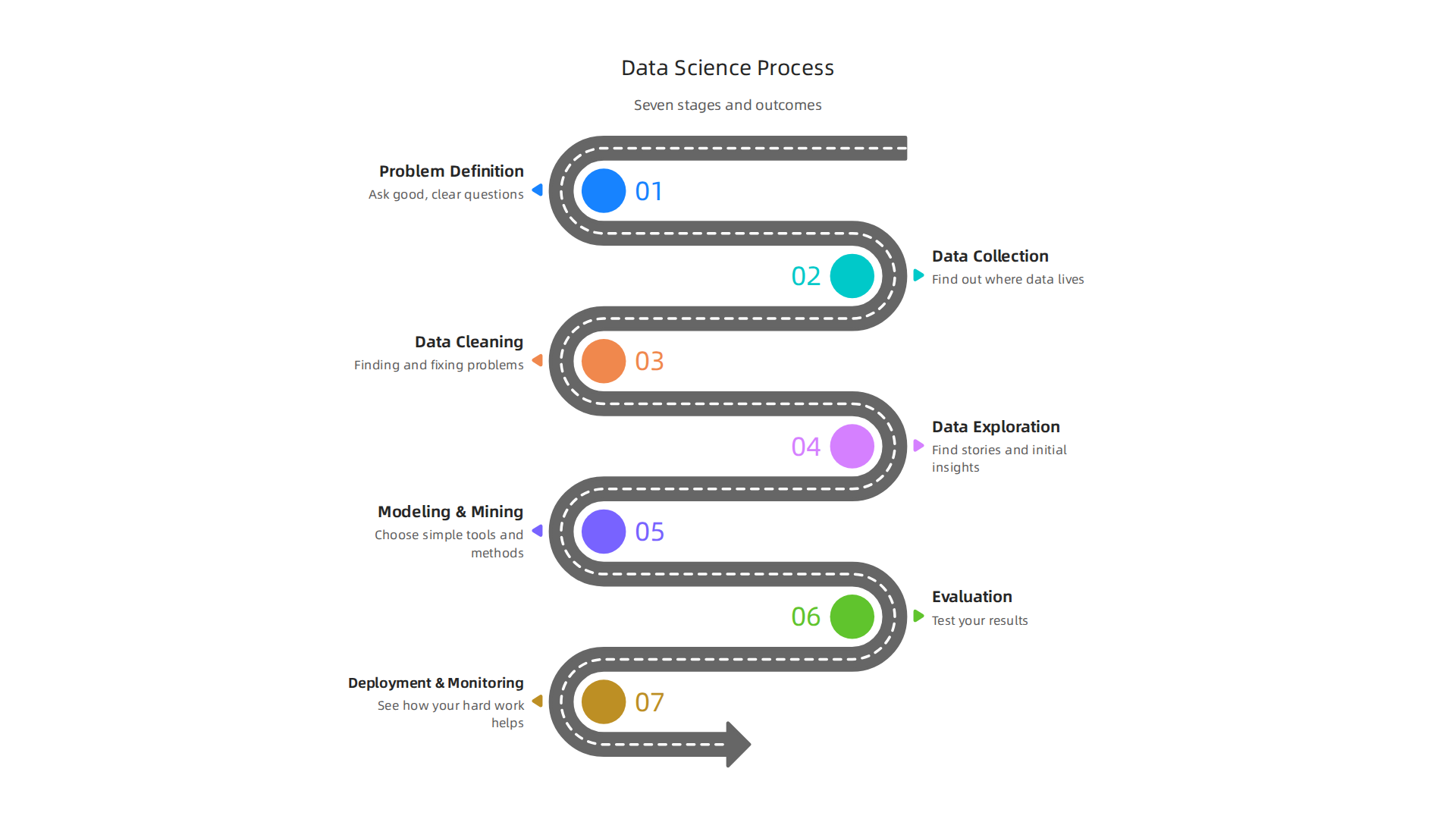
1. Problem Definition
Before you do anything else, you need to know what you want to achieve. What question are you trying to answer? What problem do you want to solve with data? This first step is all about clearly saying what your goal is.
- What you learn: You learn to ask good, clear questions. You also figure out what success looks like for your project. This helps you focus your efforts.
2. Data Collection
Once you know your goal, you need to gather the right information. This stage involves finding and getting the data you’ll work with. We call this electronic data gathering analysis and retrieval. Data can come from many places, like websites, company records, or sensors.
- What you learn: You find out where data lives and how to get it. You also start to understand different types of data.
3. Data Cleaning
Raw data is almost never perfect. It can have mistakes, missing parts, or be organized badly. Data cleaning is about fixing these issues. You make sure the data is accurate, complete, and ready to be used.
- What you learn: You become good at finding and fixing problems in data. This is a very important skill, because bad data leads to bad answers.
4. Data Exploration and Aggregation
Now that your data is clean, you can start looking at it closely. This is where eda data science comes in. You explore the data to find interesting patterns, trends, or things that stand out. You might also perform data aggregation, which means combining different pieces of data together to get a bigger picture.
- What you learn: You learn to find stories and initial insights hidden in the data. You start to see how different parts of the data connect.
5. Modeling and Data Mining
At this stage, you build a "model." Think of a model as a special recipe or a set of rules that helps you answer your question or make predictions. You use data mining techniques to discover hidden patterns and relationships in the data that can help your model work.
- What you learn: You learn to choose simple tools and methods that can help you find deeper insights or make forecasts about what might happen next. Many programs teach these core skills, which are vital for a "toolbox of skills and context for practice" in data science, as noted in reports on designing M.S. Programs in Clinical Data Science.
6. Evaluation
After you build your model, you need to check if it’s any good. Does it truly answer the question? Are its predictions correct most of the time? This step helps you know if your data work is reliable and ready to be used.
- What you learn: You learn how to test your results and understand if your solution is working as it should.
7. Deployment and Monitoring
Finally, you put your solution to work. This means making it available for others to use, perhaps as a report, a tool, or even part of an app. Then, you keep an eye on it. Data changes, and so might the problem, so you need to monitor your solution to make sure it keeps working correctly over time.
- What you learn: You see how your hard work can help people in the real world. You also learn that data solutions need constant care and updates.
Following these stages helps you build a strong foundation. Data specialists are more important than ever, and understanding this process sets you up for success. You can learn more about why these roles are so key in today’s world by reading about how data specialists are more critical than ever in the age of AI.
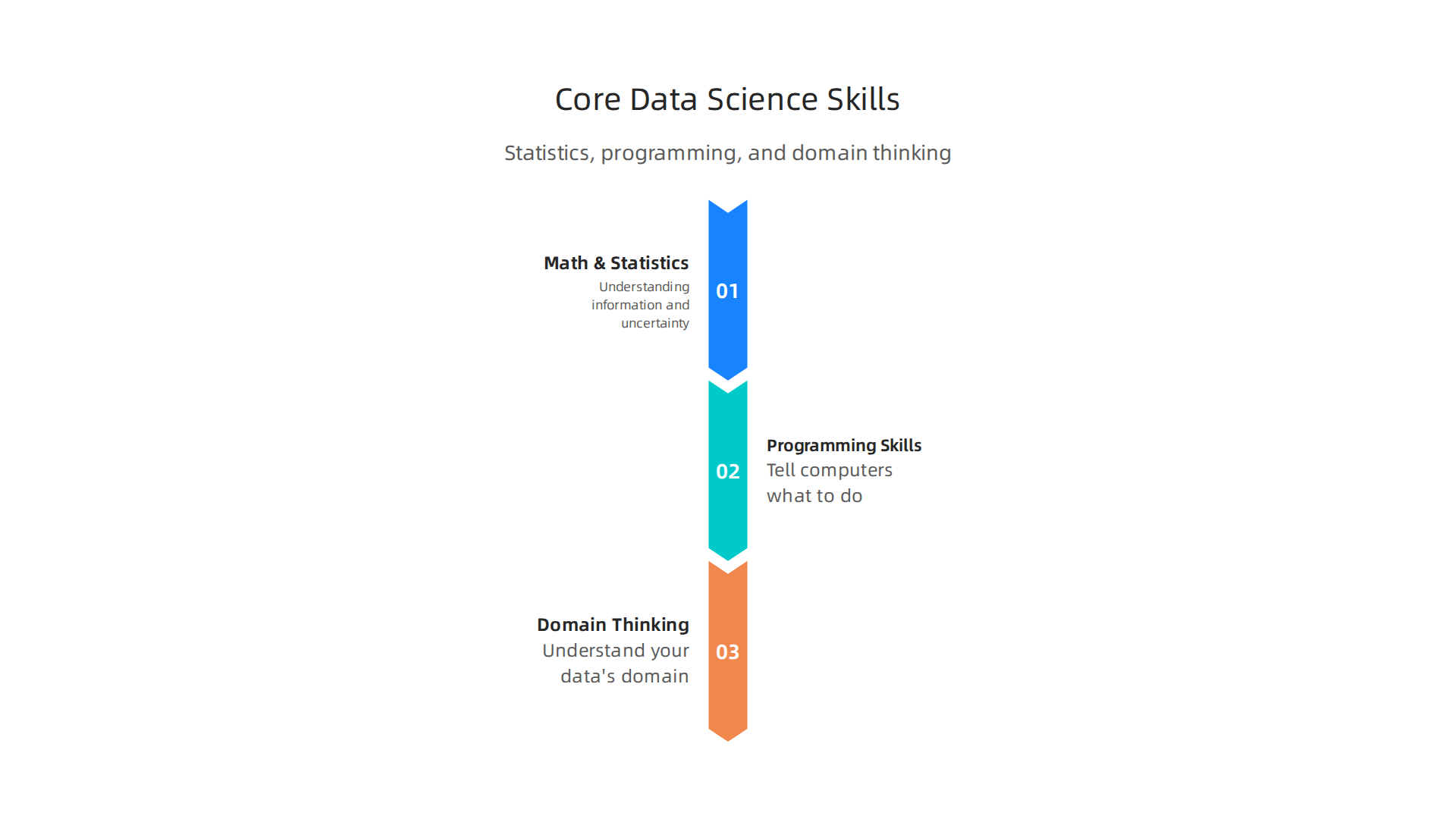
To truly master the data science process, you need a strong set of core skills.

These skills are like the tools in your toolbox that help you complete each step, from defining the problem to putting your solution into action. Let’s look at the most important ones: statistics, programming, and understanding the real-world area you are working in.
1. Master Math and Statistics Basics
Data science is all about understanding information, and that’s where math and statistics come in. You don’t need to be a math wizard, but knowing the basics is a must. This includes understanding things like:
- Averages and Medians: How to find the middle value in a group of numbers.
- Probability: The chance of something happening.
- Data Spread: How much numbers vary from each other.
- Simple Graphs: How to read and understand charts that show patterns.
These ideas help you make sense of your data during exploration, often called Top 10 Data Science Skills You Should Have in 2026. They guide you when you’re cleaning data or performing tasks like eda data science to find out what stories the numbers are telling. For beginners, the focus isn’t on complex equations, but on grasping these core ideas to interpret results and evaluate models reliably. Understanding these fundamentals is crucial for success, as highlighted in the 2026 Guide to Data Science: Skills, Strategies & Courses for building a strong foundation.
2. Learn Programming Skills
Programming is how you tell computers what to do with data. For data science, two main languages are very popular: Python and R.
- Python: Many people like Python because it’s easy to read and has lots of pre-made tools (called libraries) for data tasks.
- R: R is especially good for statistics and making detailed graphs.
With programming, you learn to write step-by-step instructions for the computer. This helps with tasks like electronic data gathering analysis and retrieval, where you collect data from different sources. You’ll also use programming for data cleaning to fix errors, and for data aggregation to combine information. Writing good code also means your work can be checked and repeated by others, making your data science process clear and trustworthy. If you’re looking to boost your abilities, exploring Top Data Analysis Certifications 2026 for AI Professionals can show you pathways to enhance these vital skills.
3. Develop Domain Thinking
Domain thinking means understanding the specific area or industry your data comes from. For example, if you’re working with data from a hospital, you need to understand healthcare. If it’s about shopping, you need to know how retail works.
This skill is often overlooked, but it’s very important for the whole data science process. It helps you:
- Define the Problem: You can ask better questions if you truly understand the business or scientific challenge.
- Collect the Right Data: Knowing the domain helps you find the most useful data sources.
- Interpret Results: When you run a
data miningtool or build a model, domain knowledge helps you understand if the insights make sense in the real world.
The ability to connect technical skills with real-world problems is a key part of what makes data specialists valuable. A 2026 report on STEM 2026: A Vision for Innovation in STEM Education highlights that even outside traditional STEM fields, there is a clear need for these core cognitive skills to drive innovation. It helps you turn numbers into useful actions that truly help people or businesses.
After learning the important skills needed for data science, it’s time to talk about the tools that help you use those skills. Think of these tools as the workbench and special machines that make the data science process easier. For beginners in 2026, choosing the right tools makes a big difference in how quickly you learn and get things done.
Let’s look at some friendly tools and when to use them.
Easy-to-Use Notebooks
For writing code and showing your work step-by-step, notebooks like Jupyter Notebooks are fantastic.
- What they are: Imagine a digital notebook where you can write code, explain what you’re doing with regular text, and see the results (like graphs or numbers) all in one place.
- Why they’re great for beginners: They let you try out small bits of code, fix mistakes easily, and see immediate feedback. This is super helpful when you’re doing
eda data science, which means exploring and understanding your data. You can also use them fordata aggregationto combine information or forelectronic data gathering analysis and retrievalto collect and examine data. - Learning Curve: They take a little getting used to, but once you know the basics of Python or R, notebooks make your coding journey much smoother.
Helpful Visualization Tools
Making sense of data often means seeing it in pictures. This is where visualization tools come in.
- What they are: Programs like Tableau and Power BI help you turn numbers into easy-to-understand charts, graphs, and dashboards without much coding.
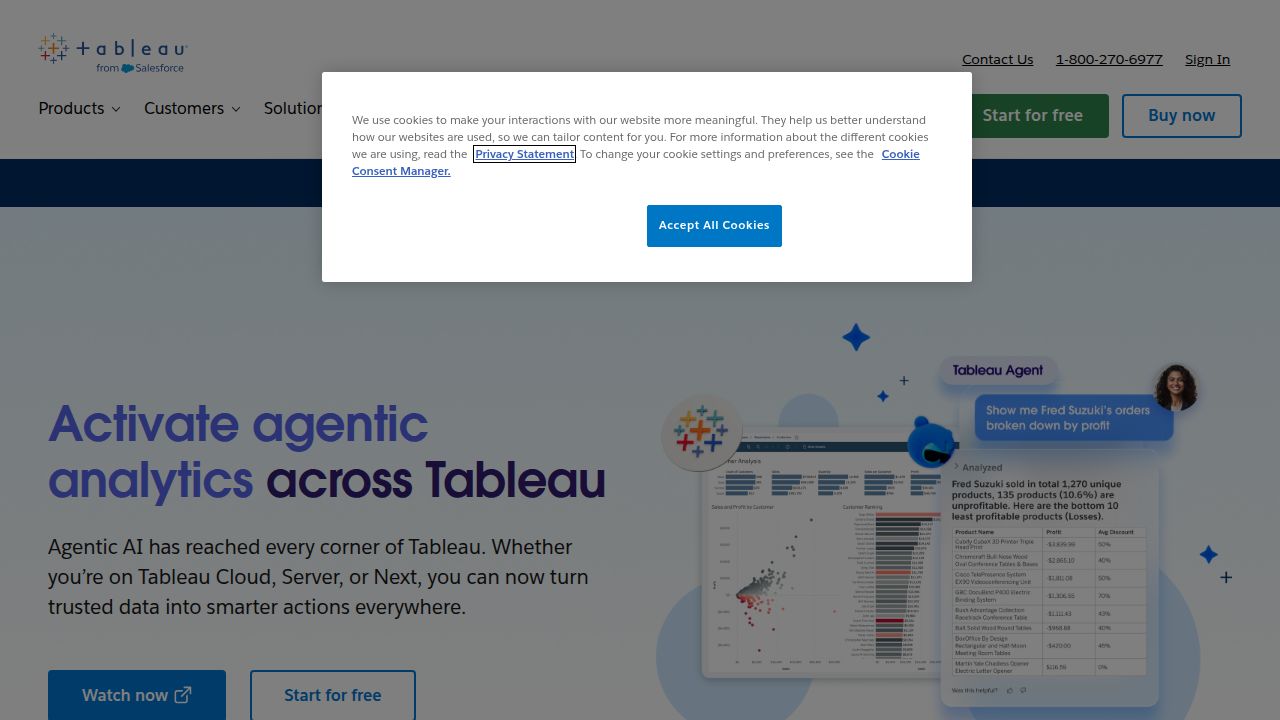
- Why they’re great for beginners: If you want to quickly see patterns or share your findings, these tools are powerful. They are often used by data engineers to make complex data easier to understand, as mentioned in a report on Data Sandboxes- Managing the Open Data Spectrum. They make
data miningresults visible and help others grasp the insights quickly. - Learning Curve: They usually have a gentler learning curve than coding, as you often drag and drop elements to build your visuals. A detailed comparison between Tableau vs. Power BI: BI Platform Market Analysis & Comparison shows how these tools lead the market in helping people understand data visually.
Cloud vs. Local Setups
You can run your data science tools in two main ways:
- Local Setup: This means installing everything on your own computer. It gives you full control but can be tricky to set up at first.
- Cloud Setup: This means using tools that run on someone else’s powerful computers over the internet. Services like Google Colab (for Jupyter Notebooks) or cloud versions of visualization tools are often easier for beginners because you don’t need to install much.
Recommended Starter Toolchain
For anyone starting their data science process journey in 2026, here’s a good set of tools to begin with:
- Python with Jupyter Notebooks: Start here to learn programming, clean data, and do initial data exploration.
- A Visualization Tool (Tableau or Power BI): Once you have some cleaned data, use one of these to create engaging charts and dashboards.
This combination lets you learn programming skills while also seeing the immediate impact of your work through clear visuals. Building small projects from start to finish using these tools will really help you understand the entire data science process. For more ideas on effective tools, explore how to choose Data Analysis Tools in 2026 for AI Professionals.
Now that you know about some useful tools, let’s talk about how to put them to work. Learning data science isn’t just about picking up tools; it’s about following a clear plan. We’ll look at a step-by-step learning path for the whole data science process, even for people who can only study part-time.
Building Your Learning Roadmap
Think of your learning journey like a road trip. You need a map, stops along the way, and ways to check if you’re still on track.

Phase 1: Getting the Data Ready (Weeks 1-4, part-time)
This first step in the data science process is all about finding and cleaning data. Many experts agree this is one of the most important parts. Without good data, everything else falls apart.
- What to learn:
- Basic Python or R: Learn how to write simple code to handle data.
- Data Gathering: Understand where to find data and how to collect it responsibly. This might involve
electronic data gathering analysis and retrievalfrom public sources. - Data Cleaning: Learn how to fix mistakes, fill in missing spots, and get data into a usable format. This is key for good
data aggregation.
- Checkpoint/Deliverable:
- Cleaned Dataset: Take a messy dataset and turn it into a perfectly clean one. You should be able to show all the steps you took to clean it.
Phase 2: Understanding the Data (Weeks 5-8, part-time)
Once your data is clean, you need to explore it to find interesting things. This is where eda data science comes in.
- What to learn:
- Exploratory Data Analysis (EDA): Use simple math and visual tools to understand what your data is telling you. What are the big trends? Are there any odd numbers?
- Basic Statistics: Learn about averages, percentages, and how to spot relationships between different parts of your data.
- Visualization Skills: Practice making charts and graphs using tools like Tableau or Power BI.
- Checkpoint/Deliverable:
- Exploratory Report with Visuals: Create a short report that explains your findings from the cleaned data. Include easy-to-understand charts and graphs.
Phase 3: Making Predictions (Weeks 9-16, part-time)
This phase moves into data mining and building simple models that can predict things or find patterns. Data science isn’t just about looking at the past; it’s about looking ahead. The NIH Strategic Plan for Data Science 2023-2028 highlights the importance of data in making future health decisions, showing how widely these methods are used.
- What to learn:
- Introduction to Machine Learning: Understand what machine learning is and how simple models work. Don’t worry about being an expert yet, just grasp the basics.
- Model Building: Learn to build a simple prediction model using your Python skills and libraries.
- Checkpoint/Deliverable:
- Simple Model Prototype: Build a basic model that can make a simple prediction, like guessing if a customer will buy something or not. Explain how it works and what its limits are.
Phase 4: Sharing What You Found (Ongoing)
Finally, it’s not enough to just do the work; you have to explain it clearly to others. This part of the data science process is about communication.
- What to learn:
- Storytelling with Data: Learn how to present your findings in a way that is easy for anyone to understand, even if they don’t know much about data science.
- Presentation Skills: Practice talking about your projects and answering questions.
- Checkpoint/Deliverable:
- Project Presentation: Create a presentation of one of your projects, clearly showing the problem, how you solved it, and what you found.
Following a structured learning path like this helps you stay organized and see your progress. For those looking to deepen their skills and gain recognition, understanding what certifications are valued can be a huge boost to your career in this field. You can explore a guide on Top Data Analysis Certifications 2026 for AI Professionals to help choose your next steps.
To stay on top of the rapidly changing world of AI and data science, you’ll need regular, bite-sized updates.
Join Your Daily AI Shortcut for simple daily AI insights.
Project-Based Learning and Building a Portfolio that Demonstrates the Data Science Process
After following a clear learning path, the best way to really show what you’ve learned is through hands-on projects. Think of a project as telling a complete story using data. When you build projects that go through the whole data science process, you prove you can do the work from start to finish. These projects are super important for building a strong portfolio that helps you get noticed in 2026.
How to Build a Great Project
Each project should follow the steps we talked about earlier. This way, your project shows every part of the data science process:
- Start with a Clear Question: Don’t just look for data; look for answers. What problem are you trying to solve? For example, "Can I predict which movies will be popular?" or "What makes a car fuel-efficient?"
- Find and Prepare Your Data: This is where you put your data gathering and cleaning skills to use. You’ll use methods like
electronic data gathering analysis and retrievalto find information and then applydata aggregationto combine and organize it. Make sure your data is clean and ready, just like we discussed in Phase 1 of your learning journey. - Explore and Understand: Once you have clean data, use
eda data scienceto look closely at it. Make charts and find interesting facts. What does the data already tell you? Are there any surprises? This exploration helps you understand the story hidden in the numbers. - Build a Model (if needed): If your project needs to make predictions or find deep patterns, this is when you’d use your
data miningskills. Build a simple model that helps answer your main question. - Tell the Data Story: The most important part is explaining what you found. You need to make your project easy to understand for everyone, even people who don’t know much about data science. As one resource notes, data science often uses computational tools to explain past events, predict future outcomes, and suggest actions based on data Data Science – McGraw Hill. Your project should clearly show how you did these things.
Making Your Projects Shine
To make your projects truly stand out in your portfolio, keep these ideas in mind:
- Document Everything: Write down every step you take. What data did you use? How did you clean it? What tools did you choose and why? Good notes help others understand your work and show that you think carefully about your choices.
- Make it Reproducible: Can someone else take your code and data and get the same results? This means keeping your code organized and explaining how to run it. It builds trust in your findings.
- Focus on Communication: When you share your project, think about who you’re talking to. If it’s a business person, they care about what your findings mean for their company, not just the technical details. Make your explanations clear, simple, and focused on the big picture.
By building projects that walk through each part of the data science process and presenting them clearly, you’ll create a powerful portfolio. It shows you’re not just learning about data science, you’re doing it. In today’s world, skilled data specialists are more important than ever. You can learn more about this in our article on why Data Specialists Are More Critical Than Ever in the Age of AI.
Transitioning to a job: roles, hiring signals, and interview prep
Building a strong portfolio with clear projects is a huge step. Now, let’s talk about turning those projects into a real job. Your portfolio acts as your resume, showing what you can actually do.

In 2026, companies want to see that you understand the full data science process.
Common Entry-Level Data Roles
When you’re starting out, you’ll see a few main types of jobs that need the skills you’ve built:
- Data Analyst: These jobs often focus on gathering, cleaning, and looking at data to find answers to specific business questions. Your skills in
data aggregationandeda data science(exploring data) are key here. You’ll help make reports and dashboards. - Junior Data Scientist: This role often involves more complex tasks, including building predictive models. Here, your knowledge of the entire
data science process, from asking questions to usingdata miningto find patterns, really shines. - Machine Learning (ML) Engineer Intern: For those interested in building smart systems, an ML engineer intern role focuses on making sure data models work well and can be used in real products. This uses the model-building part of your
data science processskills.
The world of data jobs is always changing, and many companies are looking for people who can adapt to new tools and ideas, especially with how much AI is growing. A report on data science careers highlights how diverse these roles can be, with different skills in demand Analysis of Data Science Occupations.
Preparing for Hiring Exercises and Interviews
Once you apply, you’ll likely face a few steps. Many companies use technical tests or case studies. These are perfect chances to show off your project skills:
- Technical Tests: These might ask you to clean a messy dataset or write a simple piece of code to analyze information. If you’ve practiced
electronic data gathering analysis and retrievalanddata aggregationfor your projects, you’ll be ready. - Case Studies: You might get a business problem and need to walk through how you’d solve it using data. This is where you can tell the story of your
data science processprojects. Explain how you started with a problem, found data, explored it witheda data science, and found insights. Show how you’d usedata miningif predictions were needed. - Interviews: Be ready to talk about your projects in detail. Don’t just list what you did; explain why you did it. What challenges did you face? How did you fix them? This shows your problem-solving skills and how you think.
Remember, the job market in 2026 is always evolving, and understanding what companies need is important. Being ready for these steps with a strong portfolio that clearly shows your data science process skills will help you stand out. You might also want to explore what additional qualifications can boost your resume, like those mentioned in our guide on top data analysis certifications 2026 for AI professionals.
Staying informed about the latest in AI and data science is crucial for your career journey. Join The Deep View Newsletter for simple daily AI insights. You’ll get valuable information to help you stay sharp and ready for new opportunities.## Transitioning to a job: roles, hiring signals, and interview prep
Building a strong portfolio with clear projects is a huge step. Now, let’s talk about turning those projects into a real job. Your portfolio acts as your resume, showing what you can actually do. In 2026, companies want to see that you understand the full data science process.
Common Entry-Level Data Roles
When you’re starting out, you’ll see a few main types of jobs that need the skills you’ve built:
- Data Analyst: These jobs often focus on gathering, cleaning, and looking at data to find answers to specific business questions. Your skills in
data aggregationandeda data science(exploring data) are key here. You’ll help make reports and dashboards. - Junior Data Scientist: This role often involves more complex tasks, including building predictive models. Here, your knowledge of the entire
data science process, from asking questions to usingdata miningto find patterns, really shines. - Machine Learning (ML) Engineer Intern: For those interested in building smart systems, an ML engineer intern role focuses on making sure data models work well and can be used in real products. This uses the model-building part of your
data science processskills.
The world of data jobs is always changing, and many companies are looking for people who can adapt to new tools and ideas, especially with how much AI is growing. A report on data science careers highlights how diverse these roles can be, with different skills in demand An Analysis of Data Science Occupations, Skills Demand, and Career Pathways.
Preparing for Hiring Exercises and Interviews
Once you apply, you’ll likely face a few steps. Many companies use technical tests or case studies. These are perfect chances to show off your project skills:
- Technical Tests: These might ask you to clean a messy dataset or write a simple piece of code to analyze information. If you’ve practiced
electronic data gathering analysis and retrievalanddata aggregationfor your projects, you’ll be ready. - Case Studies: You might get a business problem and need to walk through how you’d solve it using data. This is where you can tell the story of your
data science processprojects. Explain how you started with a problem, found data, explored it witheda data science, and found insights. Show how you’d usedata miningif predictions were needed. - Interviews: Be ready to talk about your projects in detail. Don’t just list what you did; explain why you did it. What challenges did you face? How did you fix them? This shows your problem-solving skills and how you think.
Remember, the job market in 2026 is always evolving, and understanding what companies need is important. Being ready for these steps with a strong portfolio that clearly shows your data science process skills will help you stand out. You might also want to explore what additional qualifications can boost your resume, like those mentioned in our guide on top data analysis certifications 2026 for AI professionals.
Staying informed about the latest in AI and data science is crucial for your career journey. Join Your Daily AI Shortcut for simple daily AI insights. You’ll get valuable information to help you stay sharp and ready for new opportunities.
Keeping skills current: continuous learning, communities, and evaluating new methods
After landing a job, the learning doesn’t stop. In fact, keeping your skills sharp is a big part of being successful in data science in 2026. The world of data and AI changes very quickly, so continuous learning is a must.
How to Stay Updated Without Getting Overwhelmed
It’s easy to feel like there’s too much to learn. New tools and ideas come out all the time. To avoid getting lost in all this information, you need a good plan:
- Find good sources: Think of this as setting up your "reading pipeline." This means finding a few trusted websites, newsletters, or people to follow. These sources should explain things clearly and help you understand new trends without making you feel confused.
- Join communities: Being part of data science groups online or in person is a great way to learn. You can ask questions, share what you know, and hear about new methods from others. To keep up, you might even look for fresh project ideas, like those often shared in online communities, helping you apply new skills Data science project ideas for 2026.
- Pick what’s important: Not every new tool is for you. Focus on what helps your current work or interests. Learning how to manage all this new information is a skill in itself, especially if you want to become a Meta data scientist in 2026 and beat information overload.
How to Check New Tools and Ideas
When a new tool or method comes along, how do you know if it’s worth your time? Think about it through the lens of the data science process.
- Does it help with getting data? Does it make
electronic data gathering analysis and retrievaleasier or better? - Does it help clean and sort data? Does it improve
data aggregation? - Does it help explore data? Can it make
eda data sciencequicker or give you new insights? - Does it help build models? If you’re doing
data miningfor predictions, does this new method make your models more accurate or faster?
If a new tool or idea doesn’t clearly help with one of these steps in a meaningful way, it might just add extra work. Always ask yourself if it truly makes the data science process smoother or helps you get better results.
Summary
This article explains why the data science process matters today and walks you through a practical, step-by-step guide for turning raw information into useful insights. It defines the seven key stages—problem definition, data collection, cleaning, exploration and aggregation, modeling/data mining, evaluation, and deployment—and shows what you learn at each stage. The guide highlights core skills (basic statistics, programming in Python/R, and domain knowledge), beginner-friendly tools (Jupyter notebooks, Tableau/Power BI, cloud vs. local setups), and a part-time learning roadmap with deliverables you can complete in weeks. It also explains how to build project-based portfolios that demonstrate end-to-end work, what entry-level roles to target, and how to stay current through selective reading and communities. After reading, you’ll have a clear learning plan, tool recommendations, project templates, and hiring-prep tips to move from learning to working with data.