

Introduction
Have you ever wanted to create content but felt stuck because you do not want to show your face on camera?

You are not alone. More and more creators, marketers, and business owners are turning to faceless AI tools to produce high-quality videos, images, and posts without ever appearing on screen.
Here is the thing. This shift is massive right now. In 2026, there are more than 14,200 active AI tools available worldwide. That is a 68% jump compared to 2025. The AI video generator market alone will hit $946 million this year, and 78% of marketing teams already use AI video content. On top of that, over 34 million AI images are created every single day.
So why go faceless? The reasons are simple. Some people feel camera shy. Others want to protect their privacy and keep their face off the internet. Many just do not have the time, budget, or equipment to set up a studio with lighting and cameras. But they still need engaging content for YouTube channels, podcasts, blogs, and social media.
That is where faceless AI tools change the game. Tools like PixVerse AI for video creation, Seeing AI for image recognition, and Real Magic AI for creative content help you produce professional media without ever hitting record on yourself. And if you are working with a tight budget, an ai video generator free option can get you started at no cost.
In this guide, I will walk you through the best faceless AI tools available in 2026. You will find clear selection criteria, comparison tables, and practical workflow tips to help you scale your content creation anonymously. If you want to check out the top AI image generators to pair with your video workflow, that is covered too.
If staying ahead of fast-moving AI trends matters to you, consider joining The Deep View Newsletter for simple daily AI insights straight to your inbox.

What Are Faceless AI Tools and Why Do They Matter?
Faceless AI tools are software programs that create video, audio, or written content without ever showing your face or using your real voice on camera. Instead of recording yourself, you type a prompt or pick a template, and the tool does the rest. Think of them as your invisible production team.
Here is why they matter more than ever in 2026.
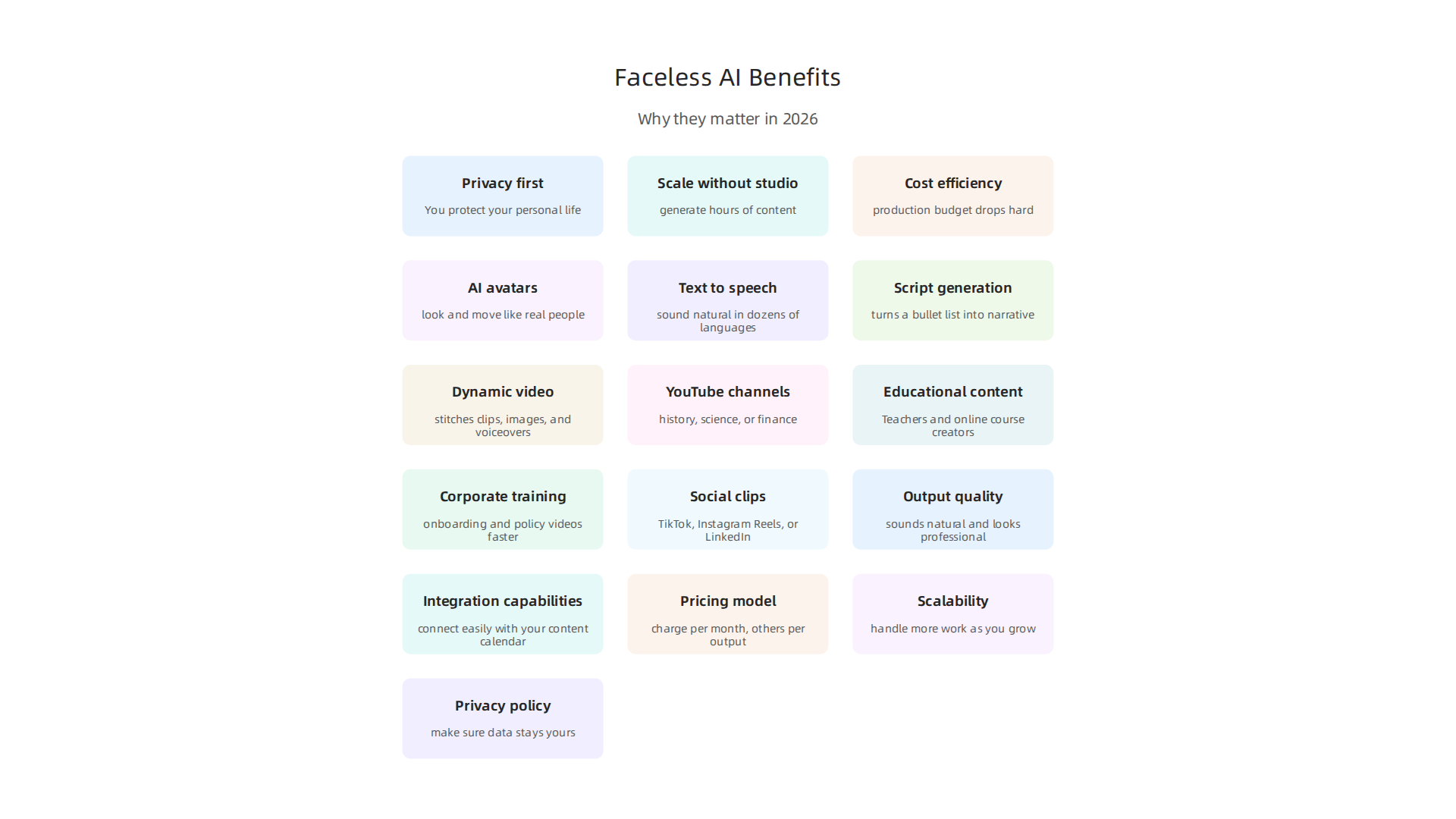
Privacy first. Not everyone wants to be the face of a brand. Maybe you value your anonymity, or you work in a sensitive field where showing your identity is risky. Faceless AI tools let you build an audience and share value without putting yourself in the spotlight. You protect your personal life while still growing your influence.
Scale without a studio. Traditional video creation needs a camera, lighting, soundproofing, and editing skills. That costs time and money. With faceless AI tools, you can generate hours of content from a single script. The global AI market is projected to hit $2.52 trillion in spending this year, according to AI automation statistics.
Businesses are moving from small tests to full integration because these tools make scaling fast and cheap.
Cost efficiency you can feel. When you do not need actors, voice talent, or editors, your production budget drops hard. The AI video generator market alone is expected to reach $946 million in 2026, with production costs dropping by 91% for teams that adopt it, as shown in AI video generation statistics. That means more content for less money.
What do these tools look like in practice? Here are common examples:
- AI avatars that look and move like real people but are fully digital.
- Text to speech voiceovers that sound natural in dozens of languages.
- Automated script generation that turns a bullet list into a full narrative.
- Dynamic video assembly that stitches clips, images, and voiceovers together automatically.
If you want to create visual assets to go with your faceless videos, you can compare the best free AI image generators to find one that fits your workflow.
The big takeaway? You no longer need to be a performer to be a creator. Faceless AI tools let anyone produce professional content at scale, privately and affordably. And because the AI tool landscape has exploded to more than 14,200 active tools in 2026 according to AI tools statistics, you have plenty of options to start.
Want to stay on top of the fastest changing tools and trends? Join The Deep View Newsletter for simple daily AI insights delivered straight to your inbox.
Top Faceless AI Tools for Video Creation
By now you know faceless AI tools can save you time and money. But which ones actually work well in 2026? Here are the top video tools worth your attention.
Synthesia
Synthesia is probably the most well-known faceless video platform.

You type a script, pick an AI avatar, and get a talking-head video in minutes. It supports over 140 languages and lets you create custom avatars that look like real people. Many businesses use it for training videos, marketing clips, and internal updates.

A test from the AI video generator guide of 2026 found Synthesia’s avatars to be among the most realistic for professional use cases.
HeyGen
HeyGen is a close competitor with a strong focus on ease of use. You can start with a single image to generate a video avatar, which is great for personal branding without showing your face. HeyGen also offers a free tier, making it a good option if you are looking for an ai video generator free tool to test the waters. Its multilingual support is solid, so you can create content for global audiences quickly.
Colossyan
Colossyan is designed specifically for workplace learning and corporate training. It has a simple interface that anyone can use without editing skills. You can add interactive quizzes and captions right inside the video. That makes it a favorite for HR teams and educators who need to produce compliance training or explainer videos at scale.
Other noteworthy tools
The market is packed with more options. MagicLight AI scores high for faceless YouTube channels. InVideo AI and Pictory are good for repurposing blog posts into videos. Runway Gen-3 offers more creative control for advanced users. For a full comparison of 10 leading AI video generators, check out the tested guide from Manus that breaks down quality, speed, and pricing.
If you want to see how these tools stack up against each other, there is a handy video ranking all the best tools of 2026 on YouTube.
Use cases that work
Here are some ways creators are using these tools right now:
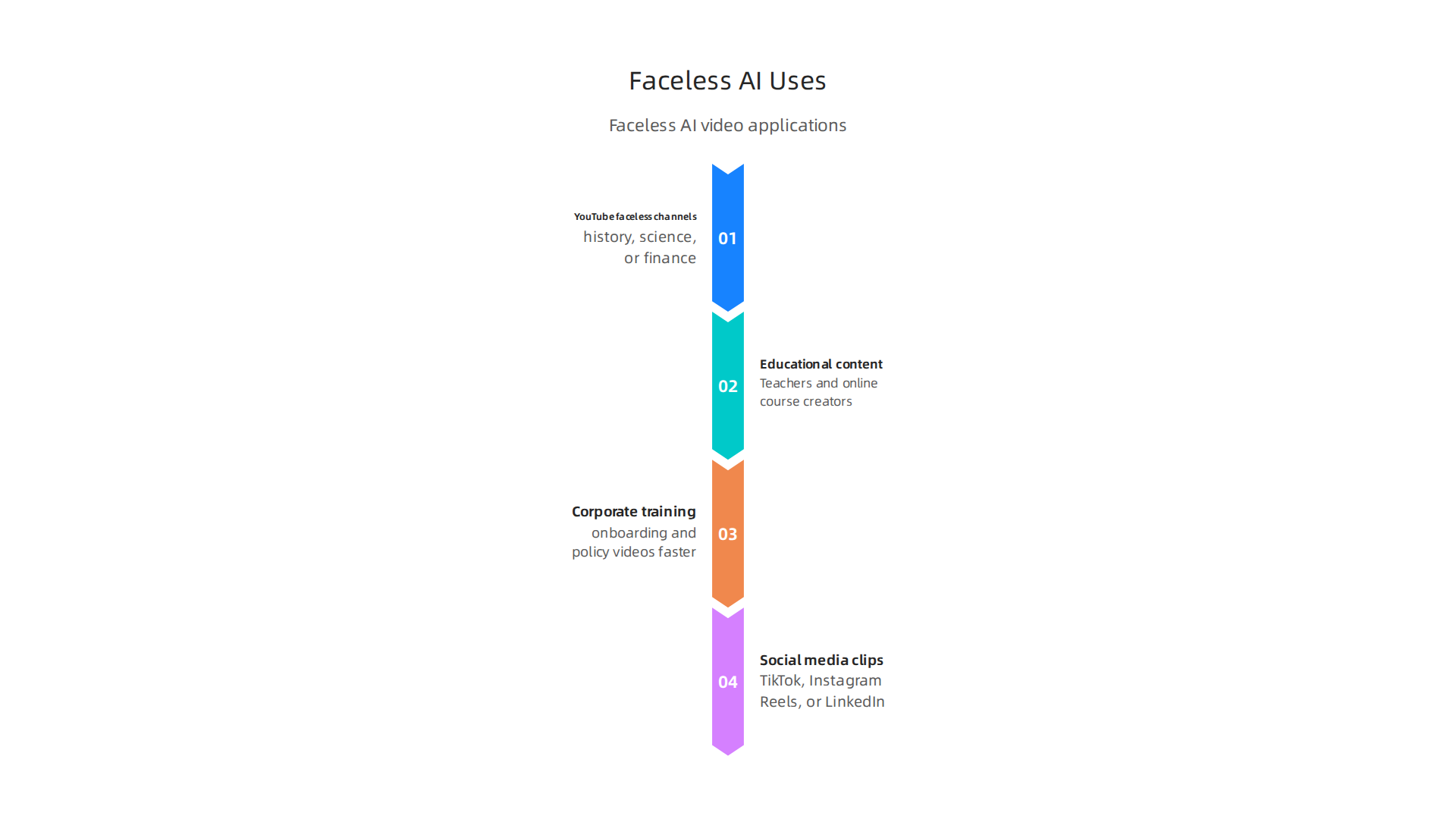
- YouTube faceless channels – Channels about history, science, or finance that use AI narration and visuals.
- Educational content – Teachers and online course creators produce lessons without being on camera.
- Corporate training – Companies roll out onboarding and policy videos faster than ever.
- Social media clips – Short faceless videos for TikTok, Instagram Reels, or LinkedIn.
No matter which tool you pick, the core idea is the same: type a script, get a video. You can learn more about the complete landscape of faceless content tools in the ultimate guide for 2026 from Clippie.
Ready to start creating?
The best way to figure out what works for you is to try one of these tools. And to stay updated on the latest AI tools and trends that can save you even more time, we recommend joining a daily newsletter that cuts through the noise.
[Your Daily AI Shortcut] – Join The Deep View Newsletter for simple daily AI insights.
Faceless AI Tools for Audio and Podcasting
Video is not the only place where faceless content thrives. Audio is booming too. Podcasts, audiobooks, and voiceovers can all be produced without ever recording your own voice.

AI voice cloning and text-to-speech tools make this easy, fast, and surprisingly natural.
ElevenLabs and other voice cloning leaders
The best place to start is ElevenLabs. This tool lets you clone a voice using just a small sample of audio. You can either create a custom voice that sounds exactly like you, or choose from their library of realistic AI voices. A recent guide on the best ElevenLabs alternatives in 2026 confirms that many faceless creators rely on voice cloning for editing and correcting mistakes in their audio. The result is a polished podcast without hours of re-recording.
Another professional option is Respeecher, which is used in big media productions. But for most creators, ElevenLabs is more than enough. If you are looking for a free option to test the waters, there is a YouTube video showing a free unlimited AI voice cloning tool that works as an ElevenLabs alternative.
Tools that go beyond voice cloning
For producing complete podcasts or audiobooks, tools like Wondercraft and Descript are game changers. Wondercraft is built specifically for faceless podcasting. You type a script, pick voices, and it creates the full episode with transitions and sound effects.
Descript takes a different approach. It is a full video and audio editor with built-in AI voice features. You can record your voice once, then edit the transcript like a document. When you delete a word, the AI voice fills the gap seamlessly. A review of the best AI voice generators in 2026 highlights Descript’s voice cloning as a top feature for podcasters who want to fix mistakes without re-recording.
Why audio tools matter for faceless creators
Here is why these faceless ai tools are worth your time:
- Consistent quality – Every episode sounds professional, no matter how tired you are.
- Multiple voice options – Switch between narrators, characters, or languages without hiring actors.
- Speed – A 30-minute podcast can be scripted, generated, and published in under an hour.
These tools also pair well with other AI workflows. If you are building an audience with faceless YouTube channels, you can use the same AI voices for both video and audio content. The list of best AI tools for faceless YouTube channels in 2026 often includes ElevenLabs and Descript as must-haves.
Stay ahead of the AI curve
The world of AI tools changes fast. New voice cloning tools and platforms appear every month. To keep up without spending hours searching, you need a reliable source of daily insights.
That is exactly why we recommend The Deep View Newsletter. It delivers simple, practical AI updates straight to your inbox. You will learn about new tools, trends, and strategies that can save you time and improve your content. Subscribe today and make staying informed your daily shortcut.
Best Faceless AI Tools for Blogging and Written Content
Audio is great, but written content is still the backbone of the internet. Blogs, social media posts, newsletters, and even entire eBooks can now be created without showing your face or using your own writing voice. AI writing tools are the perfect addition to your set of faceless ai tools.
The big players: Jasper, Copy.ai, and Writesonic
The most popular faceless ai tools for written content are purpose built for speed and quality. Jasper is a favorite among bloggers because it blends well with SEO platforms.
It can write full blog posts, product descriptions, and social media captions. Copy.ai is another strong choice, especially for short-form marketing copy. Writesonic offers a mix of both long and short form content.
According to a 2026 review of AI writing tools, specialized tools like Jasper and Surfer SEO outperform general purpose models for SEO focused work source: Guideflow. That matters because faceless creators often rely on search traffic to grow.
But general tools still have a place. ChatGPT and Claude are flexible and great for brainstorming and drafting. A comparison of AI content generation tools in 2026 notes that a general tool like ChatGPT is best for early stage ideas, while a specialized tool like eesel AI is better for final drafts source: eesel. So you might use both together.
You can also find free AI content generators that work well for testing. A list of the best free options in 2026 includes Machined and several others source: Machined. These are perfect when you are just starting out.
SEO integration and staying undetected
One concern for faceless bloggers is whether AI content can rank. The answer is yes, but you need to optimize it. Many of these tools integrate directly with SEO platforms like Surfer SEO or Frase. They help you include the right keywords, structure your headings, and match search intent. This keeps your author identity hidden while still producing content that Google loves.
On the other hand, if you worry about AI detection tools flagging your work, there is a reliable solution. You can check your content with a tool like Originality.ai, which is considered the most accurate AI content detection tool in 2026. It helps you make sure your writing sounds natural and human like.
Emerging tools for long form faceless content
The best faceless ai tools are not just for blog posts anymore. New platforms now help you create long form content automatically. You can generate an entire eBook from a single prompt. You can also start a faceless newsletter that publishes daily using AI. Tools like Frase and RightBlogger are stepping up to fill this need. A 2026 guide to AI blogging tools lists RightBlogger among the top picks for bloggers source: RyRob.
Stay ahead with daily AI insights
The landscape of AI writing tools changes fast. What works today might be outdated next month. To keep your faceless content strategy fresh, you need reliable updates.
That is where The Deep View Newsletter comes in. It delivers simple, practical AI news straight to your inbox. You will learn about new writing tools, SEO strategies, and content trends that matter. Subscribe today and make staying informed your daily shortcut.
By now you have a solid list of faceless ai tools for both video and written content. But having many choices can feel overwhelming. How do you know which one fits your workflow best? The wrong tool can waste time and money. The right tool can make your faceless content creation almost automatic.

Here are the key things to look for.
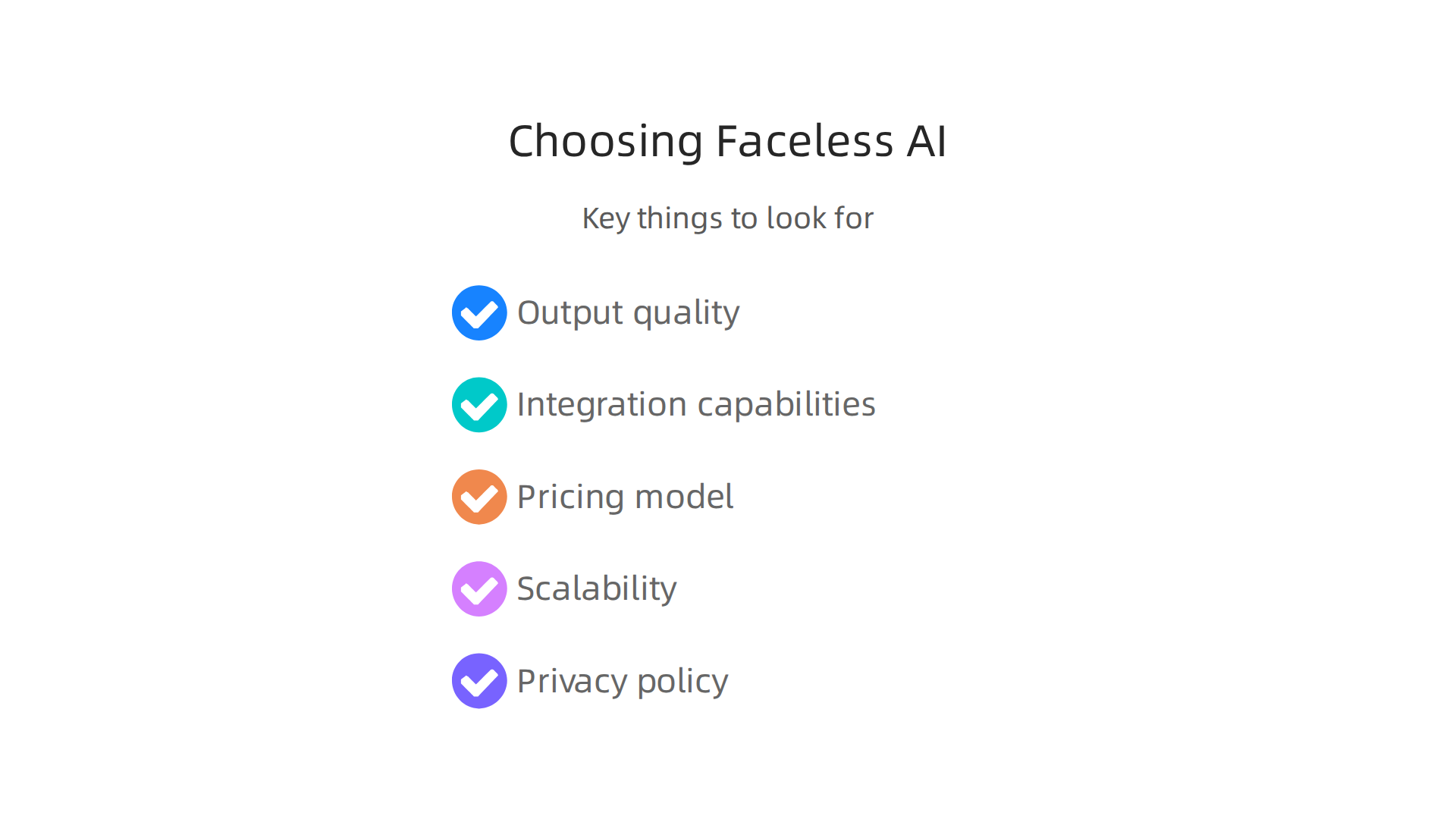
Output quality. Does the tool create content that sounds natural and looks professional? For video, check if the ai video generator free trial produces smooth motion and clear audio. For writing, test the tone and flow.
Integration capabilities. Your tool should connect easily with your existing content calendar, editing software, and distribution channels. If you use a scheduling app, the tool should support that.
Pricing model. Some tools charge per month, others per output. If you are just starting, look for a free version or a low cost plan. Many faceless ai tools like Pixverse AI offer a free tier so you can test before buying.
Scalability. Can the tool handle more work as you grow? A tool that works for one post a day might slow down when you need ten.
Privacy policy. This matters for faceless creators. You want to make sure your ideas and data stay yours.
Choosing the right tool also means making it part of your daily routine. The best faceless ai tools blend seamlessly with your workflow. They should feel like a natural step, not a separate task. According to a 2026 guide, the most successful faceless channels use format specific AI generators instead of traditional editing source: Syllaby. That saves time.
So test free versions first. Read user reviews. Benchmark the tool against your specific needs. For example, if you need an AI video generator free option, try Pixverse AI alongside others and compare speed and quality.
You can apply a similar process for selecting an AI image generator or any other tool in your stack.
Once you find the right fit, you can focus on creating, not figuring out tech.
To stay ahead of new tools and trends, you need a steady source of reliable updates. That is where The Deep View Newsletter comes in. It delivers simple, practical AI news straight to your inbox every day. You will learn about the latest faceless ai tools, strategies, and insights. Subscribe today and make staying informed your daily shortcut.
The Future of Faceless Content Creation and Emerging Trends
The world of faceless ai tools is changing fast. What worked last year might feel outdated next month. Keeping an eye on where things are headed helps you stay ahead. Here are three big trends shaping the future.
Trend 1: Hyper Realistic AI Avatars
Avatars are getting scarily good. In 2026, the AI video generator market is expected to hit $946 million, and 78% of marketing teams already use AI video content (source: AI Video Generation Statistics 2026). That means avatars that look real, move naturally, and speak with emotion. For faceless creators, this opens up a new option. You could use a virtual presenter without ever showing your real face. Some of the 8 fastest growing AI companies are leading this avatar revolution.
Trend 2: Regulatory Shifts Around Synthetic Media
As more people use faceless ai tools, governments are paying attention. New laws about deepfakes and synthetic media are coming. The global AI market already reached $390.91 billion in 2026 (source: AI Statistics & Trends 2026), and regulators want to make sure content is labeled correctly. This will affect how tools handle consent, watermarks, and disclosure. It is smart to pick tools that follow these emerging rules so your content stays safe.
Trend 3: Integration with AR, VR, and Interactive Media
Imagine walking through a virtual world where AI creates the scenery and characters as you go. That is where faceless ai tools are heading. Over 34 million AI images are created every day (source: AI Image Generation Statistics 2026), and that tech is merging with augmented and virtual reality. Soon, faceless creators could build immersive experiences without showing a face at all. If you want to experiment with visuals, check out this guide on the best AI image generator free options to get started.
These trends mean one thing: stay flexible. The faceless ai tools you choose today should be able to adapt tomorrow. And the easiest way to keep up? Get a daily dose of clear, practical AI news. That is exactly what The Deep View Newsletter delivers every morning. Subscribe now and never miss the next big shift.
Summary
This guide explains how to create professional content without appearing on camera using faceless AI tools for video, audio, and written formats. It walks through leading platforms—like Synthesia and HeyGen for video, ElevenLabs and Descript for audio, and Jasper or ChatGPT for writing—shows common use cases (YouTube channels, courses, training, podcasts), and gives practical selection criteria such as output quality, integrations, pricing, scalability, and privacy. You’ll learn which free or low-cost options to test, how to pair image generators with video workflows, and why staying current on regulation and tool advances matters. The article also highlights future trends—hyperreal avatars, tighter synthetic-media rules, and AR/VR integration—and offers a simple workflow to start producing faceless content quickly and safely.