

The AI Revolution in Data: Why Data Specialists Are More Critical Than Ever
Let me ask you something. Have you looked at the data job market lately? It feels like everything is changing overnight. One day you are building dashboards or running SQL queries. The next day, someone says AI can do all that for you. And honestly? That thought can be scary.
Here is the truth. The World Economic Forum predicts that 170 million new roles will be created, while 92 million will be displaced due to AI. That is a massive shift. And according to BCG, over the next two to three years, 50% to 55% of jobs in the US will be reshaped by AI. So yes, the work of a data specialist is evolving fast.
But here is the good news. This change is not a death sentence for your career. It is an invitation to grow. The demand for people who can work at the intersection of data and AI is exploding.

Roles like machine learning data scientist and other generative ai jobs are some of the fastest growing positions out there. In fact, PwC found that jobs requiring AI skills now carry a 56% wage premium over similar roles that don’t need those skills.
What does this mean for you? It means that old school data analytics skills are no longer enough on their own. You need to understand how AI models think, how to train them, and how to keep them honest. The data specialist of 2026 is part analyst, part engineer, and part strategist.
The key point is simple. If you adapt, you become indispensable. If you stay the same, you risk being left behind. That is why I want to walk you through exactly what is changing, what new career paths are opening up, and how you can future proof your skills starting today.
Let us dive in.
How AI Is Reshaping the Data Specialist Role
Picture this. A few years ago, you might have spent half your day cleaning messy spreadsheets, removing duplicates, or writing basic SQL queries. It was tedious, but it was your job. Now, AI tools can do that work in seconds. Tools like automated data pipelines and AI-powered analytics platforms handle the grunt work. So what is left for you as a data specialist?
Plenty. But the nature of the work is shifting fast.
The Old Grunt Work Is Getting Automated
Let’s be direct about what is changing. According to a BCG report from April 2026, 50% to 55% of jobs in the US will be reshaped by AI over the next two to three years. For data roles, that means tasks like data cleaning, basic reporting, and routine data analytics are increasingly handled by machines. Harvard Business Review research this year found that the number of skills required for roles prone to automation has actually shrunk by 7%. Translation: AI is eating the easy stuff.
But here is the thing. That automation frees you up to focus on higher value work. Work that actually requires human judgment, creativity, and domain expertise. The data science field is not dying. It is evolving.
The Rise of Model Interpretation and Data-Centric AI
So what replaces the old tasks? Two big trends define the data specialist role in 2026.
First, there is a huge demand for people who can interpret AI models. Companies are deploying machine learning models everywhere, from customer service chatbots to fraud detection systems. But these models are often black boxes. They give answers, but not explanations. Data specialists are now expected to explain why a model made a certain decision. Is it biased? Is it hallucinating? Can we trust it? This is where your skills become irreplaceable.
Second, we are seeing a shift toward data-centric AI. Instead of obsessing over the perfect algorithm, smart companies focus on improving the data itself. Clean, well-labeled, and balanced datasets make weaker models perform better. According to the PwC AI Jobs Barometer, roles requiring AI skills now command a 56% wage premium compared to similar non-AI roles. That premium is up from just 25% a year ago. Companies are willing to pay top dollar for people who understand data quality, curation, and annotation.
New Roles and New Titles
This shift has created entirely new career paths. Job titles like machine learning data scientist and other generative ai jobs are among the fastest growing in the market. The HeroHunt.ai report on fastest growing AI roles in 2026 confirms that demand for these hybrid positions is soaring.
So what does this mean for you as a data specialist? You need to grow beyond just running dashboards. You need to understand how AI models think, how to evaluate their outputs, and how to design data pipelines that fuel better AI. That is the winning formula.
If you want a deeper look at the certifications and credentials that can help you make this leap, check out our guide on top data analysis certifications for AI professionals.
It breaks down the certifications that actually matter in 2026.
The Bottom Line
Your role is not disappearing. It is being elevated. The routine stuff is automated. The strategic stuff is yours to own. The data specialist of 2026 is no longer just a number cruncher. You are the bridge between raw data and intelligent decision making. That is a role worth fighting for.
Emerging Hybrid Roles: Data Specialist Meets AI Engineer
So if your job is moving away from basic data cleaning and toward higher level thinking, what does the new job title actually look like? In 2026, you are not just a data specialist anymore. You are becoming something hybrid. Think of it as a blend between a traditional data analyst and an AI engineer.
The numbers back this up. LinkedIn’s 2026 Jobs on the Rise report ranked AI Engineer as the number one fastest growing job title in the United States, with job postings surging. That is not a coincidence. Companies are realizing that they need people who can do both sides of the work: understand data deeply and also build or manage AI models.

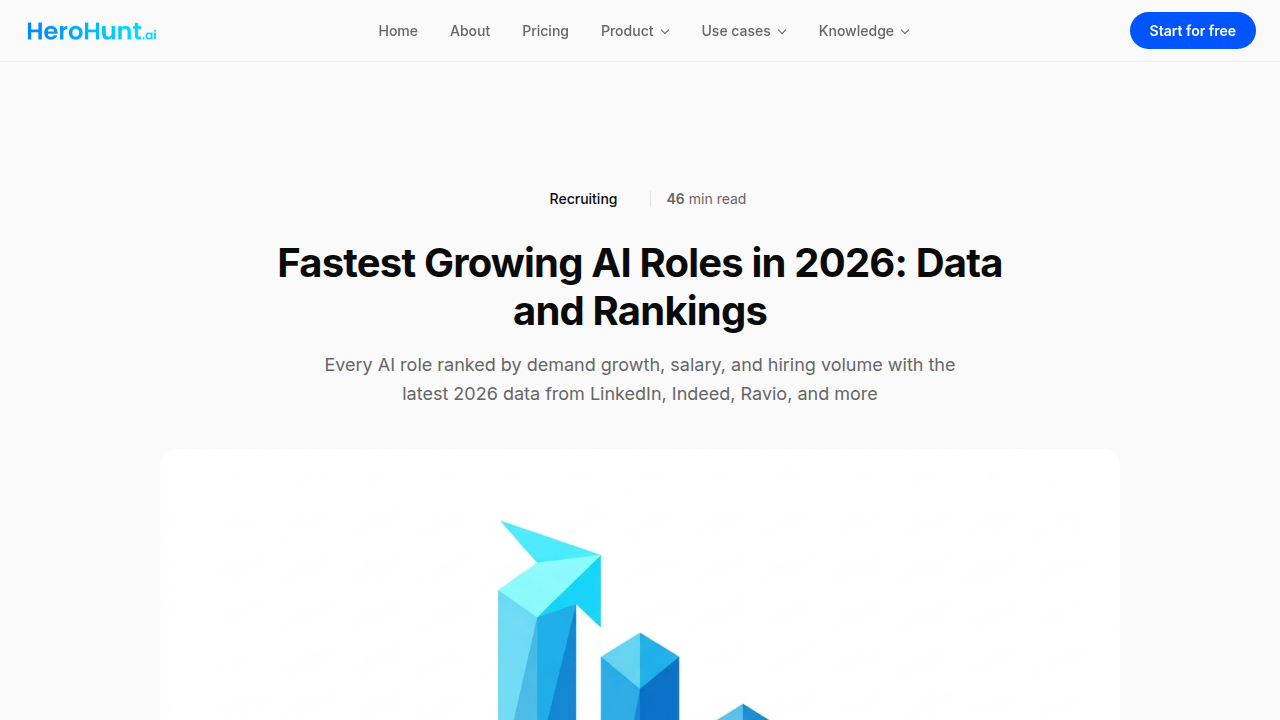
Roles like machine learning data scientist and ML Data Engineer are now standard in job boards from San Francisco to New York. In fact, the HeroHunt.ai analysis of fastest growing AI roles confirms that demand for these hybrid positions is climbing fast.
What does a hybrid role actually involve? It is not just about running a model and calling it done. You need to know how data flows from raw source into a training pipeline. You need to check if the data is clean, balanced, and labeled correctly. Then you need to understand how the AI model processes that data, how to evaluate its predictions, and how to explain its decisions to a business stakeholder. That is the core of the hybrid skillset.
Companies like those hiring on Built In San Francisco are looking for "Staff Software Engineer, Data Platform" and "Senior Staff Data Engineer" roles that blend data engineering with software and AI platform work. These are not your old SQL only jobs. They require you to think about system design, model deployment, and data quality all at once.
The Kore1 report on AI Jobs 2026 names specific roles like MLOps engineers, prompt engineers, and data annotators as part of the hiring boom. And over at Syracuse University’s list of highest paying AI jobs, you will see roles like machine learning platform specialist and AI product manager sitting right alongside data scientist. The Coursera guide to AI jobs in 2026 lists AI engineer, machine learning engineer, and data engineer as the top roles to explore.
The message is clear: the lines between titles are blurring.
This is great news for you as a data specialist. You already have the data foundation. You know data analytics, you understand basic data science concepts. You just need to layer on AI knowledge. You do not need to become a full blown software engineer overnight. But you do need to learn how AI models work, how to train them, and how to evaluate their outputs. That is the path toward those generative ai jobs that everyone is talking about.
If you want a practical next step, check out our guide on how to become a Meta Data Scientist in 2026. It walks you through exactly the kind of hybrid thinking and skill building that top tech companies are looking for.
Companies are also creating specialized teams around data-centric AI. Instead of one person doing everything, we are seeing small squads with a mix of data engineers, AI modelers, and domain experts. But every person on that team needs to speak the same language. That is why hybrid roles matter. You are the translator between the data world and the AI world. And that is a role that is only going to grow in demand.
Essential Skills for the Modern Data Specialist in 2026
Your old skills still matter. In fact, they matter more than ever. You still need SQL, Python, and a solid grasp of statistics. You still need to know how to clean messy data and build a clear dashboard. Those skills are the foundation.
But here is the thing: in 2026, the foundation alone is not enough. Companies are looking for a new mix of abilities. They want a data specialist who can also work with AI tools, communicate with non-technical teams, and think about ethics.
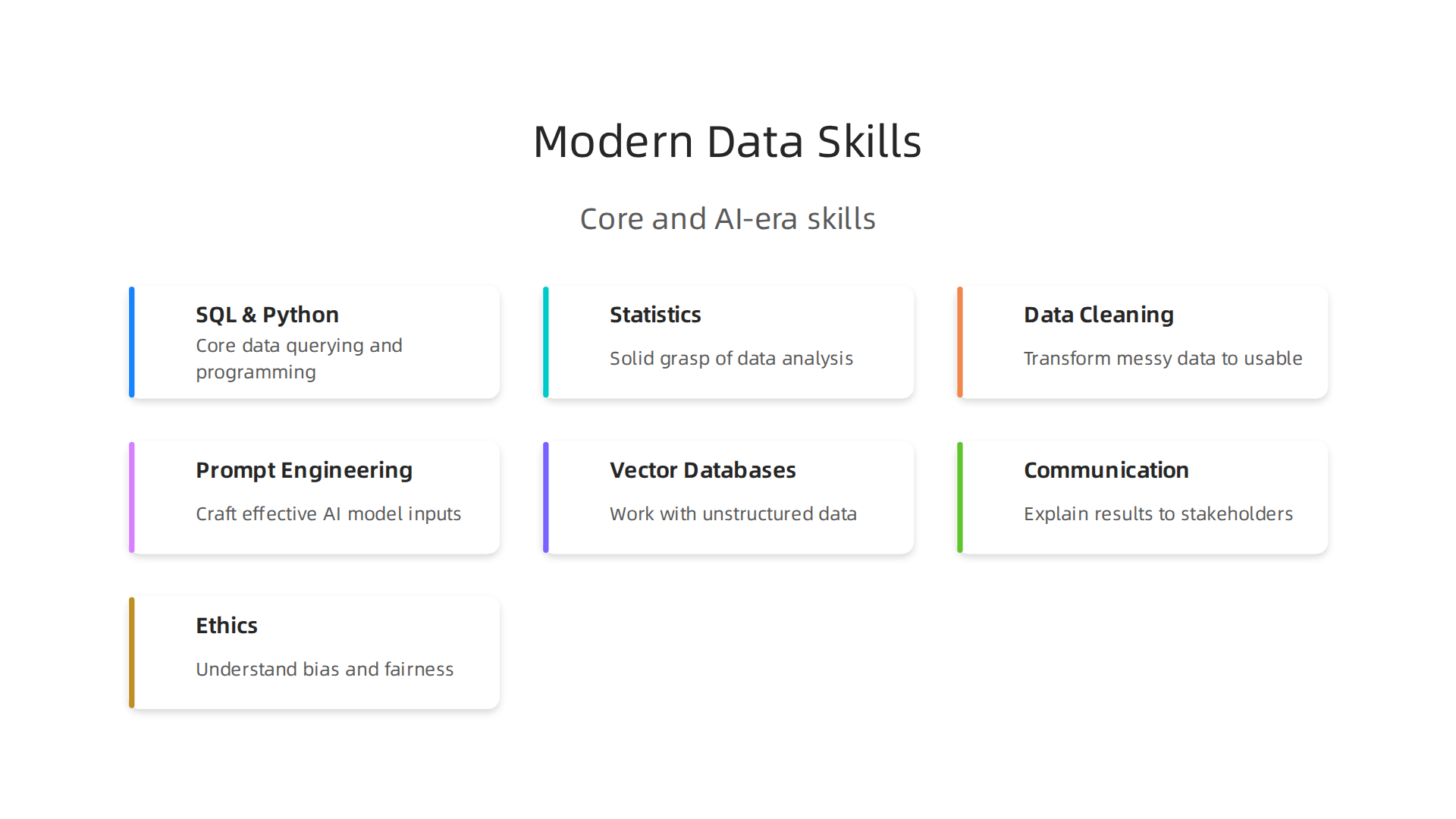
Let’s break down the most important skills to build right now.
Core data skills are non-negotiable
Before you layer on AI, make sure your basics are solid. According to the Coursera guide to AI jobs in 2026, roles like data engineer and data scientist still require strong data wrangling and analytics skills. Every hybrid role we talked about earlier still expects you to pull data, transform it, and make sense of it.
If you want to strengthen your foundation, check out our roundup of the top data analysis certifications in 2026 for AI professionals. It lists the credentials that will keep your core skills sharp.
New AI skills you need to learn
Here is where the shift happens. You do not need to become a PhD level AI researcher. But you do need to understand how large language models work. You need to know how to write good prompts.
Prompt engineering is one of the fastest growing skills on job boards. The Kore1 report on AI jobs in 2026 lists prompt engineers as a dedicated role, but even as a data specialist, you will be expected to craft prompts that get useful outputs from AI. It is not just about asking questions. It is about structuring inputs so the model gives you reliable answers.
Another emerging skill is working with vector databases. If you deal with unstructured text or images, you need to understand embeddings and retrieval augmented generation (RAG). The Murray Resources list of top AI IT jobs shows roles like AI Software Architect that demand knowledge of these modern data structures. Knowing how to store, search, and retrieve vectors is becoming as important as knowing how to join tables.
Soft skills are finally getting respect
The technical stuff is necessary, but it is not enough. Companies in 2026 are desperate for people who can communicate clearly. They need a data specialist who can explain why a model made a bad prediction to a product manager or a compliance officer.
The Alexander Technology Group hiring trends report emphasizes that soft skills like collaboration and adaptability are now ranked higher in job descriptions than ever. Why? Because AI outputs are hard to interpret. If you cannot explain them, your insights get ignored.
Ethics is another skill that is moving from nice to have to must have. The Syracuse University list of highest paying AI jobs includes roles like AI product manager and chief AI officer. Those roles demand an understanding of bias, fairness, and responsible AI use. Even if you are not in a leadership role, you should know how to check your data for hidden bias and how to document your decisions.
How to start building these skills
You do not need to take a year off. Start with one new skill at a time.

If you already know SQL, spend a few hours learning how to write effective prompts. If you already use Python, try building a simple RAG pipeline using a vector database like Pinecone or Weaviate.
For a practical example of how top tech companies combine data skills with AI thinking, read our guide on how to become a Meta Data Scientist in 2026 and beat information overload. It shows exactly the kind of hybrid mindset you need.
Remember, the machine learning data scientist of 2026 is not a completely different person. It is you, with a few new tools in your belt. Start layering today, and you will stay valuable tomorrow.
Industries with the Highest Demand for AI-Data Professionals
You have the skills. You know what a data specialist needs to learn. But where should you take your career? The answer depends on the industry you choose. Some sectors are hiring faster than others. And the roles they need look different than they did a few years ago.
Let’s look at the industries that want machine learning data scientist talent the most in 2026.
Healthcare leads the pack
Healthcare is exploding with data science needs. Hospitals use AI to read medical scans. Insurance companies use it to predict patient risks. Drug companies use it to speed up clinical trials.
According to the Coursera guide to artificial intelligence careers in 2026, healthcare is one of the top sectors investing in AI talent. They need people who understand both data and medical regulations. If you can handle sensitive patient data and build models that save lives, you will have plenty of options.
Finance is not far behind
Banks and fintech companies have always loved data. But in 2026, they are going all in on AI. They use generative ai jobs to detect fraud, automate customer service, and create personalized financial advice. The hiring is strong and the pay is high.
The January 2026 US Labor Market Update from Indeed Hiring Lab shows that job postings mentioning AI are growing even when overall hiring is slow. Finance is a big part of that growth. They need data analytics experts who can also work with AI models.
Tech is still growing, but differently
You might think the tech sector would be the biggest winner. It is. But the roles have changed. Companies are no longer hiring general "data scientists." They want specialists with defined skills.
The AI Staffing Ninja list of most in demand AI jobs in 2026 highlights roles like MLOps Engineer and AI Solutions Architect. These are not old school data jobs. They require a mix of software engineering, data engineering, and AI deployment skills.
If you are aiming for a tech company, focus on building those hybrid skills. Our article on how to become a Meta Data Scientist in 2026 shows exactly what top tech firms look for now.
Retail and manufacturing are catching up
These two industries used to lag behind. Not anymore. Retailers use AI to manage inventory, predict demand, and personalize shopping. Factories use AI for predictive maintenance and quality control.
The Onward Search list of top AI jobs in 2026 includes roles that span across sectors. Retail and manufacturing are creating new positions for data specialists who understand their specific challenges.
If you want to explore which certifications help you break into these industries, check out our guide on the top data analysis certifications for AI professionals in 2026. It covers credentials that open doors in healthcare, finance, and beyond.
One last thing to remember
The best industry for you depends on what you care about. Do you want to save lives? Go healthcare. Do you want high pay? Go finance. Do you want cutting edge tech? Go to a tech company. Do you want stability and steady growth? Retail and manufacturing are solid bets.
The University of San Diego careers guide confirms that AI jobs are growing across the board. The key is picking the sector that fits your goals and then building the specific skills they need. You have the foundation. Now choose your path.
How to Transition into an AI-Focused Data Specialist Career
So you know which industry fits you best. Now comes the real question. How do you actually make the switch? Moving from a general data role to an AI focused one does not have to be painful. But it does require a clear plan.
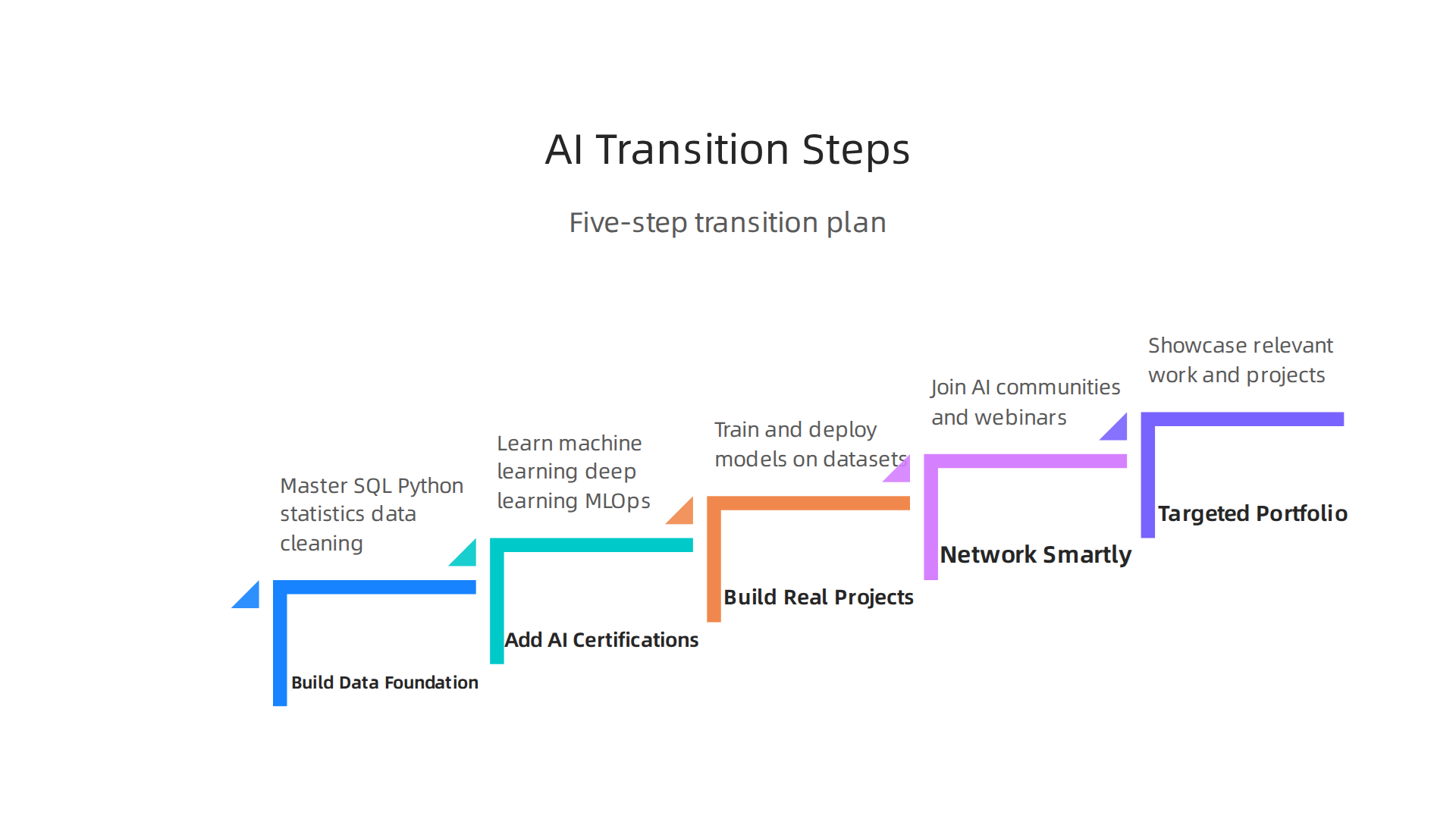
The Coursera guide to AI careers in 2026 shows that most employers want people who combine deep data knowledge with practical AI skills. Here is how you build that combination step by step.
Step 1: Build a rock solid foundation in data fundamentals
You cannot rush this part. Before you touch any AI model, you need to master the basics. That means SQL, Python, statistics, and data cleaning. These are the building blocks every data specialist relies on.
Companies like to hire people who can handle messy data first and ask smart questions second. If you skip these fundamentals, your AI models will be built on shaky ground. And no one wants that.
The University of San Diego careers guide points out that even advanced AI roles require strong data manipulation skills. So spend time here. It will pay off.
Step 2: Add AI certifications and build real projects
Once your data skills are solid, it is time to go deeper. Look for certifications that teach machine learning, deep learning, and MLOps. The AI Staffing Ninja list of most in demand AI jobs in 2026 highlights roles like MLOps Engineer and AI Solutions Architect. These are the jobs that require both data expertise and AI knowledge.
Certifications give you structured learning. But projects prove you can actually do the work. Build something real. Train a model on a public dataset. Deploy it. Document your process. That is what hiring managers want to see.
If you are wondering which certifications open the most doors, check out our guide on the top data analysis certifications for AI professionals in 2026. It covers credentials that employers actually recognize.
Step 3: Network smartly and build a targeted portfolio
You have the skills and the projects. Now people need to see them. Create a portfolio that shows exactly the kind of work you want to do. If you want to work in healthcare, include a project on predicting patient readmissions. If you want finance, build a fraud detection model.
Networking is just as important. Join AI focused communities, attend webinars, and connect with people already working in the roles you want. The January 2026 US Labor Market Update from Indeed Hiring Lab confirms that AI mentioning jobs are growing even when overall hiring is slow. That means companies are actively looking. You just need to put yourself in front of them.
One more thing
The Onward Search list of top AI jobs in 2026 reminds us that the job market is changing fast. But the path is clear. Build your foundation. Earn relevant certifications. Create real projects. Network with purpose.
Follow these steps and you will be ready for the opportunities waiting in 2026.
Salary and Career Growth Projections for Data Specialists with AI Skills
Now let’s talk about the part that gets everyone excited: the money. Adding AI skills to your data specialist toolkit can seriously boost your earning potential. Companies are paying a premium for people who can bridge the gap between raw data and intelligent systems.
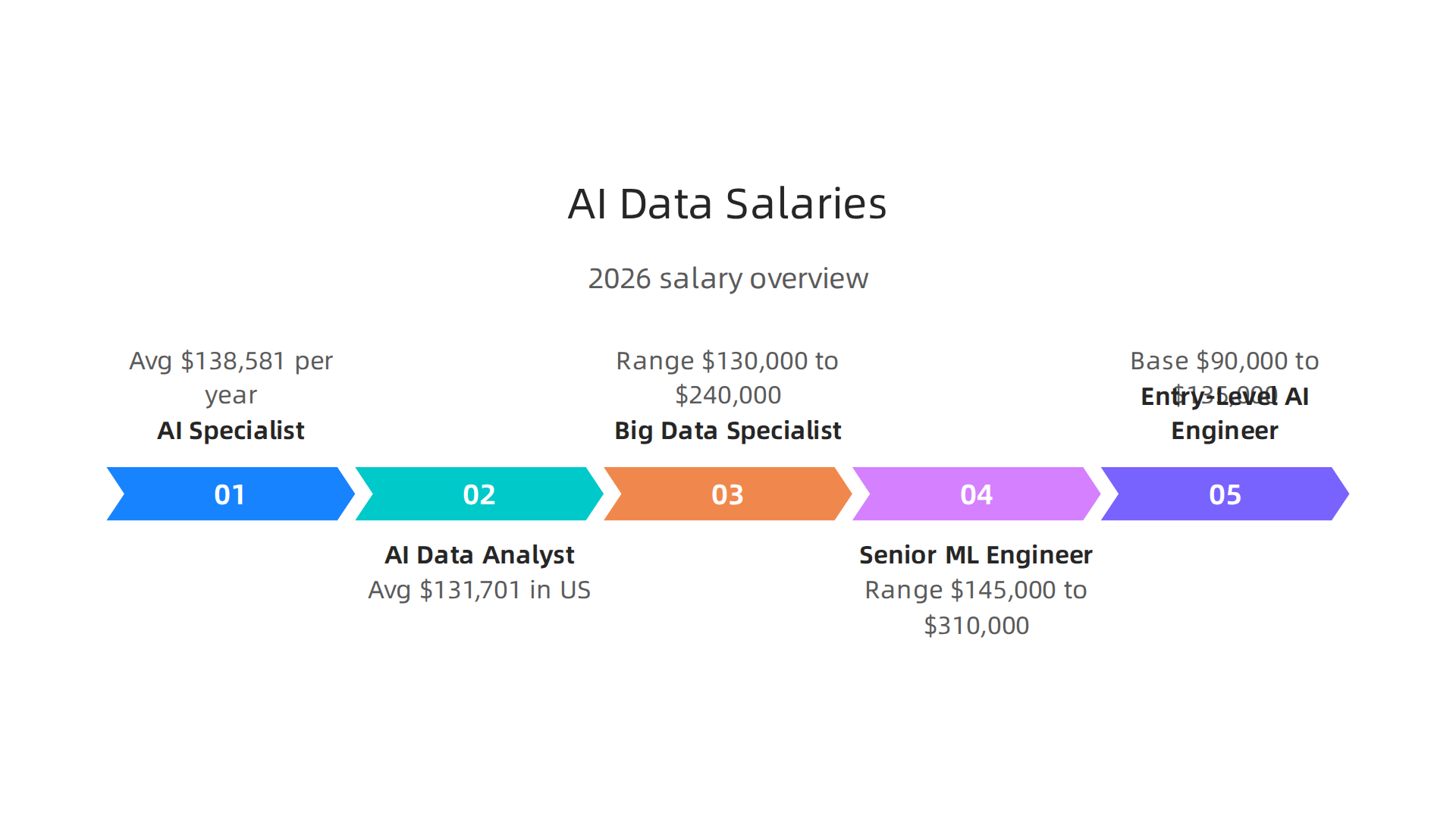
Here is what the numbers look like in 2026. The average salary for an AI Specialist is around $138,581 per year, according to PayScale.
That is a solid jump from a traditional data analyst role.
If you move into a big data specialist role focused on AI infrastructure, the range goes even higher. Syracuse University reports salaries between $130,000 and $240,000 for that position. And for those working directly as AI data analysts, Glassdoor shows an average of $131,701 in the US.
How senior roles push past $150k
Once you reach senior levels, the ceiling lifts fast. KORE1’s real offer data shows AI engineer salaries running from $145,000 to $310,000 in base pay. Senior machine learning engineers in tech hubs like San Francisco and New York hit the top end of that range.
Even entry-level AI engineers are starting strong. Everyone Who Code notes base salaries between $90,000 and $135,000, with total compensation reaching $110,000 to $160,000 when you factor in bonuses and equity.
Location and industry matter
Not every market pays the same. Tech hubs offer higher salaries, but remote work also opens doors to top tier companies regardless of where you live. Industries like finance, healthcare, and cloud infrastructure tend to pay the most for AI skilled data specialists.
Career growth is real
The job market for AI roles keeps expanding. Even while overall hiring slows, jobs that mention AI continue to grow. That means demand for your skills will stay strong for years.
To keep your career moving forward, it pays to stay smart about the tools and certifications you choose. Our guide on choosing the right data analysis tools in 2026 for AI professionals can help you pick the platforms that employers value most.
The bottom line is simple. Invest in AI skills now, and the salary growth will follow. Whether you are just starting or moving into senior territory, the financial reward is there for those who build the right combination of data expertise and AI knowledge.

Future Trends: What’s Next for AI and Data Roles Beyond 2026
The strong salaries and demand we just looked at are not slowing down. But the way you work as a data specialist will change a lot in the coming years. AI is moving fast, and the jobs that exist today will look different by 2027. Here are the biggest trends that will shape your career.
AI automation will shift your responsibilities
Right now, a lot of data work involves cleaning data, running basic reports, and building simple models. Machines will handle more of that routine work soon. That means your job will move away from repetitive tasks. Instead, you will spend more time on things like choosing the right problem to solve, checking that models are fair, and explaining results to business leaders. The data specialist of the future is more of a strategist than a button pusher.
This shift is already happening. Companies are paying top dollar for people who can step up. Syracuse University reports that big data specialists focused on AI infrastructure earn between $130,000 and $240,000. That high pay reflects the need for workers who can manage complex AI systems, not just run spreadsheets.
Data governance and ethics roles will grow
As AI tools get used in more places, companies face big questions about privacy, bias, and data quality. Who owns the data? Is the model fair to all users? How do you keep customer information safe? These questions are creating whole new jobs in data governance and AI ethics.
If you want to move into this area, adding a certification can help. Our guide on top data analysis certifications for AI professionals lists credentials that teach you how to manage data responsibly. This is a fast growing field where data science skills meet policy and law. Expect more roles like "data ethics officer" and "AI governance analyst" to appear on job boards.
Edge AI and real time data will demand new expertise
Most AI today runs in the cloud on big servers. But more and more, AI is moving to the edge. That means processing data right on devices like phones, cameras, and sensors. Think of a smart factory that analyzes machine vibrations instantly, or a self driving car that makes decisions in milliseconds.
Handling real time data at the edge requires different skills. You need to know about streaming data platforms, low latency models, and how to make AI work with limited computing power. As a machine learning data scientist or data analytics pro, you will need to learn tools designed for edge computing.
This trend also ties into generative AI jobs because companies want to run smaller, faster versions of models on devices. The demand for people who can build and maintain these systems is only going up.
The future is bright for anyone willing to keep learning. The roles will change, but the core value of understanding data and AI will only grow. Stay curious, keep building skills, and you will be ready for whatever comes next.
Summary
This article explains how AI is transforming the data specialist role rather than replacing it, and it shows what skills and career moves will keep you valuable through 2026 and beyond. It outlines which routine tasks are being automated, why model interpretation and data‑centric approaches matter, and how hybrid roles (like machine learning data scientist and MLOps) are rising. The piece details the technical and soft skills employers now demand—SQL, Python, prompt engineering, vector databases, ethics and communication—and maps industries with the strongest hiring (healthcare, finance, tech, retail). It also gives a practical three‑step plan to pivot into AI‑focused work, plus salary ranges to expect, so after reading you’ll know what to learn, which roles to target, and how to build a portfolio and network to land those jobs.