

The world of Artificial Intelligence (AI) is moving super fast in 2026. It feels like new AI tools and apps come out every single day. This can make it really hard to know "what is the best ai" for you or your job. With so many choices, including lots of AI apps free to try, it’s easy to feel lost in all the information. You might wonder which tool will actually help you and not just waste your time or money.

Picking the wrong one can slow you down or even cause problems.
That’s why choosing the right general-purpose AI tool is so important. It’s not just about finding any AI, but finding the one that truly fits what you need to do. Different tools are good for different tasks. It’s a big decision because the right AI can make your work much easier and help you achieve your goals faster. To help you pick wisely, experts often look at many things. This includes how accurate the AI is and if it makes up facts, which is called hallucination. They also check for safety and if the tool works well with your other systems. For more on evaluating these tools, you can read about 5 best AI evaluation tools for AI systems in production (2026).
This guide is here to make things simple. We will cut through the noise and give you clear, proven ways to find the best AI for different roles and tasks. We’ll show you how to look at the facts, understand what matters most, and give you tips on how to start using these tools effectively. Our goal is to help you confidently choose the AI tools that will make a real difference for you. To learn more about making smart choices for your company, check out our guide on Master how to choose AI tools for your business needs.
The world of AI is always changing. To keep up with all the new AI models, company news, and important updates every day, you need a trusted source.
Get clear daily AI updates from The AI Newsletter Worth Reading.
To help you really understand "what is the best AI" for you, we look at several important things.

It’s like checking a car before you buy it. You don’t just pick any car; you check its speed, how much gas it uses, and if it’s safe for your family. For AI tools, we use clear rules to see how good they are.
Here are the main things we check:
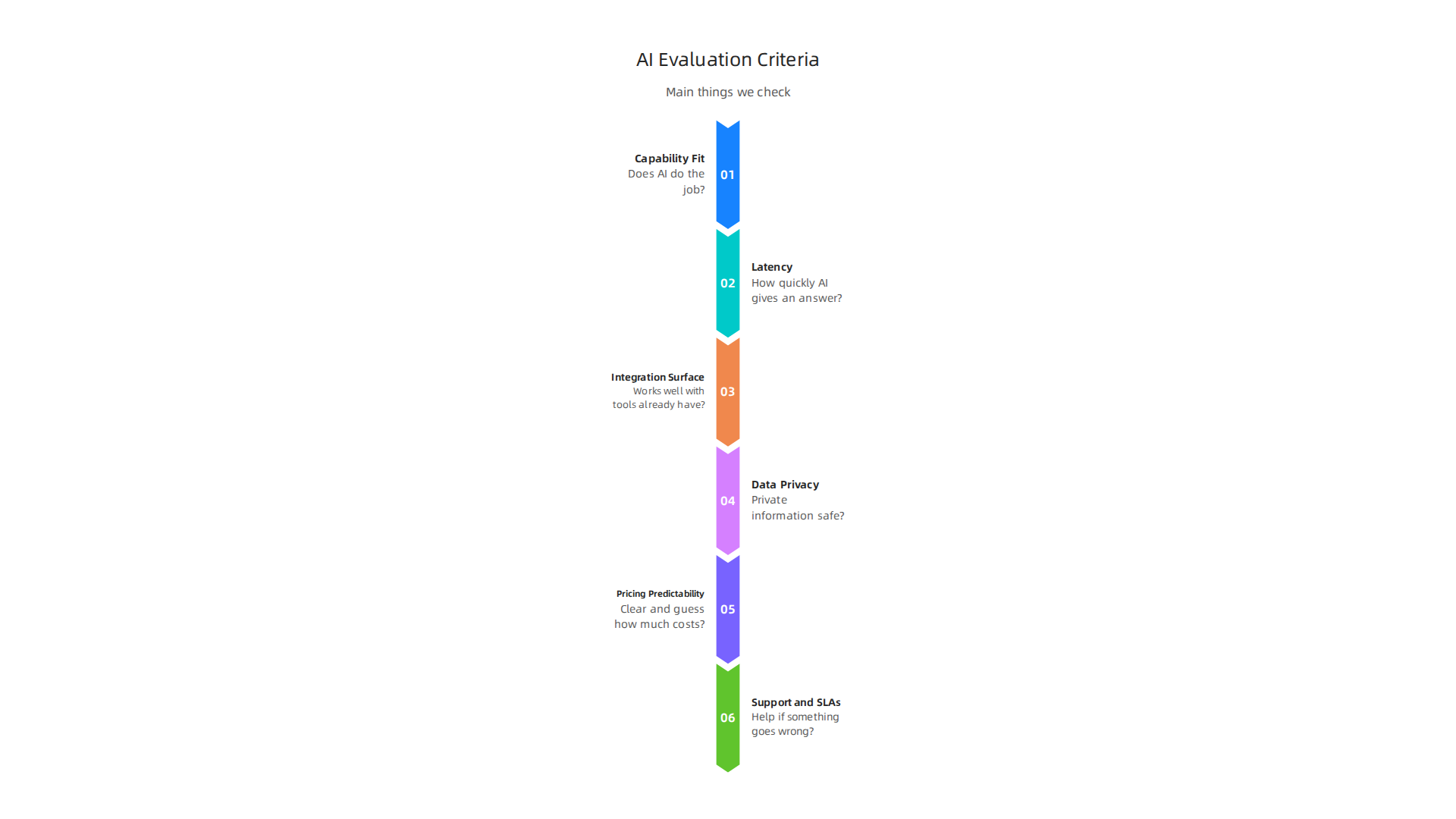
- What it can do (Capability Fit): First, we see if the AI tool can actually do the job you need. Does it write well? Can it solve problems? Does it help with data? If you want an AI to make images, it needs to be good at that, like an AI photo enhancer fixes blurry photos in seconds in 2026. This is also called "business fit" or "output quality" by some experts, meaning it solves a real problem and gives good results.
- How fast it is (Latency): Nobody likes to wait. We check how quickly the AI gives you an answer or finishes a task. A slow AI can slow down your whole day. Fast AI saves you time. This is part of looking at its "performance" and "efficacy" or how well it works.
- How it works with other tools (Integration Surface): Most people use many different computer programs. A good AI tool should work well with the tools you already have. Can it easily connect to your other apps and systems? If an AI can’t easily fit into your current setup, it might not be worth it. Experts say easy connection to your own databases and other tools is key for teams in 2026.
- How safe your information is (Data Privacy): This is super important. You need to know that your private information and work secrets are safe with the AI tool. We look at how the tool handles your data and if it keeps it private. Safety checks are a core part of evaluating any AI system.
- How much it costs (Pricing Predictability): You don’t want surprises on your bill. We check if the pricing is clear and if you can guess how much it will cost you each month. Some free AI apps are available, but even paid ones should be clear about their prices. Things like "cost-effectiveness" are important for how businesses choose AI tools.
- Help and support (Support and SLAs): What happens if something goes wrong? A good AI tool should come with helpful support. This means if you have a problem, someone can help you fix it quickly.
Why different people care about different things
Not everyone cares about the same things. What’s important depends on your job.
- For Developers: People who build software care a lot about how easy the AI is to connect to other systems (integration) and how quickly it runs (latency). They also look at how much control they have over the AI’s actions and if it has clear guides for building with it. Things like "developer experience" and community support matter a lot.
- For Marketers: If you work in marketing, you likely care most about how well the AI creates content or ideas. Is the output good quality? Is it easy to use? Can it make social media posts or ads quickly? They might use AI apps free of charge to test them out. For more on how AI helps with marketing, check out how AI transforms social media marketing services in 2026.
- For Leaders and Bosses (Executives): Business leaders want to know if the AI tool will help the company grow and save money. They care about the overall "business fit," data privacy, and predictable costs. They also want to know if the tool is reliable and ready for big company use. To pick the best tools for big companies, it’s good to learn how to choose the best enterprise AI platform for your organization.
After looking at what makes an AI tool good for different people, let’s talk about the kinds of AI tools you’ll find in 2026. Knowing these types will help you figure out what is the best AI for your own needs, because there isn’t just one "best" AI for everyone, as many experts agree The AI Model Wars Are Over.
It’s more about finding the right tool for the right job.
Top general-purpose AI tools in 2026 — categories and standout picks
In 2026, AI tools fit into a few main groups, each great for different tasks.
Think of them like different tools in a toolbox.
- Large Language Models (LLMs): These are like super-smart text buddies. They can write stories, answer questions, summarize long documents, and even chat with you. They’re what most people think of when they hear "AI." Top ones include models like GPT-5.5, Claude Opus 4.8, and Gemini 3.1 Pro. Claude Opus 4.8 is often noted for its strong performance in coding and complex thinking Best AI Models June 2026 Leaderboard.
- Multimodal Platforms: These AIs can handle more than just text. They understand images, sound, and sometimes even video. Gemini 3.1 Pro is a great example, winning awards for its ability to work with many types of information at once Top AI Models 2026 Guide.
- Code Assistants: These tools help computer programmers write code faster and with fewer mistakes. Think of them as a helper for developers. GitHub Copilot is a very popular one, giving coding ideas as you type Best AI Tools For Everyday Use in 2026. If you’re a developer, you might also look into tools like Spring AI guide for Java developers.
- Image and Video Generation: These AIs are artists. They can create new pictures and videos from simple text descriptions. They can also make existing visuals better. If you need to power your visual content strategy, there are many choices, including best AI image generators 2026.
- Data and Analytics Accelerators: These AIs help you make sense of large amounts of information. They can find patterns, create reports, and give you insights that would take a long time to find yourself. This is helpful for understanding your business better or making smart decisions with numbers. For businesses, tools like Airtable AI guide for smarter workflows can connect to your data and make things easier.
Different ways to get and use AI tools
When you’re looking for the best AI, you’ll also see different ways these tools are offered:

- API-first models: These are mainly for developers. They are like building blocks that programmers use to add AI smarts to their own apps and systems. If you want to build something totally new, this is often the way to go.
- Integrated apps: These are ready-to-use programs or websites that have AI built right in. They’re made for everyday people or specific jobs, like writing, editing photos, or planning projects. Many of these are simple to use and you might even find best AI productivity tools for 2026 that help your daily work.
- Open-source + hosted stacks: These give you more control. "Open-source" means the code is free to look at and change. "Hosted stacks" means someone else sets up and runs the powerful computers needed for the AI, so you don’t have to. This option is popular for people who want to customize AI or use it for very specific tasks. "Invoke AI" is one example in the image generation space that follows an open-source path.
Choosing the right AI means looking at your specific needs and how these different categories and types of tools can help you. To dive deeper into what’s happening in the world of AI every day, consider getting regular updates.
Get clear daily AI updates from The Deep View Newsletter.
The AI Newsletter Worth Reading
Choosing the right AI tool means looking closely at what it can do, how much it costs, and if it fits what you need. Think of it like picking the best tool for a specific job in your home or business.
Detailed comparison: features, pricing models, and best use cases
When you ask "what is the best AI," the answer truly depends on what features are important to you.
What features matter most?
Not all AI tools are made the same. Some are great at writing, others at making pictures, and some help with numbers. Here are some key features to think about:
- Task Versatility: Can the AI do many different things, or is it only good at one special job? A general-purpose AI like GPT-5.5 is known as an all-rounder, handling many tasks with good quality Best AI Models June 2026: Every Major LLM Ranked & Compared.
- Accuracy and Reliability: How often does the AI make mistakes? For important tasks, you need a tool you can trust.
- Speed: How fast does it give you an answer or finish a task? If you need quick results, speed is key.
- Ease of Use: Is the tool simple to learn and use, or is it very complicated? Many integrated apps are made to be user-friendly.
- Ability to Handle Long Information: Can the AI read and understand really long documents or conversations? Tools like Claude are good for long documents and complex thinking.
- Multimodal Skills: Can it work with more than just text, like pictures, sounds, or videos? Gemini 3.1 Pro is often praised for its ability to work across different types of information.
- Customization: Can you change the AI to fit your exact needs, or is it a "one-size-fits-all" product? Open-source options, like Flow AI for developers, often offer more ways to customize.
How pricing models affect costs
The cost of AI tools can add up, so it’s smart to understand how they charge you.
- Per-token pricing: This is common for AI models used by developers (API-first models). You pay for each small piece of text (a "token") the AI reads or writes. This can be cheap for small tasks but can get expensive quickly for very large projects. For example, some advanced models can charge up to $180 per million output tokens for businesses.
- Per-seat subscription: Many ready-to-use AI apps charge a monthly fee for each person who uses the tool. This is like paying for a software license. This is common for productivity tools and makes costs easy to predict.
- Flat monthly subscription: Some popular AI tools, like ChatGPT Plus and Claude, offer a flat fee (around $20 a month in 2026) for individual users, giving them access to advanced features.
- Free AI apps/tiers: Some AI tools offer a basic version for free, or a free trial. These can be a good way to try out an AI before you pay. You can find options for best AI image generator free if you’re looking to create visuals without cost.
Comparing AI tools: Trade-offs and best fits
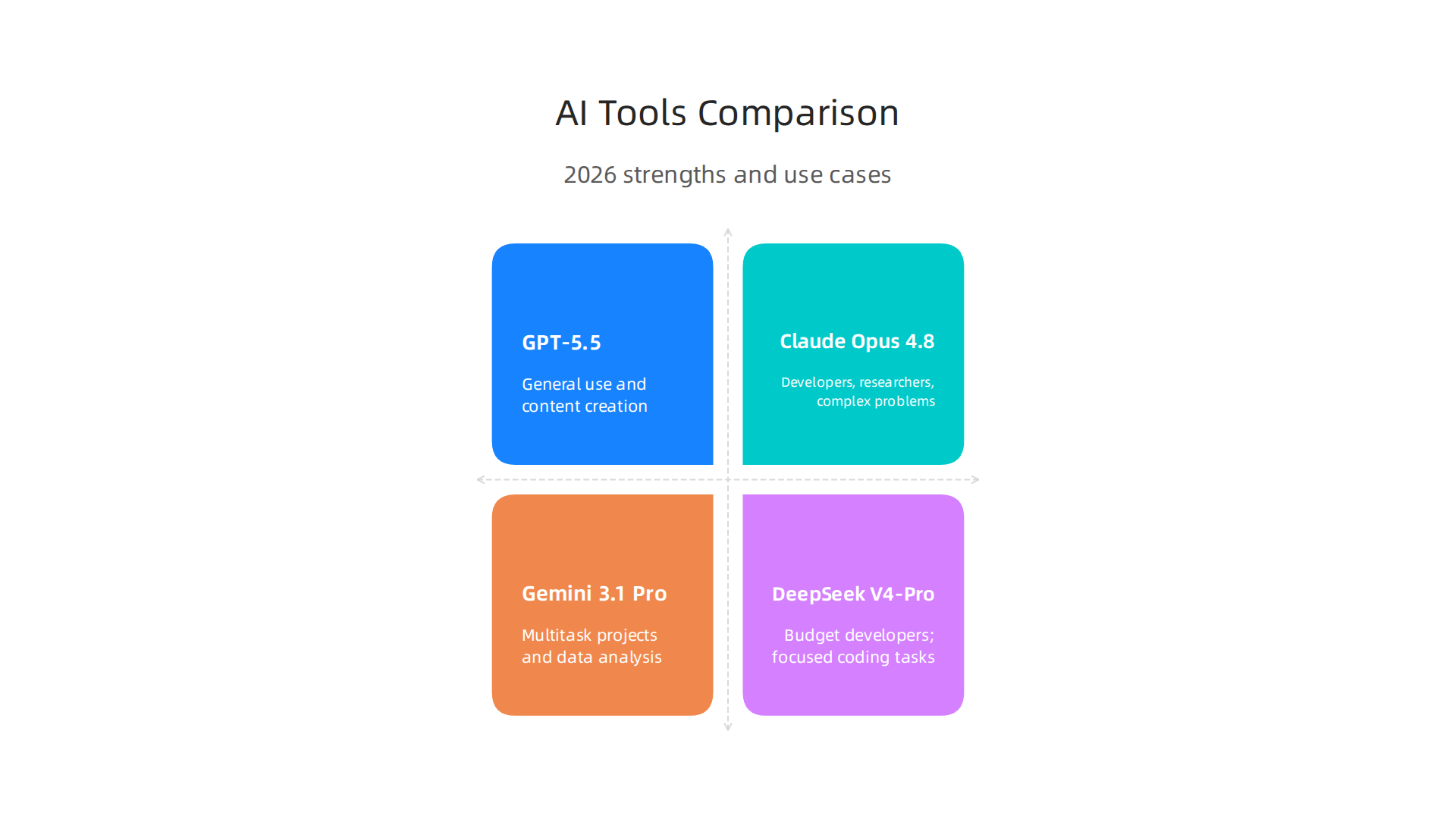
Here’s a simple look at some popular AI tools in 2026, showing their strengths and typical uses.
| AI Tool | Key Features | Pricing Model | Best For |
|---|---|---|---|
| GPT-5.5 | All-around intelligence, creative writing, broad tasks | Flat monthly ($20) or usage-based (API) | General use, content creation, quick answers |
| Claude Opus 4.8 | Complex reasoning, coding, long documents, technical writing | Flat monthly ($20) or usage-based (API) | Developers, researchers, complex problem-solving |
| Gemini 3.1 Pro | Multimodal (text, image, audio), speed, reasoning | Usage-based (API) or enterprise tiers | Multitask projects, fast results, data analysis |
| DeepSeek V4-Pro | High value for performance, developer-focused | Usage-based (API) | Developers on a budget, specific coding tasks |
| Invoke AI | Open-source image and video generation, high customization | Free (open-source core), hosting costs vary | Artists, designers, custom creative projects |
Choosing the best AI really means finding the tool that matches your needs and budget. Whether you’re a student, a creative, or a business owner, there’s an AI out there for you. If you need help picking the right tools for your business, you might want to look into how to choose AI tools for your business needs.
Choosing the best AI tool means picking one that fits your specific job and what you need to get done. What is the best AI for a developer might not be the best for a marketer or an executive.

Each role has different main goals and challenges.
What Developers Need from AI
Developers often look for AI tools that help them build new things or make existing systems better. They care a lot about how easily an AI can connect to their own code. Here’s what’s important for them:
- APIs (Application Programming Interfaces): These are like plugs that let different software talk to each other. Developers need AI with good APIs so they can easily put AI into their apps.
- Latency: This means how fast the AI responds. For things like chatbots or real-time help, a quick response is super important.
- Observability: Developers want to see how the AI is working, if it’s making mistakes, and why. This helps them fix problems and make the AI better. Tools that offer this show how well they work across speed, cost, and how reliable they are Agentic AI Frameworks in 2026: The Production ….
- Customization: They often need to change the AI to fit very specific tasks. Open-source AI projects, like those found in lists of the best open source frameworks for building AI agents, let them dig in and change things as needed.
- Integration: How well does the AI work with their existing tools and systems? If it’s hard to connect, it’s not helpful. Some frameworks are praised for how well they integrate with a team’s tools and databases Best AI Frameworks for Teams in 2026: How to Choose ….

If you’re a developer looking to build AI applications, learning about specific tools like Spring AI guide for Java developers building AI applications can be a great next step.
What Marketers Need from AI
Marketers use AI to create content, understand customers, and make their campaigns more effective. They need AI that is easy to use and gives good results.
- Content Quality: The AI should create text or images that are high-quality, sound natural, and fit the brand’s style.
- Controllability: Marketers need to guide the AI to make sure its output is on message and doesn’t make mistakes. They need to be able to fine-tune it.
- Cost-Effectiveness: Since marketing often works with a budget, the AI tool needs to provide good value for its price.
- Speed and Scale: AI should help them create content faster and handle many tasks at once, like managing social media posts or email campaigns.
To learn more about how AI helps in marketing, check out how AI transforms social media marketing services in 2026.
What Executives Need from AI
Executives think about the big picture: how AI helps the whole company, stays safe, and brings in money.
- Governance: This means making sure the AI follows all the rules, is fair, and is used in a responsible way.
- ROI (Return on Investment): Executives need to know that the money spent on AI will bring more value back to the company. They look for clear proof that the AI is making things better or saving money.
- Vendor Risk: They need to trust the company that makes the AI tool. This includes thinking about how stable the company is and if its AI will be reliable for a long time.
- Strategic Fit: The AI should help the company reach its main business goals, not just solve small problems. They also look at things like how well the AI fits with existing tech and data needs AI Performance Review: How to Evaluate & Choose AI ….
For leaders looking at how AI can help their business grow, exploring augment AI smart strategies for leaders to drive growth in 2026 can be very useful.
Checklist for AI Pilots: Testing Before Buying
Before fully using an AI tool, many businesses do a "pilot" or a small test run. This helps them see if the AI actually works for them. Here’s a simple checklist for a good AI pilot:
- Clear Goal: What specific problem do you want the AI to solve during this test? You need a single, clear purpose for your pilot How to Design an AI Pilot Program Template That Proves ….
- Minimum Viability Test: Does the AI work well enough to do its main job? Don’t worry about perfection, just if it can get the core task done.
- Success Metrics: How will you know if the pilot was a success? Set clear ways to measure if the AI helped. This could be saving time, making fewer mistakes, or making customers happier. It’s smart to track business, technical, and user experience measures Data Quality Kpis (coverage…).
- Stakeholder Alignment: Make sure everyone important in the company agrees on what you’re testing and how you’ll decide if it worked. A successful pilot needs clear objectives that align with the business Any tips for running a successful pilot of a new tool or technology?.
By carefully thinking about your role and what you need from an AI, you can pick the right tool. To stay up-to-date on all the latest AI developments that might impact your role, consider signing up for The AI Newsletter Worth Reading for clear daily updates from The Deep View Newsletter.
Choosing the right AI tool isn’t just about what it can do. It’s also about how it fits into your company’s bigger picture, especially regarding safety, rules, and how it works with other systems. When thinking about "what is the best AI" for your business in 2026, you must also look at things like data residency, security, and how the AI will be managed over time.
Integration, security, and governance considerations
Making sure your AI tools follow all the rules and work well with everything else is super important.

Here’s what you need to think about:
Following the Rules: Key Compliance Topics
Using AI means you have to be careful about your data and how the AI handles it. Here are some critical things to consider:
- Data Residency: This means where your data is actually stored and processed. Many countries have laws, like GDPR in Europe or specific rules in the US, that say data must stay within certain borders. For example, if your customers are in Europe, their data might need to be kept in Europe, even when an AI uses it. This is a big deal for AI deployments in 2026 because all data operations, from input to output, must follow these rules Data Residency Compliance for AI Deployment: 2026 Guide. Ignoring this can lead to big problems. The EU AI Act, which fully starts in August 2026, also has special rules for high-risk AI systems about how their data is handled and stored The Geopolitics of Data Residency: Navigating AI ….
- Access Controls: Who can use the AI system and see the data it works with? You need clear rules to make sure only the right people have access. This helps protect sensitive information.
- Model Provenance: This means knowing where your AI model came from and how it was trained. It’s like having a clear history book for your AI. For example, the IMDA in Singapore expects companies to keep records of how their AI data was gathered and how the model was built APAC Data Residency: A 2026 Playbook for Cross-Border AI. This helps you understand if the AI might have any biases or if there are problems with its data. Regulators are looking closely at the quality and origin of data that feeds AI systems in 2026 Data Governance Frameworks for AI Compliance | 2026.
- Vendor Contractual Protections: When you get an AI tool from another company, you need to make sure your contract protects you. This includes details about data security, who owns the data, and what happens if something goes wrong. It’s important to trust your AI provider.
Many free AI apps might not offer these levels of protection, so always check the terms carefully, even if you’re tempted by "ai apps free" options. Using AI in 2026 means being very mindful of how AI handles sensitive data, as privacy laws demand a legal basis for processing, data minimization, and accountability Data Governance for AI in 2026: Privacy, Residency ….
How AI Fits In: Integration Patterns
Even the most advanced AI needs to work smoothly with your existing tools and processes. Here’s how companies make that happen:
- Orchestration Layers: Think of this as a conductor for an orchestra. It’s a system that makes sure all the different parts of your AI and other software work together in the right order. This helps manage complex tasks where AI might be just one step in a longer process.
- CI/CD for Models: This stands for Continuous Integration and Continuous Delivery. It’s a fancy way of saying that companies have systems to constantly update, test, and deploy their AI models. Just like other software, AI models need regular updates to stay accurate and secure.
- Observability and Monitoring: This means keeping a close eye on your AI tools once they are running. You need to watch how reliable they are and if they are still working as expected. Sometimes AI models can start to "drift" or become less accurate over time because the data they see changes. Monitoring helps catch these issues early.
When thinking about "what is the best AI," remember that how well an AI tool integrates into your existing systems is just as important as its individual features. For more insights on picking the right AI for your organization, check out our guide on how to choose the best enterprise AI platform for your organization.
Staying on top of these complex AI changes and compliance needs can be a lot of work. To help you keep up with all the latest developments in AI that could affect your business, we recommend signing up for:
The AI Newsletter Worth Reading
Implementation tips, common pitfalls, and scaling advice
After you’ve picked the right AI tools and made sure they fit all the rules, the next big step is putting them to work. This means making sure they’re set up correctly, used well, and can grow with your business.
A Practical Checklist for Bringing AI Onboard
Bringing a new AI tool into your company should be done step by step. Here’s what to check:
- Prepare Your Data: AI tools are only as good as the data they use. Make sure your data is clean, well-organized, and ready for the AI. If your data is scattered or old, your AI project might not work out. In fact, many AI projects fail because the company’s data isn’t ready for AI AI bubble 2026: why so many AI projects fail.
- Test API Limits: If your AI uses APIs (which let different software talk to each other), test how much work it can handle. You don’t want your AI system to crash when things get busy.
- Train Your Team: Your employees need to know how to use the new AI tools. Provide good training so everyone feels comfortable and can get the most out of the AI. This helps ensure people understand what the AI can do and how to work with it safely. For more on preparing your team, explore our guide on mastering AI in 2026.
- Plan for Rollbacks: Always have a backup plan. What if the AI doesn’t work as expected? You need a way to go back to how things were before you started using the AI. This limits risks.
- Start with a Pilot Program: Don’t roll out AI everywhere at once. Start small with a pilot program. This is like a trial run. Define exactly what "success" looks like for this trial before you even begin How to Design an AI Pilot Program Template That Proves …. Without clear goals, it’s hard to tell if the pilot truly worked Any tips for running a successful pilot of a new tool or technology? What’s your method for tracking the results of the pilot? | Gartner Peer Community.
Common Mistakes to Avoid
Even when you know "what is the best AI" for your business, there are still traps to watch out for:
- Following the Hype: Don’t pick an AI tool just because everyone is talking about it. Make sure it truly solves a problem for your business, not just because it’s popular like some "free ai apps" that might not be suited for serious business use.
- Underestimating Ongoing Costs: AI tools aren’t a one-time purchase. They have ongoing costs for data storage, processing power, maintenance, and updates. Factor these into your budget from the start.
- Ignoring Monitoring and Feedback: Once an AI is running, you need to keep an eye on it. AI models can change how they work over time, a problem called "drift." Without good monitoring, you won’t know if your AI is still doing its job correctly. Many AI projects fail to grow past the testing stage because there isn’t enough monitoring in place The 86% Problem: Why Enterprise AI Agents Stall Between Pilot and ….
- Poor Integration: A big reason AI projects don’t make it from a small test to full use is trouble connecting them with other existing systems AI Agent Scaling Gap March 2026: Pilot to Production. Your AI needs to play nice with all your other software.
Advice for Growing with AI
Scaling up your AI means making it work for more people and bigger tasks. This is where many companies struggle. To go from a small test to a full-blown solution, you need a clear plan. Focus on building systems around the AI model itself so you can easily swap out different models if needed. Also, make sure you can constantly evaluate how well your AI is performing 5 AI Delivery Lessons From 2026 Production Builds.
Keeping an eye on these things will help your AI tools work well for your business, not just today, but also as your company grows in 2026 and beyond.
Summary
This guide explains how to choose the right general-purpose AI in 2026 by focusing on real-world fit rather than hype. It walks through the key evaluation criteria—capability fit, latency, integration surface, data privacy, predictable pricing, and support—and shows how those priorities shift for developers, marketers, and executives. The article categorizes the major AI tool types (LLMs, multimodal platforms, code assistants, image/video generators, and analytics accelerators) and explains different delivery models like API-first, integrated apps, and open-source stacks. It also covers pricing mechanics, a practical pilot checklist, compliance and integration patterns, and common pitfalls that block pilots from scaling. Readers will finish able to compare tools against their role-based needs, run a low-risk pilot, and plan for secure, scalable AI adoption that fits budget and governance requirements.